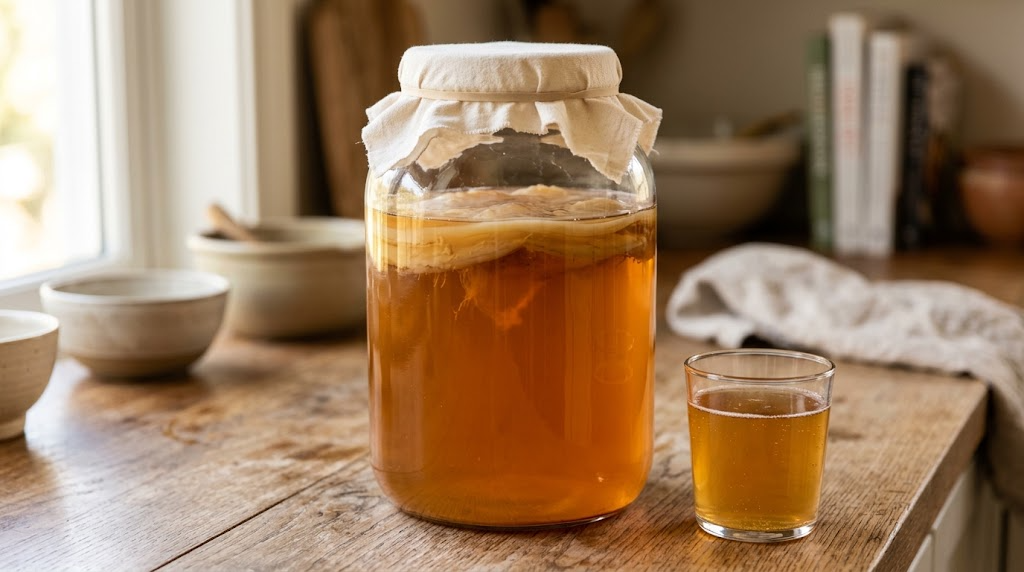
Store kombucha costs three to four dollars a bottle. Homemade costs pennies — sweet tea plus a SCOBY, sitting on a counter for a week or two. If you drink the stuff regularly, a brewing kit pays for itself inside the first month, and the brew you make yourself is fresher, fizzier and exactly as sweet or sour as you like it.
Some links in this post are affiliate links. If you buy through them we may earn a small commission at no extra cost to you — it never changes which products we recommend.
What actually decides whether your first brew succeeds is not the jar — it is the culture. The SCOBY (a living mat of bacteria and yeast) and, just as importantly, the strong starter tea that comes with it are what acidify the sweet tea fast enough to protect it while it ferments. A vigorous culture from a reputable source succeeds almost automatically; a tired one invites mould. So the kits below are judged first on the culture they ship, then on the hardware.
If you already ferment vegetables, kombucha will feel familiar — same logic, different microbes. Our mason jar fermentation guide and crock guide cover that side of the counter.
Our Top 7 Picks for the Best Kombucha Brewing Kit
Best Overall: Craft A Brew Kombucha Basic Starter Kit

Craft A Brew is a proper home-fermentation company rather than a marketplace brand, and their basic kit is the cleanest possible start: a gallon glass jar, a fresh live SCOBY with real starter tea, tea and sugar for the first batch, a cloth cover, and instructions that are actually written for a nervous beginner.
The reason it is the top pick is the culture. Their SCOBYs ship fresh and active, which means your first batch acidifies quickly — and fast acidification is the entire protection mechanism in kombucha. A kit with a strong culture and a plain jar beats a kit with fancy hardware and a tired culture, every time.
Key Specifications
- 1-gallon glass brew jar
- Fresh live SCOBY with starter tea
- Tea, sugar and cloth cover for batch one
- Beginner-focused instructions
Pros
- Vigorous culture from an established company
- Genuinely everything needed for a first gallon
- Clear, calm instructions
- Sensible price for a complete start
Cons
- One gallon only — heavy drinkers will outgrow it
- No bottles included for second ferment
- Basic jar with no spigot
Best Culture Only: Fermentaholics Organic SCOBY with 12 oz Starter Tea

If you already own a gallon jar — and most kitchens do — the only thing you actually need to buy is this. Fermentaholics ships a USDA-certified organic SCOBY with a full twelve ounces of strong starter tea, and that generous starter volume is the spec that matters: more starter means faster acidification and a safer, more reliable first brew.
This is also the answer when a brew goes wrong or a SCOBY gets tired: you do not need a new kit, you need a new culture. Cheapest honest route into kombucha, full stop.
Key Specifications
- USDA-certified organic live SCOBY
- 12 oz of mature starter tea included
- Brews one gallon immediately
- Works with any wide jar you own
Pros
- Generous starter tea — the real success factor
- Certified organic culture
- Cheapest way to start with a jar you own
- The standard replacement when cultures die
Cons
- No equipment at all — culture only
- You supply tea, sugar, jar and cover
- One culture, so no backup if mishandled
Best Continuous Brew: Cultures for Health 5-Litre Jar with Spigot

Continuous brewing is the low-effort endgame: a big spigoted vessel where you draw off a few glasses whenever you like and top back up with sweet tea, instead of harvesting whole batches. The culture stays put, the brew is always partly mature so it acidifies new tea fast, and the daily labour rounds to zero.
Cultures for Health is one of the oldest names in home culturing, and this 5-litre spigot jar is the right vessel for the method. One thing to know: spigots are the weak point of any continuous system — flush it regularly so yeast does not settle and clog it.
Key Specifications
- 5-litre glass vessel with spigot
- Designed for continuous brewing
- From a long-established culture company
- Draw-and-refill workflow
Pros
- Lowest ongoing effort of any method
- Always-mature brew acidifies refills quickly
- Serve straight from the spigot
- Bigger capacity than standard kits
Cons
- Spigots clog with yeast if not flushed
- Harder to clean fully than an open jar
- SCOBY usually sold separately
Best Complete Deluxe: Deluxe Kombucha Starter Kit with SCOBY and Bottles
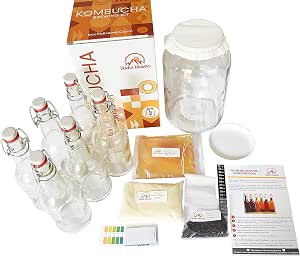
The deluxe format exists because of the second ferment — the step where you bottle the finished kombucha with a little fruit or juice and let it carbonate. That is where the fizz comes from, and it needs proper pressure-rated bottles. This kit includes them alongside the SCOBY, jar, and the usual first-batch supplies.
If what you are chasing is shop-quality fizzy flavoured kombucha rather than flat tea vinegar, buying a kit that takes you through bottling on day one is the honest shortcut.
Key Specifications
- Full kit: jar, SCOBY, starter tea, supplies
- Includes bottles for second fermentation
- Covers first ferment through carbonation
- Gift-friendly presentation
Pros
- Second-ferment bottles included from the start
- One purchase covers the whole process
- Good gift format
- No second shopping trip before the fizzy part
Cons
- Costs more than basic kits
- More components to store
- Bottle count still limits batch size
Best Jar Upgrade: Craft A Brew Kombucha Jar with Dispensing Valve

Craft A Brew’s spigoted jar is the halfway house between batch and continuous brewing: brew normally, then serve straight from the valve instead of decanting a heavy gallon jar over the sink. It also converts naturally into a continuous-brew vessel once you are comfortable.
The valve is a proper dispensing tap rather than the flimsy water-dispenser spigots on generic jars, which is exactly the part worth paying for on a vessel that holds a live acidic brew for weeks at a time.
Key Specifications
- Glass fermentation jar with dispensing valve
- Works for batch or continuous brewing
- Pairs with any healthy SCOBY
- From an established fermentation brand
Pros
- Serve without lifting or decanting
- Converts to continuous brew later
- Better valve than generic spigot jars
- Solid glass vessel
Cons
- SCOBY not included
- Valve needs regular flushing
- Bulkier than a plain jar
Best With Bottling: Deluxe Organic Kit with Six Swing-Top Bottles

Swing-top bottles are the classic kombucha bottling solution — thick glass, a gasketed cap that holds real pressure, reusable forever. Six of them plus a stainless funnel alongside the organic culture makes this the kit for someone who already knows they want the full fizzy, flavoured, fridge-stocked routine.
A pressure warning that belongs in every kombucha article and rarely appears: second-ferment bottles genuinely carbonate, and over-fermented bottles can burst. Use proper pressure-rated bottles like these, refrigerate once carbonated, and open your first few over a sink.
Key Specifications
- Organic SCOBY and starter tea
- Six swing-top pressure bottles
- Stainless steel funnel included
- Full first-and-second-ferment kit
Pros
- Proper pressure-rated bottles from day one
- Reusable swing-tops last for years
- Funnel makes bottling far less messy
- Organic culture
Cons
- Most expensive format here
- Lots of glass to store
- Swing-top gaskets eventually need replacing
Best Cold-Weather Companion: Hemlock Kombucha Heating Wrap with Thermostat

Kombucha wants to live around 75°F. In a winter kitchen at 65°F, fermentation crawls — batches take three weeks instead of one, taste flat, and give competing microbes more time to move in. A thermostat-controlled heat wrap around the jar fixes the single most common reason home kombucha disappoints from October to April.
This is not the first thing to buy; it is the second, once you notice your winter brews limping.
My kitchen sits around 28–30°C for most of the year, and at that temperature a batch is done in seven to eight days — not the fourteen the instructions promise. Almost every kombucha guide online is written for a 20°C kitchen, and if you follow those timings in a warm climate you will open the jar and find vinegar.
The rule I settled on is to start tasting at day five with a clean straw and stop while it is tart but still has a little sweetness behind it, because it keeps fermenting once it is bottled. In the cooler months here it stretches out to about ten days. Time is not the instruction. Taste is.
Key Specifications
- Wrap-around fermentation heater
- Adjustable thermostat control
- Fits gallon jars and larger vessels
- Low constant wattage
Pros
- Fixes slow winter fermentation outright
- Thermostat prevents overheating the culture
- Works for other ferments and proofing too
- Cheap to run
Cons
- Unnecessary in warm kitchens
- One more cable on the counter
- Wrap sizing varies with vessel shape
The Ultimate Buying Guide for Kombucha Kits
The Culture Is the Kit
Every part of a kombucha kit is replaceable at a hardware store except one: the SCOBY and its starter tea. A healthy culture with a generous volume of strong, mature starter tea acidifies your sweet tea within the first day or two — and that acidity is what keeps everything unwanted out while the brew develops. When comparing kits, compare cultures: how fresh, how shipped, how much starter tea. Twelve ounces of starter beats four. Everything else is jars.
Batch vs Continuous Brewing
- Batch brewing: brew a gallon, harvest it all, bottle, restart. More control per batch, easier to clean, the right way to learn.
- Continuous brewing: a big spigoted vessel you draw from and top up. Near-zero effort and a permanently happy culture, but the vessel is harder to clean and the spigot needs flushing. The upgrade once the habit is real.
The Second Ferment Is Where the Fizz Lives
First fermentation, in the open-mouthed jar under a cloth, makes flavour and acidity but almost no carbonation — the gas escapes. The fizz comes from bottling: finished kombucha plus a little fruit, juice or sugar in a sealed pressure-rated bottle for two to four days at room temperature, then into the fridge. This is also the fun part — ginger, mango, berries — and it is why kits with proper swing-top bottles are worth considering from the start.
Respect the pressure. Use real pressure-rated bottles, not repurposed jam jars; burp or refrigerate on schedule; open the first bottle of any new recipe over the sink. Over-carbonated bottles genuinely burst.
Housekeeping Rules
- Cloth cover, never sealed, on the first ferment — the culture needs air, and the cloth (tightly woven, not cheesecloth) keeps fruit flies out.
- Real sugar and real tea. The culture eats sugar — it is not optional — and camellia sinensis tea (black or green) feeds it; herbal teas alone starve it.
- No metal contact for long periods; glass vessel, and a brief pass through a stainless funnel is fine.
- Keep it at roughly 70 to 80°F, out of direct sun.
- Always reserve two cups of finished brew as starter for the next batch.
Mould, Honestly
Real kombucha mould is rare when you use enough strong starter, and unmistakable: dry, fuzzy, circular spots in blue, green or black sitting on top of the culture. If you see that, discard everything including the SCOBY and start with a fresh culture — no rescuing. What beginners usually panic about instead is harmless: brown stringy yeast strands, bubbles, a new SCOBY layer forming as a film. When in doubt, smell it — kombucha should smell sharp and vinegary, never rotten.
Frequently Asked Questions About Kombucha Brewing
How long does a batch of kombucha take?
Seven to fourteen days for the first ferment in a warm kitchen — taste from day seven and stop when the sweet-sour balance suits you — then two to four days in sealed bottles for carbonation. Cold kitchens can stretch the first ferment to three weeks, which is what heat wraps are for.
Is homemade kombucha safe?
With basic hygiene and enough starter tea, yes — the brew rapidly becomes too acidic for pathogens, the same mechanism that protects sauerkraut. The genuine risks are mould from under-acidified starts (use plenty of strong starter), and bursting bottles from over-carbonation (use pressure-rated bottles and refrigerate on time). People who are pregnant or immunocompromised should note it is a raw, live, mildly alcoholic ferment and ask their doctor.
Does kombucha contain alcohol?
A little, always — typically in the range of roughly half a percent, similar to some non-alcoholic beers, and second fermentation can push it slightly higher. It is not meaningfully intoxicating, but it is not zero, which matters to some people for religious, medical or personal reasons.
My SCOBY sank / looks weird. Is it dead?
Almost certainly fine. SCOBYs sink, float, tilt and grow strange lobes and brown yeast beards — none of that is illness. A new baby SCOBY also forms across the surface each batch, which alarms everyone the first time. The only genuine emergency is dry fuzzy mould on top. Judge the brew by taste and smell, not the culture’s looks.
What do I do with extra SCOBYs?
Every batch grows a new layer, so brewers accumulate them. Keep spares in a “SCOBY hotel” — a jar of mature kombucha in the fridge or on the counter — as insurance and gifts. A spare culture is what turns a mouldy-batch disaster into a one-week setback.
Can I take a break from brewing?
Yes. Park the SCOBY in a generous amount of mature kombucha, cover, and leave it at cool room temperature — it holds happily for weeks, even a few months, going dormant and very sour. Feed it fresh sweet tea a few days before you want to brew again.
Final Thoughts
If you own a gallon jar, buy the Fermentaholics culture and start tonight. If you want the whole path laid out, the Craft A Brew kit is the cleanest guided start, and the deluxe kits with swing-top bottles get you to fizzy flavoured bottles fastest. Continuous vessels are the lazy endgame once the habit sticks.
Strong starter, real sugar, cloth cover, patience — and always keep two cups back for the next batch. If your counter is turning into a fermentation station, our jar fermentation and crock guides cover the vegetable side.
This article is general information, not medical advice. Kombucha is a raw fermented product containing trace alcohol; if you are pregnant, immunocompromised, or avoiding alcohol, speak with a healthcare provider first.
As an Amazon Associate we earn from qualifying purchases. Availability is accurate as of the date of publishing. We do not list prices because they change too often to quote honestly.

Rimi Sultana is a home cook from Bangladesh who has cooked for her family every day for the past five years and writes about it at Smart Cooks. Perpetually testing whether internet-famous recipes actually work in a regular home kitchen. Say hello on Facebook or through the contact page.