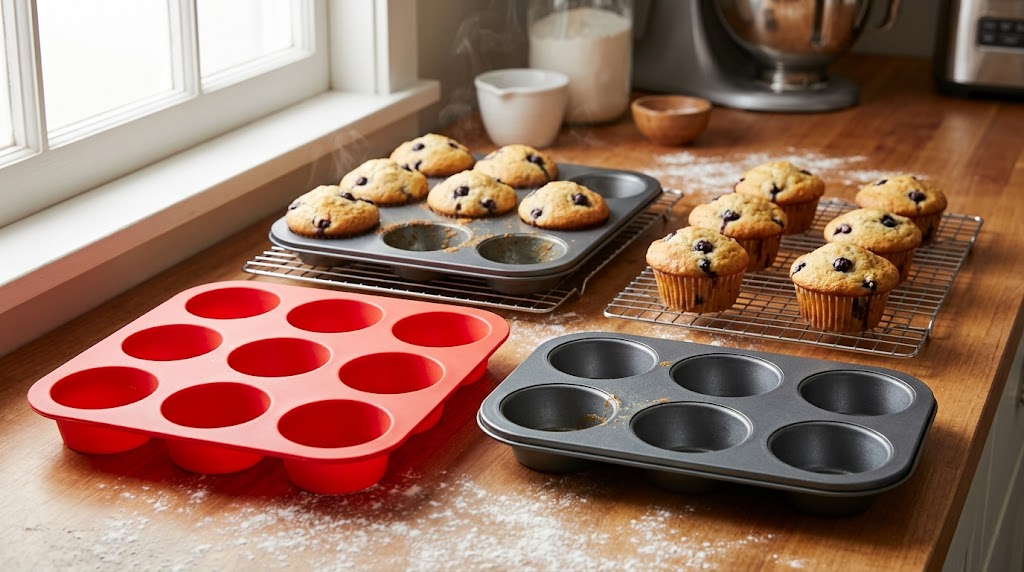
Both materials bake a proper muffin or cupcake, but they behave differently enough in the oven and afterward that the choice is worth making deliberately rather than just grabbing whatever’s cheapest.
Some links in this post are affiliate links. If you buy through them we may earn a small commission at no extra cost to you — it never changes which products we recommend.
How They Actually Differ
Heat Conduction and Browning
Metal conducts heat faster and more evenly than silicone, which means baked goods in metal pans tend to develop better browning on the sides and bottom. Silicone insulates more, giving a softer, paler crust — fine for some bakes, less ideal if you want a properly browned muffin top and sides.
Release
Silicone’s flexibility makes releasing baked goods genuinely easier — you can gently push from underneath rather than relying entirely on a nonstick coating. Metal pans depend more on their coating quality and how well they were greased.
Handling and Stability
A filled silicone mold is floppy and awkward to move into and out of the oven safely, especially a large one — you often need a rigid baking sheet underneath for support. Metal pans are rigid and easy to handle on their own.
From My Kitchen: The Silicone Mistake I Made With a Bundt-Style Mold
The first time I used a large silicone mold, I filled it with batter and tried to carry it to the oven the same way I would a metal pan — by the edges. It flexed alarmingly in the middle and I nearly spilled batter across the kitchen floor. I’ve since learned to always set a silicone mold on a rigid baking sheet before filling it, so the sheet does the structural support work and I can move the whole thing safely as one rigid unit. It’s an easy step to forget the first few times, but essential with anything beyond a small muffin-tray-sized mold.
Worth Considering
This 12-cup silicone muffin pan is a solid pick if easy release matters more to you than deep browning.
This stainless steel muffin pan is the better choice if you specifically want good browning and don’t mind a bit more effort on the release side.
Heat Conduction Is the Difference You Taste
Metal conducts heat quickly and silicone does not — silicone is effectively an insulator. That single property explains almost every difference between the two. A metal tin transfers oven heat directly into the batter at the edges, which is what produces browning, a crisp edge and the structural set that lets a muffin climb. Silicone warms slowly, so the batter sets later and browns much less, which is why silicone-baked cakes often come out pale with soft, slightly damp sides.
For some things that is exactly what you want. Delicate items that should not brown, anything you need to release without damage, and freezer work all suit silicone. For anything where a golden crust is part of the result — muffins, brownies with chewy edges, anything with a crisp base — metal is not a preference, it is the reason the recipe works.
Quick Comparison
| Silicone moulds | Metal tins | |
|---|---|---|
| Browning and crisp edges | Minimal | Good |
| Release | Excellent, flexes away | Needs greasing or lining |
| Structure while filling | Floppy, needs a tray underneath | Rigid |
| Freezer use | Excellent | Fine but harder to release |
| Longevity | Degrades and can stain | Decades if kept dry |
| Even heating | Slower, more even | Faster, edges set first |
The Practical Problems With Each
Silicone’s real weakness beyond browning is rigidity. A filled silicone tray is floppy and will spill if you lift it without a baking sheet underneath, and the thin-walled cheap ones can distort in the oven, giving lopsided muffins. Buy silicone thick enough to hold its shape, and always put it on a metal sheet — which, incidentally, also gives you back some of the bottom browning you lost.
Metal’s weakness is sticking, and it is entirely manageable. Grease and flour, or line with paper cases or parchment, and a metal tin releases as cleanly as silicone. What ruins metal tins is moisture: put them away damp and thin-gauge tins will rust at the seams within a year. Dry them properly, in a warm oven if necessary, and a good tin genuinely lasts decades.
Two Options Worth Considering
Best silicone option: 12-Cup Silicone Muffin Pan
Worth owning for the things silicone genuinely does better — egg bites, frozen portions, anything you need out intact without lining. Use it on a baking sheet, both for stability and for the bit of extra base heat.
Pros
- Nothing sticks, releases without lining
- Excellent for freezing portions
- Folds away into a small space
Cons
- Very little browning on sides and base
- Needs a sheet underneath for stability
Best for baking results: Stainless Steel Muffin Pan
Stainless avoids the rust problem of cheaper tinned steel while giving the heat conduction that produces a proper domed, golden muffin. This is the one to reach for when the recipe’s texture depends on the edges setting early.
Pros
- Real browning and a proper rise
- Stainless, so no rusting at the seams
- Rigid and easy to handle when full
Cons
- Needs greasing or paper cases
- Heavier and takes more storage space
Frequently Asked Questions
Do I need to grease silicone molds?
A light grease or spray still helps, even though silicone is naturally more nonstick than bare metal — it makes release even cleaner, especially for anything with sugar content that can caramelize and stick.
Can silicone molds go directly on the oven rack?
For small items like a standard muffin tray, usually yes, but for larger or more heavily filled molds, placing them on a rigid baking sheet first makes them much easier and safer to handle.
Which lasts longer, silicone or metal?
Both can last for years with reasonable care, but metal pans are more vulnerable to coating wear and rust if scratched, while silicone can degrade or discolor with very high heat over many uses. Neither has a dramatically shorter lifespan than the other under normal use.
Why do my silicone-baked muffins come out pale and soft?
Because silicone is not transferring enough heat to the sides and base for them to set and brown. Two things help: always bake on a preheated metal baking sheet, which gives the base real heat, and consider raising the oven temperature by around 10°C to compensate for the slower conduction. Even then, silicone will never produce the crisp edge a metal tin does — that is a limit of the material, not a technique problem.
Is silicone bakeware safe at oven temperatures?
Food-grade silicone is stable well above normal baking temperatures, typically rated to around 220°C or higher. What is worth checking is whether a mould is genuinely food-grade silicone rather than a filled blend — a quick test is to twist a corner sharply, since cheap filled silicone turns white at the stress point while pure silicone does not. Also avoid using silicone under a grill or against a direct heating element, where local temperatures exceed the oven setting.

Rimi Sultana is a home cook from Bangladesh who has cooked for her family every day for the past five years and writes about it at Smart Cooks. Perpetually testing whether internet-famous recipes actually work in a regular home kitchen. Say hello on Facebook or through the contact page.