Sprouting is the closest thing to growing food with no garden, no soil, no lights and no skill: seeds in a jar, a rinse twice a day, and in four to six days you have a jarful of crisp sprouts for a fraction of the price of the sad plastic clamshells at the supermarket. Broccoli sprouts — the ones people specifically seek out for their sulforaphane content — cost a small fortune retail and pennies to grow.
Some links in this post are affiliate links. If you buy through them we may earn a small commission at no extra cost to you — it never changes which products we recommend.
The equipment is honestly minimal: a wide-mouth jar, a mesh lid that lets you rinse and drain without losing seeds, and a stand that holds the jar tilted upside-down so it drains completely. That last part is the whole game. Almost every sprouting failure — sour smells, slime, mould — is a draining failure. Water pooling in the bottom of a flat-standing jar is how good seeds go bad.
So the kits below are judged on the boring things that decide success: mesh that is fine enough for small seeds and does not rust, and stands that hold a genuinely steep angle. It is a short list of requirements, and a surprising number of kits fail one of them.
Our Top 7 Picks for the Best Sprouting Jar Kit
Best Overall: Seed Sprouting Jar Kit with 316 Stainless Lids and Stands

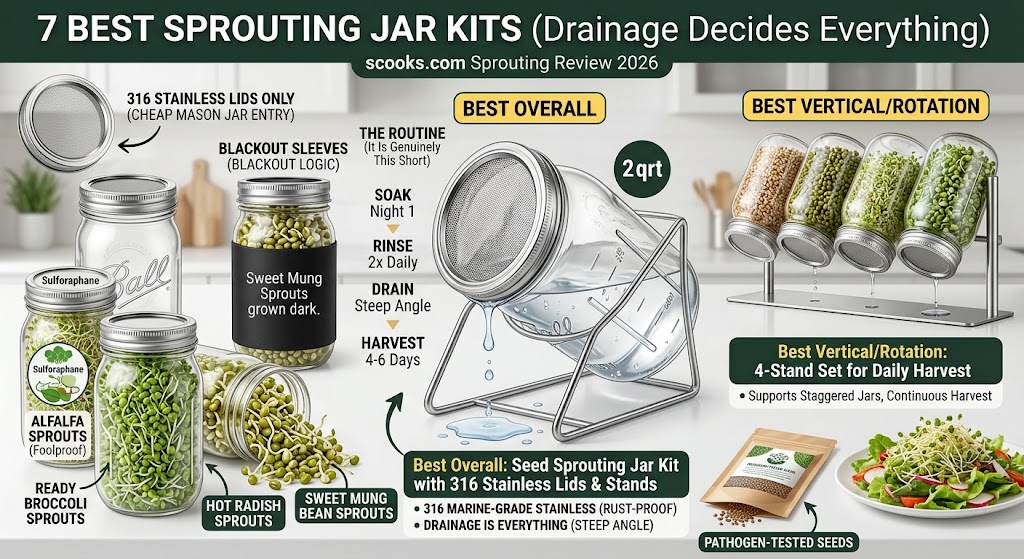
Two wide-mouth quart jars, two mesh lids, and stands that hold each jar at a proper drain angle — the complete setup, with the one spec upgrade that matters most: 316 stainless mesh rather than the usual 304. The difference sounds like trivia until you remember these lids live wet twelve hours a day for years; 316 is the marine-grade alloy, and it is the one that reliably never rusts.
Two jars is also the correct number, not a bonus. Stagger your starts by two or three days and you harvest continuously instead of getting a glut of sprouts followed by a week of none.
Key Specifications
- Two wide-mouth quart jars with 316 stainless mesh lids
- Tilted draining stands included
- Staggered two-jar workflow
- Suitable for broccoli, alfalfa, mung and radish
Pros
- 316 mesh survives permanent wetness without rust
- Stands hold a real drain angle
- Two jars enable continuous harvests
- Complete kit — nothing else to buy
Cons
- Quart jars limit single-batch volume
- Glass jars are glass jars — droppable
- Stand footprint takes counter space
Best Lids Only: 316 Stainless Sprouting Lids for Wide-Mouth Mason Jars

If your cupboard already holds wide-mouth mason jars — and after our canning and fermenting guides, it might — then the only thing you need to buy is lids. These are the same marine-grade 316 mesh in a screw-band format that fits standard 86mm wide-mouth jars.
Cheapest sensible entry into sprouting; prop the jars at an angle in a dish rack or a bowl and you have a working sprouter tonight.
Key Specifications
- 316 stainless steel mesh screw lids
- Fits 86mm wide-mouth mason jars
- Lids only — use your own jars
- Multiple lids per pack
Pros
- Cheapest route if you own jars
- Marine-grade mesh, no rust
- Fine enough mesh for small seeds
- Trivial to clean
Cons
- No stands — improvise the drain angle
- No jars included
- Flat lid rim can hold a film of water — shake well
Best With Blackout Sleeves: 6-Pack Lids with Stands and Blackout Sleeves

The blackout sleeve is the one accessory in this category with real horticultural logic. Seeds sprout best in darkness for the first days — mimicking soil — and several popular sprouts (mung beans especially) stay sweeter and less bitter if grown dark and only greened up in daylight at the end. A fabric sleeve over the jar does what stuffing it in a cupboard does, without you forgetting it exists.
Six lids plus stands makes this the scale-up kit for a household that gets serious — three staggered jars running is a permanent salad supply.
Key Specifications
- Six mesh lids with jar stands
- Blackout sleeves included
- Fits wide-mouth mason jars
- Supports multi-jar staggered growing
Pros
- Dark-then-light growing genuinely improves mung sprouts
- Enough lids to run several jars at once
- Sleeves beat remembering a dark cupboard
- Good per-lid value
Cons
- Jars not included
- Sleeves need occasional washing
- More kit than a beginner strictly needs
Best Complete Starter: Kitmiido Organic Sprouting Kit, 2 x 32 oz Jars

A tidy two-jar kit pitched at the person starting from zero: jars, stainless mesh lids, stands, and the guidance to get a first batch right. The 32-ounce wide-mouth format is the standard for a reason — big enough for a family salad’s worth per jar, small enough to rinse one-handed.
If you are choosing between near-identical two-jar kits, tiebreakers in order: mesh grade (316 beats 304), stand angle (steeper drains better), and whether the mesh is fine enough that broccoli seeds do not wash through.
Key Specifications
- Two 32 oz wide-mouth jars
- Stainless steel mesh lids
- Draining stands included
- Beginner-oriented instructions
Pros
- Complete and correctly sized for a first setup
- Standard jars accept other sprouting lids later
- Easy one-handed rinse-and-drain routine
- Reasonable price
Cons
- Check mesh fineness for tiny seeds
- Stand stability varies on narrow ledges
- Brand has a shorter track record
Best Stand Design: Sprouting Jar Kit with Stainless Stands, 2 Pieces

The stand is the undervalued half of a sprouting kit, and this one’s wire stands hold the jar at a steep, stable angle with airflow all around the mesh — which is exactly the recipe for jars that dry properly between rinses instead of sitting in their own humidity.
Worth choosing if your counter has defeated flimsier stands before; a tipped-over sprouting jar at 6 a.m. converts enthusiasm into a cancelled hobby remarkably fast.
Key Specifications
- Stainless mesh lids with wire stands
- Steep, stable drain angle
- Open airflow around the lid
- Fits wide-mouth mason jars
Pros
- Excellent drainage and airflow geometry
- Stable on a real, cluttered counter
- Simple to rinse, drain, repeat
- Durable materials throughout
Cons
- Jars not included
- Wire stands need occasional descaling in hard water
- Only two lids per set
Best Budget Multi-Jar: 12-Piece Sprouting Lids Kit with Stands

The bulk option: a mix of stainless and plastic mesh lids plus stands, enough to outfit every spare wide-mouth jar in the house at the lowest cost per jar. The honest trade is that plastic mesh is a step down — it is fine for larger seeds like mung and lentils, but it scratches, stains, and coarser weaves can lose small broccoli seeds.
Sensible for classrooms, big families, or anyone who wants to run many jars cheaply and reserve the stainless lids for the fine seeds.
Key Specifications
- Twelve pieces: stainless lids, plastic lids, stands
- Fits wide-mouth mason jars
- Outfits multiple jars at once
- Lowest cost per jar
Pros
- Cheapest way to run a whole fleet of jars
- Stainless lids included for fine seeds
- Spares on hand when one is in the wash
- Fine for classrooms and big households
Cons
- Plastic lids are the weak link
- Coarse mesh can lose broccoli seeds
- Mixed quality across the pack
Best Vertical: Sprouting Jar with Screw Lid and 4-Stand Set

A four-stand set solves the scaling problem for people whose sprouting habit has outgrown their windowsill: four jars, staggered starts, permanent rotation. The stands are the star — simple stainless frames that hold jars mouth-down at the correct angle in a neat row instead of a leaning heap in the dish rack.
Twice a day, morning and night. In a warm kitchen mung gives me a full jar in about three days; alfalfa takes closer to five, so the seed matters as much as the routine.
The thing nobody says clearly is that the rinse is not the important half — the drain is. For my first few batches I rinsed properly and then stood the jar upright, and they smelled off by day two. Propped at roughly forty-five degrees in a bowl, so water keeps running out instead of pooling, the same seeds were fine. If you are getting a sour smell, it is almost always standing water at the bottom rather than anything wrong with the seed.
Key Specifications
- Sprouting lid kit for 32 oz jars
- Four stainless draining stands
- Supports a four-jar rotation
- Compact row footprint
Pros
- Four-jar rotation means daily harvests
- Tidy, stable, counter-friendly layout
- Stainless stands last indefinitely
- Good value at scale
Cons
- More jars to rinse twice daily
- Check jar compatibility before buying
- Overkill for a first experiment
The Ultimate Buying Guide for Sprouting Kits
Drainage Is Everything
Sprouts fail one way: standing water. Seeds need moisture and air in alternation — a rinse, then hours of draining damp-but-not-wet. A jar standing flat keeps a puddle at the bottom, and that puddle is where sour smells, slime and mould begin. Whatever kit you choose, the jar must rest tilted mouth-down at a steep angle with air reaching the mesh. If a kit’s stand holds the jar nearly level, it is decoration, not equipment.
Mesh: Grade and Gauge
- 316 stainless is marine-grade and effectively rust-proof; the standard 304 is usually fine but can pit over years of permanent wetness. Lids live wet — buy accordingly.
- Fineness matters for broccoli and alfalfa, whose seeds are tiny. Coarse mesh loses seeds down the drain at every rinse.
- Plastic mesh works for big seeds (mung, lentil, pea) but scratches and stains; treat it as the budget tier it is.
What to Sprout First
- Broccoli — the famous one, 4 to 6 days, peppery; the reason half of these kits get bought
- Alfalfa — mild, foolproof, the classic sandwich sprout, 5 to 6 days
- Mung beans — fat, crunchy stir-fry sprouts in 3 to 5 days; grow them dark for sweetness
- Radish — hot and fast, great mixed into milder batches
- Lentils and green peas — hearty, nutty, nearly impossible to fail
Buy seeds sold specifically for sprouting. Garden seed packets can be treated with fungicides, and grocery-store beans are of unknown viability. Sprouting-grade seed is cheap and tested for germination and pathogens.
The Routine (It Is Genuinely This Short)
- Night one: two tablespoons of seed, cover with water, soak 8 to 12 hours.
- Every morning and evening: fill with cool water through the mesh, swirl, pour off completely, park mouth-down on the stand.
- Days 1 to 3: keep out of direct sun; dark is fine and better for some.
- Final day: indirect light greens the leaves on broccoli and alfalfa.
- Harvest: a final rinse, dry thoroughly on a towel — dryness is what makes them keep — and refrigerate up to about a week.
Food Safety, Without Panic
Raw sprouts appear on food-safety watchlists because commercial growing conditions — warm, wet, big batches — are also good bacterial conditions, and outbreaks have happened. At home you control the variables: buy pathogen-tested sprouting seed, rinse religiously with clean cold water, drain hard, and refuse the benefit of the doubt to anything slimy or sour-smelling. Health agencies advise that young children, the elderly, pregnant women and the immunocompromised avoid raw sprouts; cooking them (mung sprouts stir-fry brilliantly) removes the concern.
Smell Is Your Quality Control
Healthy sprouts smell green and fresh, like cut grass or raw peas. The fluffy white fuzz on broccoli-family sprout roots is usually root hairs, not mould — it vanishes when rinsed. Actual trouble announces itself as sourness, sliminess or a swampy smell, and the response is always the same: discard, wash everything, start over with more rinsing and a steeper drain.
Frequently Asked Questions About Sprouting
How long do sprouts take to grow?
Most kitchen sprouts run three to six days from soak to harvest: mung and lentils at the fast end, broccoli and alfalfa around four to six. Warm rooms run faster. There is no precise finish line — taste a few each day and harvest when you like them.
Why do my sprouts smell bad?
Poor draining, almost every time. Water pooled in the jar between rinses turns the batch sour and slimy. Steepen the drain angle, make sure the mesh is not clogged with seed hulls, rinse twice daily without fail, and keep the jar out of hot sun. If the smell is already swampy, discard and restart — it does not recover.
Do sprouts need sunlight?
Mostly no. Sprouts run on the seed’s stored energy, not photosynthesis, and prefer darkness for the first days. Only at the end, for leafy sprouts like broccoli and alfalfa, does an hour or a day of indirect light matter — it greens the little leaves. Never grow them in direct sun; it cooks the jar.
What is the white fuzz on my broccoli sprouts?
Almost always root hairs — fine, uniform fuzz along the root, appearing around days three to five, which slicks down and disappears when rinsed. Mould looks different: patchy circular spots, grey-green colour, and a bad smell, and it does not vanish with rinsing. Root hairs come with a fresh green smell; mould does not.
How do I store harvested sprouts?
Dry, cold, and breathing. Rinse a final time, dry them genuinely well — a salad spinner or twenty minutes spread on a towel — then refrigerate in a container lined with paper towel, loosely closed. Wet sprouts sealed airtight turn to compost in two days; dry ones keep about a week.
Are home-grown sprouts cheaper than store-bought?
Dramatically. A pound of sprouting seed costs about what two or three retail clamshells do and grows many jarfuls — seeds expand six to ten times their volume. Broccoli sprouts, the most expensive to buy retail, are where home sprouting pays back fastest.
Final Thoughts
If you own wide-mouth jars, buy the 316 stainless lids and prop them in a dish rack tonight; that is the whole barrier to entry. Starting from nothing, the two-jar 316 kit with stands is the right first purchase, and the staggered two-jar rhythm is the habit that makes sprouts a permanent fixture rather than a phase.
Rinse twice a day, drain steep, trust your nose, dry before the fridge. Once the counter is producing food, the adjacent guides are natural next steps: jar fermentation for the cabbage, and kombucha for the shelf beside it.
This article is general information. Health agencies advise that young children, elderly people, pregnant women and immunocompromised people avoid raw sprouts; cooking sprouts addresses the concern.
As an Amazon Associate we earn from qualifying purchases. Availability is accurate as of the date of publishing. We do not list prices because they change too often to quote honestly.

Rimi Sultana is a home cook from Bangladesh who has cooked for her family every day for the past five years and writes about it at Smart Cooks. Perpetually testing whether internet-famous recipes actually work in a regular home kitchen. Say hello on Facebook or through the contact page.