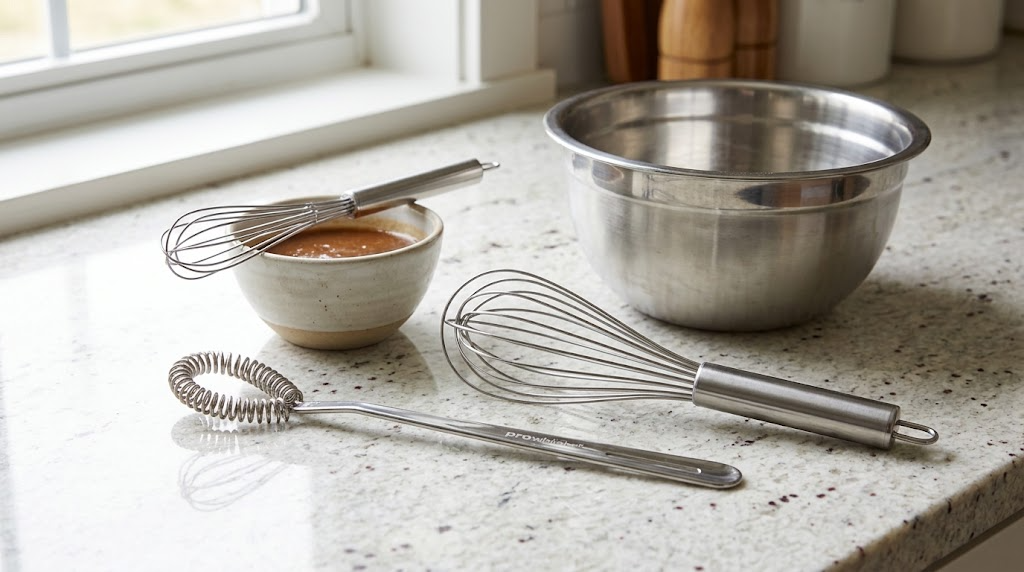
Whisks aren’t interchangeable the way they look on a wall rack. The shape genuinely changes how well a whisk performs at two very different jobs: smoothing a sauce in a shallow pan versus incorporating air into something like whipped cream or egg whites.
Some links in this post are affiliate links. If you buy through them we may earn a small commission at no extra cost to you — it never changes which products we recommend.
How the Shapes Actually Differ
Sauce Whisk (Flat or Roux Whisk)
These have a flatter, narrower profile designed to sit close against the bottom and sides of a saucepan, reaching into corners and edges that a rounder whisk can’t access well. This makes them better at breaking up lumps and preventing sticking or scorching in a shallow-sided pan.
Balloon Whisk
The classic rounded, bulbous shape is built to maximize air incorporation — it moves a large volume of loops through the mixture quickly, which is exactly what you want for whipping cream or egg whites to full volume, but it doesn’t reach into pan corners as effectively as a flatter design.
Where Each One Actually Wins
- Sauce whisk wins for gravies, béchamel, and roux-based sauces — its flat profile smooths out lumps against the pan’s flat bottom far more effectively.
- Balloon whisk wins for whipping — cream, egg whites, and anything that needs volume and air incorporation benefits from its rounder, wider shape.
- Sauce whisk wins in a shallow pan generally — its narrower shape simply fits and maneuvers better in a wide, low-sided pan than a bulky balloon whisk does.
- Balloon whisk wins in a deep bowl — its shape is built for reaching down and around the sides of a rounded mixing bowl.
From My Kitchen: The Gravy That Wouldn’t Smooth Out
For a long time I only owned a balloon whisk and used it for everything, including gravy. I could never quite get the lumps fully worked out along the edges of the pan, no matter how long I whisked — the rounded shape just wasn’t making good contact with the flat corners where flour tended to clump. Switching to a flat sauce whisk for gravy and roux-based sauces solved that problem almost immediately; the flatter profile actually reaches into those corners the balloon whisk was gliding past. I still use the balloon whisk constantly, just not for anything cooked directly in a shallow pan anymore.
Worth Considering
OXO’s Good Grips balloon whisk is a well-built, comfortable option for whipping cream, eggs, and batters.
This 3-pack stainless steel whisk set includes multiple shapes and sizes, useful if you want both styles covered without buying separately.
Shape Decides What a Whisk Can Do
A balloon whisk has widely spaced, flexible wires in a rounded cage. That shape is designed to drag air into a liquid, which is what you want for egg whites, cream and anything you are trying to aerate. The same shape works against you in a saucepan: the round cage cannot reach into the corner where the base meets the wall, which is exactly where a sauce catches and where lumps form first.
A flat or sauce whisk has fewer, stiffer wires in a flattened loop that lies close to the pan base. It cannot aerate much, and it does not need to — its job is to keep a roux or a custard moving across the whole bottom surface, including the corners. If you have ever made a béchamel with a balloon whisk and still found lumps, the whisk shape was the reason.
Quick Comparison
| Balloon whisk | Flat or sauce whisk | |
|---|---|---|
| Whipping cream and egg whites | Excellent | Poor |
| Reaching pan corners | Poor | Excellent |
| Smoothing a roux or custard | Adequate | Excellent |
| Working in a shallow pan | Awkward | Designed for it |
| Mixing dry ingredients | Good | Good |
Wire Count, Stiffness and Handle
More wires give a finer, smoother emulsion but make the whisk harder to clean and slower to move through a thick mixture. Fewer, stiffer wires cut through heavy batters and roux with less effort. For a single all-purpose whisk, a medium wire count with moderate stiffness is the sensible compromise — very flexible whisks feel unpleasant in thick mixtures and very stiff ones are poor at aerating.
Check where the wires enter the handle. A sealed joint is what stops water and batter getting inside, and an unsealed one will eventually smell and leak grey water into whatever you are mixing. This is the single most common way a whisk becomes unusable, and it has nothing to do with the wires themselves.
Two Whisks Worth Considering
Best balloon whisk: OXO Good Grips Balloon Whisk
Well-judged wire flexibility — springy enough to whip cream efficiently, stiff enough not to feel useless in a thicker batter — and a sealed handle joint, which is what determines whether a whisk lasts.
Pros
- Good balance of flexibility and stiffness
- Sealed handle joint, no water ingress
- Comfortable grip when hands are wet
Cons
- Round cage cannot reach pan corners
- Many wires take a little effort to clean
Best set for covering both: 3-Pack Stainless Steel Whisk Set
A set covering different sizes means having a small whisk for a dressing and a larger one for batter, which in practice gets used more than a single premium whisk. Good value if you do not yet know which shape you reach for most.
Pros
- Covers several sizes in one purchase
- Stainless throughout, easy to clean
- Inexpensive enough to keep one by the hob
Cons
- Handles are less comfortable than premium models
- None is a true flat sauce whisk
Frequently Asked Questions
Can I use a balloon whisk for sauces if it’s all I have?
Yes, it’ll still work, just less effectively at reaching pan corners than a flatter sauce whisk — you may need to switch to a spatula occasionally to scrape those edges manually.
What’s a roux whisk exactly?
It’s a specific style of flat sauce whisk, often with a slightly different wire arrangement, designed specifically for working a butter-and-flour roux smooth as it cooks.
Do I need both types of whisk?
If you cook both sauces and baked goods regularly, having both is genuinely useful rather than a luxury — each does its specific job meaningfully better than the other.
Can I whip cream with a flat whisk?
Slowly and with difficulty. A flat whisk moves very little air into the cream because the wires travel through it in a narrow plane rather than sweeping a volume, so you will be at it for several minutes and may never reach firm peaks. It is the wrong tool rather than a slower one. If a balloon whisk is not available, a fork in a narrow jug works better than a flat whisk for small quantities.
Why does my whisk leave lumps in a sauce?
Usually the corners. A balloon whisk cannot reach the angle where the pan base meets the wall, so flour or starch sits there, cooks and then breaks loose as lumps. Switch to a flat whisk, or tilt the pan and work the whisk deliberately around the edge every few strokes. The other cause is adding liquid too quickly to a roux — add it in stages, whisking each addition smooth before the next, and lumps mostly stop happening regardless of whisk shape.

Rimi Sultana is a home cook from Bangladesh who has cooked for her family every day for the past five years and writes about it at Smart Cooks. Perpetually testing whether internet-famous recipes actually work in a regular home kitchen. Say hello on Facebook or through the contact page.