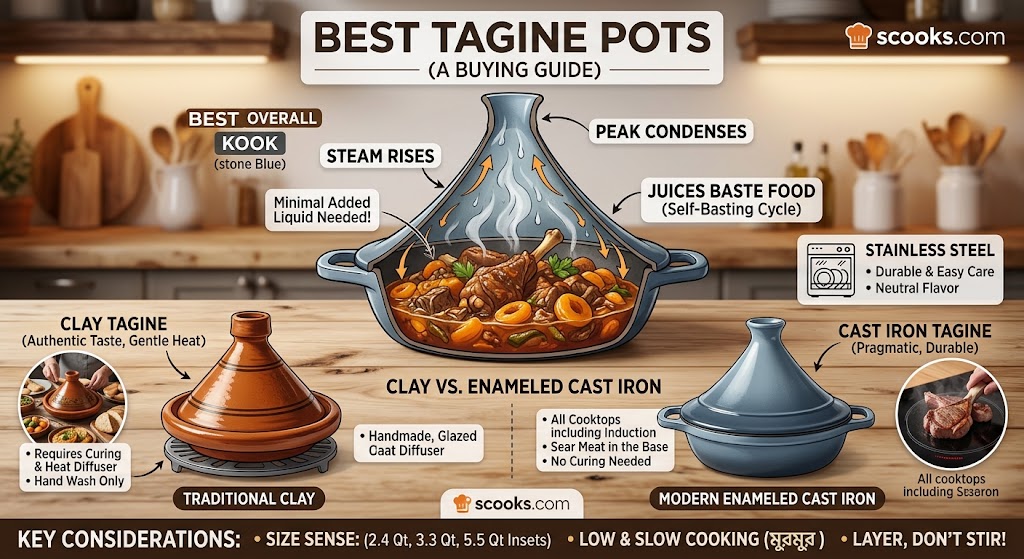
The cone is not decoration. A tagine’s tall conical lid is a passive condensation machine: steam rises off the stew, cools in the peak, and runs back down the walls into the pot, basting the food in its own juices for hours. That is why Moroccan tagines come out of a pot with barely a cup of added liquid tasting more concentrated than a braise made with a quart — nothing escaped.
Some links in this post are affiliate links. If you buy through them we may earn a small commission at no extra cost to you — it never changes which products we recommend.
The buying decision splits cleanly in two. Clay tagines are the traditional article — beautiful, gentle, and demanding: they need curing, a diffuser over flame, and the same care as any earthenware. Enameled cast iron tagines keep the condensation cone but swap the base for metal, which means you can sear the lamb in the same pot, use any cooktop including induction, and skip the curing entirely. Purists keep clay; pragmatists cook more often in iron.
We have covered clay’s rules and rewards in our cazuela guide and donabe guide; the tagine is the third leg of that clay-pot family, and here are eight worth owning.
Our Top 8 Picks for the Best Tagine Pot
Best Overall: Kook Moroccan Tagine, Enameled Cast Iron, 3.3 Qt

The Kook is the tagine most home cooks should buy, because it removes every excuse: enameled cast iron base you can sear in over high heat, a ceramic cone that does the condensation work, no curing, no diffuser, and it works on every cooktop including induction. Brown the meat, add the spices and a splash of liquid, set the cone on, and walk away.
At 3.3 quarts it feeds four generously, and the stone blue enamel goes stove-to-table looking like it planned to be there.
Key Specifications
- 3.3-quart enameled cast iron base
- Ceramic condensation cone lid
- All cooktops including induction
- Sear and slow-cook in one vessel
Pros
- Sear-then-braise without changing pots
- No curing or diffuser needed
- Works on induction unlike clay
- Handsome enough to serve from
Cons
- Cast iron base is heavy
- Ceramic cone is still droppable
- Not the traditional clay flavour experience
Best Premium: Emile Henry Flame Tagine, 3.7 Qt, Made in France
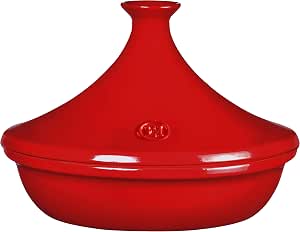
Emile Henry’s Flame ceramic is the answer to clay’s biggest weakness: it is a high-fired Burgundy clay engineered to sit directly on a gas flame without a diffuser and without cracking — traditional material, modern tolerance. You get clay’s gentle, even heat and its slight breathability, minus the anxiety.
This is the tagine for someone who wants the ceramic cooking experience as a lifetime piece. French-made, decades of reputation, and a lid that seats beautifully.
Key Specifications
- 3.7-quart Flame ceramic, made in France
- Direct-flame safe without a diffuser
- High-fired Burgundy clay
- Ten-year manufacturer guarantee class
Pros
- Ceramic cooking without ceramic fragility rules
- Flame-safe straight on gas
- Superb even, gentle heat
- A genuine lifetime piece
Cons
- Premium price
- No induction — ceramic is ceramic
- Cannot hard-sear like cast iron
Best Authentic Clay: Kamsah Handmade Clay Tagine, Large 5.5 Qt

Kamsah’s is the proper handmade clay article at a generous 5.5 quarts — the size for a family platter of chicken with preserved lemon and olives, served straight from the base with everyone tearing bread at the same pot, which is how a tagine is actually meant to land on a table.
It is glazed, hand-finished, and carries the full clay rulebook: cure before first use, diffuse over flame, heat gently. In exchange you get the real thing, including the way clay rounds off flavours that metal keeps sharp.
Key Specifications
- 5.5-quart handmade clay tagine
- 12-inch family-platter base
- Glazed and hand-finished
- Traditional cooking and serving piece
Pros
- Authentic handmade clay experience
- Big enough for a whole-family platter
- Beautiful centrepiece finish
- The traditional flavour argument
Cons
- Needs curing and a heat diffuser
- All clay-care rules apply
- No induction
Best Colour Choice: Kook Tagine in Crimson, 3.3 Qt

The same Kook underneath — cast iron base, ceramic cone — in crimson, listed separately because colourways price independently and one is frequently on sale when the other is not. Buy whichever is cheaper on the day; the stew cannot tell.
The red does photograph magnificently against couscous, if your dinners end up on an audience’s screen.
Key Specifications
- 3.3-quart enameled cast iron
- Crimson colourway
- Same spec as the stone blue
- All cooktops including induction
Pros
- Identical function to our top pick
- Colourways often price differently — arbitrage
- Striking on a set table
- Sear-and-braise versatility
Cons
- No functional difference to pay extra for
- Heavy, like all cast iron
Best Budget Enameled: Classic Enameled Cast Iron Tagine, 2.4 Qt

The compact route into cast-iron tagine cooking: 2.4 quarts, induction- and oven-safe, at a price that makes the experiment low-stakes. Two-and-a-half quarts is honestly the right size for a couple — tagine recipes concentrate, and a smaller pot concentrates faster.
The trade at this price is finish quality: enamel is thinner than Kook’s and the cone is simpler. It cooks the same dinner.
Key Specifications
- 2.4-quart enameled cast iron
- Induction and oven safe
- Compact two-to-three person size
- Budget entry point
Pros
- Cheapest cast-iron tagine here
- Right size for couples
- Full cooktop compatibility
- Low-stakes way to try the cuisine
Cons
- Thinner enamel than premium brands
- Small for family cooking
- Simpler cone geometry
Best Ivory Classic: Kook Tagine in Ivory, 3.3 Qt

The third Kook colourway — ivory — for the kitchen that runs cream and wood tones. Same 3.3-quart cast iron base and ceramic cone; the pale enamel also shows fond developing while you sear, which is genuinely useful feedback rather than pure aesthetics.
As with the crimson: three colourways, one spec, buy on price.
Key Specifications
- 3.3-quart enameled cast iron
- Ivory colourway
- Ceramic condensation cone
- All cooktops including induction
Pros
- Pale enamel shows searing progress
- Fits neutral kitchen palettes
- Same proven Kook spec
- Often the discounted colour
Cons
- Ivory shows staining sooner
- No functional edge over siblings
Best Stainless Alternative: Cone-Lid Stainless Moroccan Tagine

The stainless tagine is the unsentimental workhorse: the condensation cone in metal, over a base that behaves like any good stainless casserole. It cannot chip, cannot crack, cannot care about thermal shock, and goes from stove to dishwasher like ordinary cookware — because it is.
Flavour-wise it is the most neutral of the group; what you lose in clay romance you gain in a tagine you will genuinely use on a Tuesday.
Key Specifications
- Stainless steel base and cone
- Casserole-grade construction
- Dishwasher safe
- No curing, no care rules
Pros
- Indestructible by tagine standards
- True weeknight-casual usability
- Lightest full-size option
- Easy cleaning
Cons
- No clay or iron heat character
- Thin base can run hot — use moderate flame
- Least traditional of the group
Best Slow-Cooker Style: Enameled Cast Iron Tagine with Wide Base

A wider, shallower cast-iron base under the classic cone — geometry that favours the layered, barely-stirred tagines where vegetables sit over meat and everything cooks in ranked order. More base means more contact for the initial sear and more room to arrange rather than pile.
Chicken with preserved lemon and olives — and I did not believe the no-added-water instruction for a second, so I put in about half a cup anyway as insurance. It was too much. What came out was good, but the sauce was thin and I had to reduce it separately at the end, which rather defeats the purpose of the pot.
The second time I trusted it: onions, chicken, a couple of spoons of oil, nothing else liquid at all. The onions released more than enough, the cone caught it and dropped it back, and the sauce at the end was thick and concentrated. If you cannot bring yourself to add nothing, add two tablespoons — not half a cup.
Key Specifications
- Wide-base enameled cast iron
- Classic tall cone lid
- Layered-cooking geometry
- All cooktops
Pros
- Wide base suits layered tagine builds
- Good searing real estate
- Cone does the self-basting work
- Stove-to-table format
Cons
- Wide footprint needs a big burner
- Shallower base holds less liquid dishes
The Ultimate Buying Guide for Tagines
How the Cone Actually Works
Steam rises from the simmering base, hits the cooler walls of the tall cone, condenses, and runs back down into the food. The pot recycles its own moisture, which is why authentic recipes add astonishingly little liquid — often just what clings to washed vegetables plus a splash. The result is concentration: sauces that taste reduced without ever boiling hard, and meat that steams tender in aromatics rather than poaching in dilution. A taller cone condenses more; that is the one piece of lid geometry worth comparing.
Clay vs Enameled Cast Iron vs Stainless
- Clay — the traditional experience: gentlest heat, subtle flavour rounding, most beautiful, most demanding. Curing, diffusers and thermal-shock rules apply, exactly as with our cazuelas.
- Enameled cast iron base + ceramic cone — the pragmatic best of both: sear in the base, condense under the cone, use any cooktop. The format most people should buy.
- Flame-rated ceramic (Emile Henry) — clay’s character with modern flame tolerance; the premium middle path.
- Stainless — indestructible and neutral; a casserole wearing the cone.
Size Sense
- 2 to 2.5 quarts — couples; concentrates fastest
- 3 to 3.7 quarts — the family default
- 5+ quarts / 12-inch base — the communal platter format, bread-tearing included
Using One Properly
- Low and slow is the whole religion. A tagine never boils hard; it murmurs. High heat defeats the condensation cycle and risks clay.
- Layer, do not stir: onions and oil below, meat in the centre, vegetables ranked around, spices over, liquid barely at all.
- Resist lifting the cone. Every peek dumps the water cycle; trust the timer.
- Clay first-timers: cure it (soak, then a low slow first cook), and always use a diffuser over direct flame.
- Serve in the base. The bottom is the platter; that is the design.
Frequently Asked Questions About Tagines
Do I need to add water to a tagine?
Barely — and this is the adjustment that surprises everyone. The cone returns evaporation to the pot, so a splash of stock or the water clinging to rinsed vegetables is usually enough. If your tagine ends watery, you added too much or peeked too often; the dish should finish in a thick, glossy, reduced sauce.
Can I use a tagine on an electric or induction stove?
Enameled cast iron tagines, yes — including induction. Clay and ceramic tagines work on electric coil with gentle preheating and on gas with a diffuser, but never on induction (not magnetic). Stainless tagines follow their base material — most are induction-fine.
Do clay tagines need to be cured?
Yes: soak base and cone in water (several hours), dry, rub lightly with oil, and run a low, slow first cook — the same logic as any earthenware. Skipping it invites cracking and a raw-clay taste in the first dish. Enameled cast iron and stainless need nothing.
Can the tagine go in the oven?
Most bases can; the constraint is the cone’s height versus your racks. Cast-iron-based tagines bake happily lidless as a braiser. Check each maker’s stated oven rating, and never take any clay from fridge to hot oven — thermal shock is the one unforgivable move.
What should I cook first in a tagine?
Chicken with preserved lemon and olives is the canonical first dish — forgiving, spectacular, and it teaches the no-added-water lesson safely. Lamb with apricots and almonds is the second. Both want low heat, ninety patient minutes, and bread instead of cutlery.
Is a tagine just a slow cooker?
They rhyme but differ: a slow cooker surrounds food with steady wet heat in a sealed pot; a tagine actively cycles moisture — evaporating, condensing, re-basting — which concentrates flavour instead of diluting it. You can adapt tagine recipes to a slow cooker, but cut the liquid hard and expect a soupier result.
Final Thoughts
Buy the Kook enameled cast iron in whichever colour is cheapest today — it is the tagine that gets used weekly because it forgives everything. The Emile Henry is the lifetime ceramic if you want clay’s soul with fewer rules, and the Kamsah is the honest handmade article for the table-centrepiece dinners.
Whichever you choose: low flame, layered pot, closed cone, and bread for cutlery. The cone does the cooking; your job is to leave it alone.
As an Amazon Associate we earn from qualifying purchases. Availability is accurate as of the date of publishing. We do not list prices because they change too often to quote honestly.

Rimi Sultana is a home cook from Bangladesh who has cooked for her family every day for the past five years and writes about it at Smart Cooks. Perpetually testing whether internet-famous recipes actually work in a regular home kitchen. Say hello on Facebook or through the contact page.