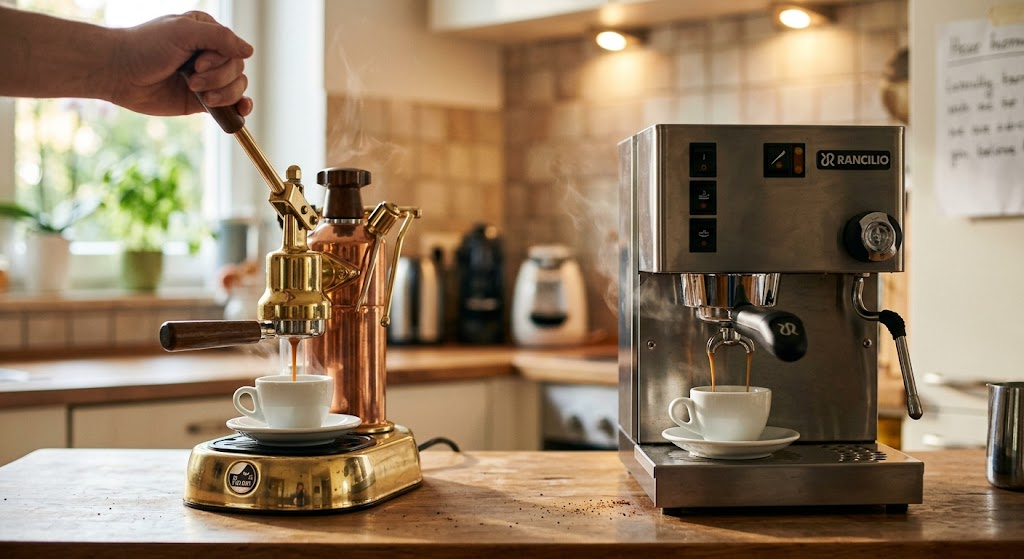
Manual lever espresso makers have a devoted following, and stovetop moka pots get called ‘espresso’ constantly even though purists will argue that point for hours. If you’re deciding between a manual approach and an electric espresso machine, the real differences are about control and effort, not just price.
Some links in this post are affiliate links. If you buy through them we may earn a small commission at no extra cost to you — it never changes which products we recommend.
What Actually Matters
Pressure Consistency
A true manual lever espresso maker can produce genuine espresso-level pressure (around 9 bar) if you pull the lever correctly and consistently, but that consistency depends entirely on your technique each time. An electric machine with a pump maintains that pressure automatically, which is more forgiving for a repeatable daily shot.
Stovetop Moka Pots Aren’t True Espresso
Moka pots produce a strong, concentrated coffee that’s often called espresso, but they only reach around 1-2 bar of pressure — nowhere near true espresso pressure. It’s a genuinely great, different style of strong coffee, just not technically espresso, and it’s worth knowing that going in so expectations match reality.
Learning Curve and Hands-On Time
Manual lever machines have a real learning curve — grind size, tamp pressure, and lever technique all affect the shot, and it takes practice to get consistent results. Electric machines remove several of those variables, trading some hands-on ritual for repeatability.
From My Kitchen
I switched to a manual lever machine expecting café-quality shots immediately and instead pulled a lot of under-extracted, sour shots for the first couple weeks while I dialed in grind size and lever pressure. Once it clicked, the shots were genuinely excellent — but the honest timeline to consistency was closer to a month of daily practice, not a weekend.
Worth Considering
For a genuine manual espresso experience with real control over pressure, the Flair UPDATED Espresso Maker Classic is a well-regarded starting point for lever brewing. If you want a strong, concentrated stovetop coffee without the learning curve of true espresso, the GROSCHE Milano Stovetop Espresso Maker (Moka Pot) is a simple, reliable way to get there.
Pressure Is the Line Between Espresso and Strong Coffee
Espresso is defined by roughly 9 bar of pressure pushed through a finely ground, tamped puck in about 25 to 30 seconds. That pressure is what emulsifies the oils into crema and extracts the concentrated, syrupy body people are actually after. Any device that cannot reach it — a moka pot at 1 to 2 bar, an Aeropress at well under 1 — makes good concentrated coffee, but it is not espresso, and no amount of marketing language changes that.
What is genuinely surprising is that a manual lever press can reach real espresso pressure using nothing but your arm. There is no pump and no boiler; you supply the force through a lever, and a well-made manual press will hit and hold 9 bar comfortably. The trade-off is that you are also the pressure controller, which is simultaneously the appeal and the difficulty.
Quick Comparison
| Manual lever press | Pump machine | Moka pot | |
|---|---|---|---|
| Pressure achieved | 9 bar, controlled by you | 9 bar, controlled by the pump | 1–2 bar |
| Consistency shot to shot | Depends on technique | High once dialled in | High but not espresso |
| Grinder requirement | Espresso-capable burr grinder | Espresso-capable burr grinder | Forgiving |
| Setup and cleanup | Few minutes, hand wash | Warm-up plus routine cleaning | Minimal |
| Electricity | None | Required | Hob only |
The Grinder Is the Real Prerequisite
This is the part most buying guides underplay: a manual espresso press with a cheap blade grinder will not make good espresso, and neither will a thousand-pound machine. Espresso needs a narrow, even particle size, because the pressure will find any channel through the puck and race through it — that is channelling, and it produces sour, thin shots no matter how good the brewing device is. A burr grinder capable of espresso-fine, repeatable settings is not optional equipment.
If you are choosing where to put your money, and the grinder you own is a blade grinder or an entry-level burr that does not go fine enough, put it into the grinder first. A moka pot with an excellent grinder makes better coffee than a lever press with a poor one.
Two Devices Worth Considering
Best for real espresso without a machine: Flair Espresso Maker Classic
A manual lever press that genuinely reaches espresso pressure, with no electricity, no boiler and nothing to descale. You control the pressure profile through the lever, which is either the fun part or the frustrating part depending on temperament.
Pros
- Reaches true espresso pressure
- No electronics, pump or descaling to fail
- You control pressure through the shot
Cons
- Needs a capable espresso burr grinder
- Technique takes weeks to become consistent
Best low-effort alternative: GROSCHE Milano Stovetop Espresso Maker
Not espresso in the technical sense, but a genuinely good concentrated coffee with almost no learning curve and no grinder requirements beyond a decent even grind. The sensible choice if what you want is a strong base for milk drinks rather than a shot with crema.
Pros
- Simple, reliable and inexpensive
- Forgiving about grind size
- Nothing to break or service
Cons
- Does not produce true espresso or crema
- Needs attention on the hob to avoid scorching
Frequently Asked Questions
Can a moka pot make real espresso?
Not technically — moka pots brew under much lower pressure than true espresso machines, producing a strong, concentrated coffee that’s genuinely delicious but has a different crema and body than true espresso.
Is a manual lever espresso maker harder to use than an electric machine?
Yes, meaningfully — it requires more hands-on technique for grind size, tamping, and lever pressure, and takes longer to master consistent results compared to a pump-driven electric machine.
Can a manual press really match a machine?
At the level of what ends up in the cup, yes — a well-pulled manual shot is genuinely comparable to one from a mid-range pump machine, and some people prefer it because the pressure profile is theirs to shape. Where the machine wins is consistency and convenience: it repeats the same shot without thought, and it steams milk. A manual press asks for attention each time and steams nothing.
How important is water temperature?
Very. The target is roughly 92 to 96°C at the puck, and manual presses lose heat through the metal body, so most people preheat the brewing chamber with hot water before the shot. Skipping that is one of the most common reasons an early manual shot tastes sour and thin — the coffee is being under-extracted by cold metal rather than anything to do with pressure or grind.
Rimi Sultana is a home cook from Bangladesh who has cooked for her family every day for the past five years and writes about it at Smart Cooks. Perpetually testing whether internet-famous recipes actually work in a regular home kitchen. Say hello on Facebook or through the contact page.