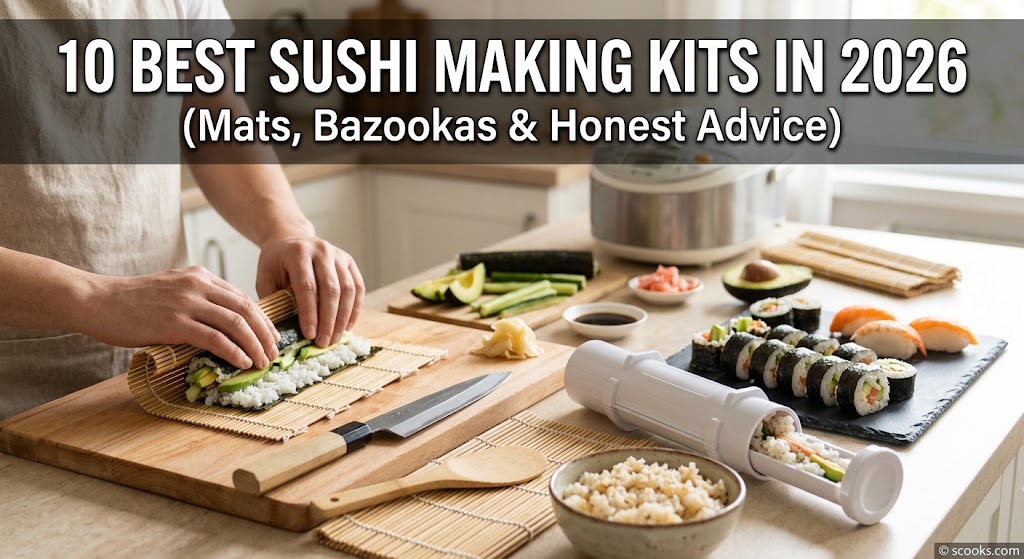
Home sushi fails for exactly two reasons, and neither is the fish. The first is rice — unseasoned, wrongly cooked, or applied in a doughy inch-thick layer. The second is the roll itself: without a mat, nori and rice cannot be compressed evenly, and the result unrolls on the cutting board like a bad secret. A bamboo makisu solves the second problem for pocket change, which is why every kit on this list is built around one.
Some links in this post are affiliate links. If you buy through them we may earn a small commission at no extra cost to you — it never changes which products we recommend.
What separates kits is everything bundled around the mat: rice paddles and spreaders (genuinely useful), a sharp knife (occasionally decent, usually the weakest item in the box), bazooka-style tube molds (divisive but honest fun for beginners), and nigiri presses. The right kit depends on whether you want to learn the craft or just want maki on the table tonight — and those are different purchases.
Two notes before the list. Rice matters more than any tool: short-grain, properly seasoned — a rice cooker helps, and our Zojirushi vs Tiger comparison covers that. And raw fish at home means sushi- or sashimi-grade from a fishmonger you trust, kept relentlessly cold — or skipping raw entirely, since cooked shrimp, cucumber and avocado rolls are how most home sushi actually happens.
Our Top 10 Picks for the Best Sushi Making Kit
Best Overall: Delamu 9-in-1 Bamboo Sushi Kit for Beginners

Delamu’s 9-piece kit is the sensible first purchase: two proper bamboo mats (one rolling, one spare or for a second pair of hands), paddles, spreaders and chopsticks, with a guide aimed at someone who has never rolled anything. No gimmick tools, nothing you will not use.
Two mats is the underrated spec — sushi night is social, and the second mat turns a spectator into a participant.
Key Specifications
- 9-piece kit with 2 bamboo mats
- Rice paddle and spreader included
- Chopstick sets
- Beginner guide
Pros
- Everything needed, nothing gimmicky
- Second mat for a second roller
- Natural bamboo throughout
- Reliable brand in this category
Cons
- No knife — use your own sharp one
- Mats need proper drying care
Best Complete Kit: Delamu 20-in-1 with Bazooka, Knife and Mats

The everything-box: bamboo mats, a sushi bazooka (a two-piece tube that molds a perfect rice-and-filling core you then wrap in nori), a knife, paddles, molds, and enough accessories to run a party table. The bazooka gets sneered at by purists and quietly loved by everyone whose first three hand-rolled attempts fell apart — it guarantees a uniform roll on night one.
Honest note on bundle knives: adequate, not great. The rest of the kit is the value.
Key Specifications
- 20-piece set with bazooka roller
- Bamboo mats plus molds
- Knife and serving accessories
- Party-scale bundle
Pros
- Bazooka makes night-one success certain
- Covers every roll format at once
- Great gift box
- Both cheat-mode and craft-mode included
Cons
- Bundle knife is merely okay
- Many parts to wash and store
- Purists will roll their eyes (while eating)
Best Classic Mats: JapanBargain Bamboo Rolling Mats, Set of 6

The purist package: six plain bamboo makisu, nothing else. This is what a sushi-ya uses, and six of them means a party where everyone rolls, or years of replacements as mats age out.
JapanBargain has supplied Japanese kitchenware to the US for decades; the mats are the proper tight-woven, flat-slat article. Pair with your own knife and a rice cooker and you have the professional setup for less than a takeout order.
Key Specifications
- Six traditional bamboo makisu
- Tight flat-slat weave
- No accessories — mats only
- Established importer
Pros
- The authentic minimal toolkit
- Party quantity for group rolling
- Cheapest per-mat route
- Nothing to break or gimmick
Cons
- No paddles, knife or guide
- Beginners get no hand-holding
Best Kit With Knife: Alas 20-Piece Sushi Set with Chef’s Knife

Positioned a step up from the commodity bundles: two mats, molds, full accessories, and a bundle knife noticeably better than the category norm — still not a yanagiba, but sharp and thin enough to slice a roll cleanly when wetted between cuts.
A clean cut is half of how sushi looks professional, so a kit that takes its knife semi-seriously earns its ranking.
Key Specifications
- 20-piece set with better-grade knife
- Two bamboo mats
- Nigiri and roll molds
- Full accessory spread
Pros
- Best bundle knife of the group
- Complete beginner-to-competent path
- Two-mat social rolling
- Well-presented gift box
Cons
- Still not a specialist sushi knife
- Lots of storage footprint
Best Bazooka-First Kit: SmileTools 22-in-1 Roller Kit

The maximal bazooka bundle: tube roller, mats, molds for nigiri and shapes, paddles, and the sort of accessory count that makes a family sushi night feel like a workshop. For households with kids, the tube roller is honestly the difference between children participating and children watching.
Everything is dishwasher-simple plastic apart from the mats — pragmatic, not artisanal, and that is its job.
Key Specifications
- 22-piece bundle
- Bazooka tube plus shape molds
- Bamboo mats included
- Family-oriented format
Pros
- Kids can genuinely make their own rolls
- Biggest accessory spread here
- Uniform rolls without technique
- Easy-clean plastics
Cons
- Most plastic of any kit
- Quantity over refinement
- Storage sprawl
Best Eco Kit: No-Plastic Premium Bamboo Sushi Kit

The plastic-free counterpoint: mats, paddles, spreaders and serving pieces in bamboo and natural materials only. It rolls exactly as well — bamboo was always the correct material — and it gifts beautifully to the friend who reads labels.
Natural-material kits demand the same care as the mats alone: rinse, dry flat, no dishwasher.
Key Specifications
- All-bamboo, no-plastic kit
- Mats, paddles, spreaders, serving pieces
- Natural material construction
- Gift-ready presentation
Pros
- Zero plastic in the box
- Bamboo performs identically anyway
- Handsome gift format
- Complete core toolkit
Cons
- All-wood care rules apply to everything
- No bazooka or molds for shortcut fans
Best Budget Mats: BZG 2-Pack Bamboo Rolling Mats

Two honest bamboo mats at the lowest sensible price — the buy for finding out whether sushi night becomes a habit before any bundle money changes hands.
A mat, a sharp knife you own, supermarket nori and good rice: that is genuinely the whole minimum toolkit, and this is its cheapest respectable form.
Key Specifications
- Two bamboo makisu
- Standard 9.5-inch format
- Tight weave
- Entry price
Pros
- Cheapest real starting point
- Two mats from day one
- Nothing extraneous
- Fine weave quality for the money
Cons
- No accessories at all
- No instructions for true beginners
Best With Rice Tools: Bamboo Kit with Paddle, Spreader and Chopsticks

The rice-first kit: mats plus the paddle and spreader that make seasoned rice handling civilised. Sushi rice is sticky by design, and spreading it thin and even with fingers is how beginners end up wearing it — the flat spreader fixes the single most common rookie mess.
A sensible middle path between bare mats and twenty-piece sprawl.
Key Specifications
- Bamboo mats with rice paddle and spreader
- Chopsticks included
- Natural bamboo set
- Core-tools format
Pros
- Spreader solves the sticky-rice fight
- Compact, no-gimmick bundle
- All natural materials
- Good price for the trio
Cons
- No molds or knife
- Modest presentation for gifting
Best for Kids: Silicone Sushi Making Kit with Rolling Mat

Silicone mats trade bamboo’s tradition for two real advantages: they rinse or dishwash clean in seconds (no rice cement in the slats), and rice barely sticks to them — which for small hands and inside-out rolls is the difference between fun and tears.
The texture of the roll is marginally softer-pressed than bamboo’s. For a family kit or a weeknight-convenience kit, that trade is fine.
Key Specifications
- Silicone rolling mat kit
- Dishwasher-safe
- Low-stick surface
- Kid-friendly format
Pros
- Easiest cleanup of any mat
- Rice barely sticks — ideal for uramaki
- Kids roll successfully
- Durable and rot-proof
Cons
- Slightly softer compression than bamboo
- Loses the traditional feel entirely
Best Party Pack: Fusion Select 3-Pack Bamboo Mats

Three mats for the middle ground between a pair and a six-pack — the family-of-three-rollers format, or two working mats plus the one that lives damp in the drying rack.
Plain cucumber — and only after three of them had fallen apart. What was going wrong was the rice, not the technique. I was using far too much of it and spreading it thick, so there was nothing for the nori to grip at the seam. The roll that finally held had a thin layer with a clear two-centimetre strip of bare nori at the far edge, wetted right at the end.
The other thing nobody says loudly enough is that the rice has to be cool. I was rolling with warm rice and steaming the nori limp from the inside. Make the rice, fan it, let it come down to room temperature, then roll. Cucumber first, avocado second, fish only once the roll itself has stopped being interesting.
Key Specifications
- Three bamboo makisu
- Rolling, shaping and molding use
- Standard size
- Mid-count pack
Pros
- Right count for family rolling
- Spare covers the drying rotation
- Consistent weave across the pack
- Fair per-mat price
Cons
- Mats only
- No beginner materials
The Ultimate Buying Guide for Sushi Kits
Mat, Bazooka or Molds — Three Philosophies
- The bamboo mat (makisu) is the craft path: a week of slightly loose rolls, then a lifetime of proper ones. Everything else is optional around it.
- The bazooka tube is the results path: rice and filling pressed in a mold, extruded, wrapped. Uniform rolls on night one, ceiling reached by night three. Excellent for kids and parties; nobody ever got better at sushi with one.
- Nigiri and shape molds are honest tools even in Japan — hand-forming nigiri properly is genuinely hard, and a press is how home cooks get evenly-sized pieces.
Rice Is 80 Percent of Sushi
Short-grain japonica rice, rinsed until the water runs clear, cooked slightly firm, and seasoned while hot with rice vinegar, sugar and salt, then fanned and folded — that is sushi rice, and no kit replaces it. Spread it thin (nori should shadow through), keep a bowl of water for your hands, and work at room temperature: refrigerated sushi rice turns to gravel. A proper rice cooker is the best sushi tool money buys.
The Knife Truth
Bundle knives range from adequate to ornamental. What actually cuts a roll cleanly is any genuinely sharp thin blade, wiped and dipped in water between every cut, drawn through in one pull rather than sawed. Your sharpest kitchen knife beats most kit knives — see our knife set guide for that department.
Raw Fish, Responsibly
Buy fish labelled sushi- or sashimi-grade from a fishmonger who can say when it arrived, keep it iced until the minute of use, and make it the same day. FDA guidance relies on commercial deep-freezing to handle parasites in fish served raw — which is what sushi-grade implies — so supermarket fillets intended for cooking are not candidates. And know that most home sushi is happily cooked or vegetarian: shrimp, crab stick, tamago, cucumber, avocado. Start there; the technique is identical.
Mat Care
Rinse promptly, scrub rice from the slats with a brush, air-dry flat and completely — a damp rolled mat mildews exactly like the bamboo steamers in our steamer guide. Wrapping the mat in cling film before rolling inside-out rolls keeps rice out of the weave entirely; many cooks film the mat for every roll and make the mat effectively immortal.
Frequently Asked Questions About Sushi Kits
Why do my rolls fall apart?
Overfilling, mostly — the classic beginner roll carries double the filling a nori sheet can close around. Thin rice layer, a modest finger of filling, a firm even squeeze along the whole mat, and seal the bare nori edge with a wet fingertip. Second cause: cutting with a dry or dull knife, which drags the roll open.
Do I need a bamboo mat, or will a towel work?
A clean towel under cling film rolls a passable maki in a pinch — the technique matters more than the tool. But mats cost almost nothing, compress more evenly, and last years; there is no argument for improvising past your first experiment.
Is a sushi bazooka cheating?
It is a mold, and molds are ancient kitchen equipment. It makes uniform, well-packed rolls with zero technique and teaches you nothing — both true. Parties and kids: bazooka. Learning: mat. Many kitchens happily run both.
What sushi should a beginner make first?
Cucumber rolls (kappa maki) — cheap ingredients, no fish anxiety, and the thin filling makes rolling easy. Then avocado, then cooked shrimp, then inside-out California rolls once the mat feels natural. Raw fish is a technique reward, not an entry requirement.
How do I store leftover sushi?
Reluctantly. Rice hardens in the fridge and nori goes leathery; sushi is a same-day food. If you must, wrap tightly and eat within a day, accepting the downgrade — or plan quantities so the question never arises. Components store far better than finished rolls.
Final Thoughts
Buy the Delamu 9-in-1 to learn properly, the 20-in-1 bazooka bundle if the goal is a fun table tonight, or the JapanBargain six mats if you already know the craft is the point. Silicone for the kids, all-bamboo for the purist on your gift list.
Then forget the tools and respect the rice — short-grain, seasoned, spread thin. Everything the kit does is downstream of that.
As an Amazon Associate we earn from qualifying purchases. Availability is accurate as of the date of publishing. We do not list prices because they change too often to quote honestly.

Rimi Sultana is a home cook from Bangladesh who has cooked for her family every day for the past five years and writes about it at Smart Cooks. Perpetually testing whether internet-famous recipes actually work in a regular home kitchen. Say hello on Facebook or through the contact page.