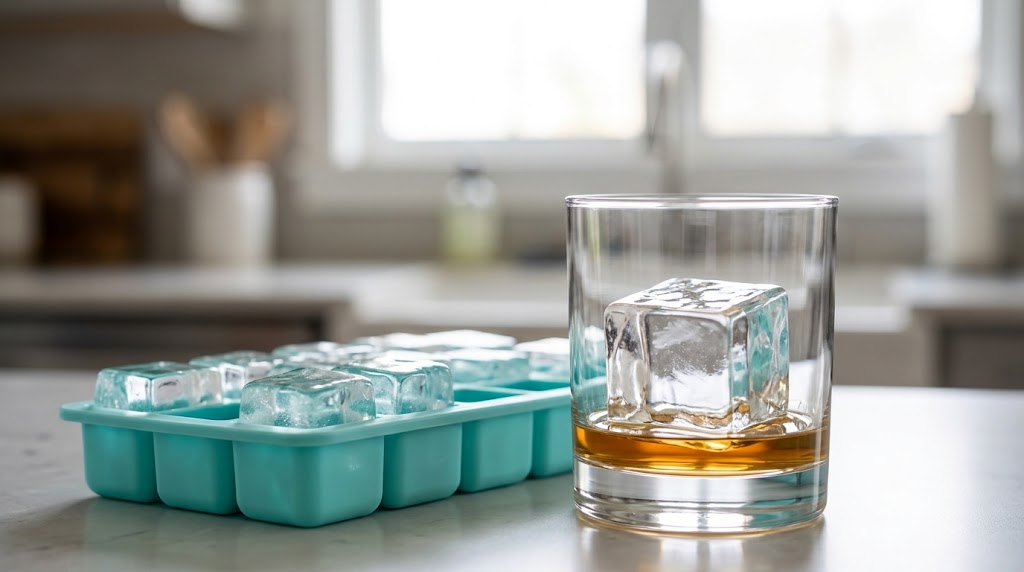
Clear ice looks impressive in a cocktail photo, and clear ice trays promise to replicate that at home without special equipment. The real question is whether the process is worth the extra time compared to a normal ice tray, and that depends on how much you actually care about presentation.
Some links in this post are affiliate links. If you buy through them we may earn a small commission at no extra cost to you — it never changes which products we recommend.
What Actually Matters
Directional Freezing Explains the Cloudiness Fix
Regular ice trays freeze from all sides at once, trapping air and minerals in the center as cloudy white ice. Clear ice trays work by forcing water to freeze from one direction only (usually top-down, with an insulated base), pushing impurities and air downward into a separate reservoir instead of trapping them in your cube.
Freeze Time Is Genuinely Longer
Because directional freezing is slower by design, clear ice trays typically take 18-24 hours rather than the 4-6 hours of a standard tray. This isn’t a flaw, it’s how the process works, but it does mean you need to plan ahead rather than freeze ice same-day.
Water Quality Still Matters
Using filtered water improves clarity further, since minerals in tap water can still show up as slight cloudiness even with directional freezing. It’s a small extra step but makes a visible difference in the final clarity.
From My Kitchen
My first attempt with a clear ice tray came out only partially clear because I didn’t leave enough time for the full freeze cycle and pulled the cubes early. Letting a full batch go the full 24 hours the next time made a genuinely dramatic difference — the cubes came out glass-clear, and it was clear the extra patience, not a different tray, was what I’d been missing.
Worth Considering
The True Cubes Crystal Clear Ice Cube Maker is a well-reviewed directional-freezing tray that produces genuinely clear large cubes with patience. The TINANA Clear Ice Cube Tray is a more affordable option that still uses the same directional-freezing principle.
Why Ordinary Ice Is Cloudy
The white core in a normal ice cube is trapped air and dissolved minerals. Water in a standard tray freezes from all sides inward, so as the outer shell solidifies it pushes impurities and air toward the centre, where they end up concentrated in a cloudy plug. It is not a sign of bad water — the same thing happens with filtered water, because the cause is the direction of freezing rather than what is in it.
Clear ice trays solve this with directional freezing. The mould is insulated on the sides and bottom so the water can only freeze downward from the top, pushing air and minerals ahead of the ice front into a reservoir below, which you discard. The cube that comes out is clear all the way through because everything that would have clouded it has been driven out of the cube entirely.
Quick Comparison
| Directional-freeze clear tray | Standard silicone tray | |
|---|---|---|
| Clarity | Fully clear | Cloudy core |
| Freeze time | 18–24 hours | 3–4 hours |
| Freezer space used | Substantial, insulated housing | Minimal |
| Cubes per batch | Usually 4–9 large cubes | 12 or more |
| Melt rate in a glass | Slower — dense, low surface area | Faster |
Clarity Is Not the Only Reason People Buy Them
The practical benefit is dilution control, and it applies whether or not you care how the drink looks. These trays produce large, dense cubes, and a single large cube has far less surface area relative to its volume than four small ones. Less surface area means slower melting, which means a spirit-forward drink stays at the strength you made it rather than watering down over fifteen minutes. For a whisky or a Negroni that you sip slowly, that is a real difference in the last third of the glass.
The honest counterpoint is freezer space. These trays are bulky because the insulation is the mechanism, and they produce only a handful of cubes per 18 to 24 hour cycle. If your freezer is already full, or you need ice in quantity for a party, they are the wrong tool — they are for two or three considered drinks, not a crowd.
Two Trays Worth Considering
Best results: True Cubes Crystal Clear Ice Cube Maker
A well-executed directional freezing system that reliably produces genuinely clear cubes rather than mostly-clear ones. The reservoir design means the cloudy portion collects below the cubes and is simply discarded.
Pros
- Consistently clear cubes
- Straightforward to demould
- Large cubes melt slowly in a glass
Cons
- Takes up real freezer space
- Only a few cubes per 24-hour cycle
Best value: TINANA Clear Ice Cube Tray
The same directional-freezing principle at a lower price. Clarity can be slightly less perfect than premium trays, but the cubes are still dramatically better than a standard tray and the dilution benefit is identical.
Pros
- Much cheaper entry into clear ice
- Same slow-melt benefit from large cubes
- Simple to use and clean
Cons
- Occasional slight cloudiness at the base
- Silicone can pick up freezer odours over time
Frequently Asked Questions
Why does my clear ice tray still make cloudy cubes sometimes?
The most common cause is pulling the cubes before the full freeze cycle finishes, or using unfiltered water with a higher mineral content — both interrupt the directional freezing process that pushes cloudiness away from the cube.
Does clear ice actually melt slower than regular ice?
Larger clear ice cubes do melt slower than small standard cubes mainly because of their size and lower surface-area-to-volume ratio, not because clarity itself changes melt rate — but the two often go together since clear ice trays tend to make larger cubes.
Does boiling the water twice actually make clear ice?
It helps a little and it does not solve the problem. Boiling drives off some dissolved air, so a cube can come out slightly clearer, but the mineral content is untouched and the freezing direction — which is the actual cause — has not changed. You will still get a cloudy core, just a smaller one. Directional freezing is the only method that reliably produces fully clear ice at home, whether in a purpose-made tray or a small cooler box left open in the freezer.
Why does my clear ice crack when I pour a drink over it?
Thermal shock. A cube straight from a −18°C freezer meeting room-temperature spirit expands unevenly and fractures. Let the cube sit out for a minute or two until the surface just starts to look wet before using it — bartenders call this tempering, and it also stops the cube shattering when you try to trim or handle it.
Related: Ice mold vs ice tray: understanding the real differences for clear and shaped ice

Rimi Sultana is a home cook from Bangladesh who has cooked for her family every day for the past five years and writes about it at Smart Cooks. Perpetually testing whether internet-famous recipes actually work in a regular home kitchen. Say hello on Facebook or through the contact page.