As an Amazon Associate, Smart Cooks earns from qualifying purchases. Product prices and availability are shown on Amazon and may change.
A good wood cutting board can last for decades, but only if it’s actually conditioned regularly — and the products marketed for this (mineral oil, board wax, conditioning sprays) aren’t interchangeable in what they actually do for the wood.
Some links in this post are affiliate links. If you buy through them we may earn a small commission at no extra cost to you — it never changes which products we recommend.
What Actually Matters
Food-Grade Mineral Oil Is the Base Layer
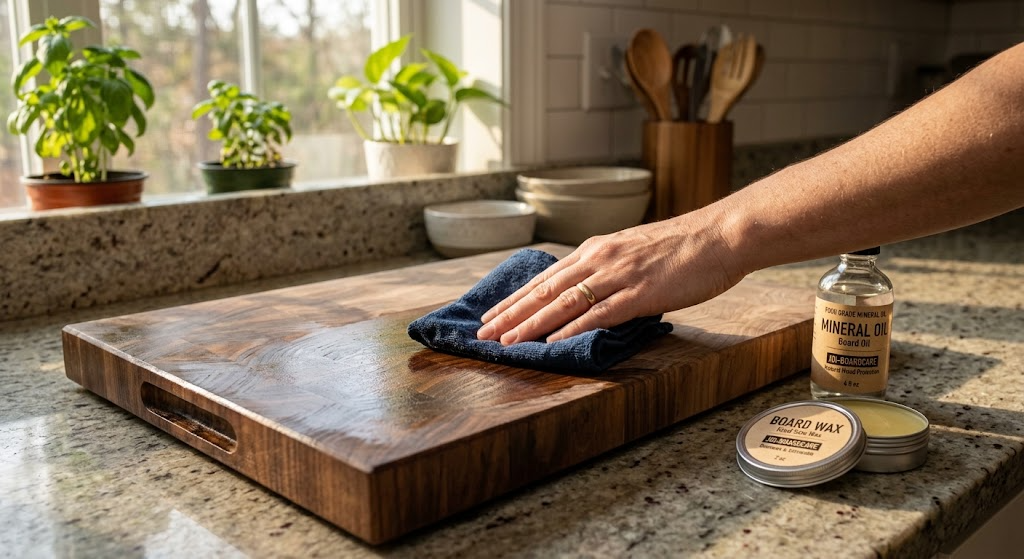
Plain food-grade mineral oil penetrates the wood and replaces moisture the wood loses from washing and air exposure, preventing cracking and warping. This is the foundational product — never use regular cooking oils, which can go rancid and create off smells over time, unlike mineral oil which stays stable.
Board Wax or Conditioner Adds a Protective Top Layer
Beeswax-based board conditioners (often blended with mineral oil) sit more on the surface, adding a water-resistant barrier on top of the oil layer underneath. This is a supplementary step, not a replacement for oiling — think of it as a sealant applied after the wood is properly conditioned.
How Often Actually Depends on Use, Not a Fixed Schedule
A board used daily and washed frequently needs oiling more often (roughly monthly) than one used occasionally. The real signal to watch for is the wood looking dry, dull, or feeling rough — that’s the board telling you it needs oil before it starts to crack.
From My Kitchen
I let a good wood cutting board go unoiled for several months because it wasn’t visibly damaged, and when I finally checked it closely I found the beginning of small surface cracks near one edge that hadn’t been there before. Getting into a monthly mineral oil routine after that stopped further cracking, and the wood noticeably darkened and looked healthier within just a couple of applications.
Worth Considering
For the foundational oiling step, Kate Naturals Food-Grade Mineral Oil is a straightforward, odorless option made specifically for wood cutting boards. For a combined conditioner that adds a protective wax layer, the Howard Products Butcher Block Conditioner set pairs oil and a finishing cream in one purchase.
What Each Product Actually Does to the Wood
Mineral oil penetrates. It soaks into the wood fibres and fills the microscopic spaces that would otherwise absorb water, food juices and odours. It does not harden and it does not sit on the surface, which is why it needs reapplying — it slowly migrates out and washes away. It is also the only one of the three that genuinely conditions the wood rather than coating it.
Wax — usually beeswax blended with mineral oil, sold as board cream or butcher block conditioner — sits on the surface and seals in the oil beneath it. It sheds water visibly, gives a soft sheen, and slows how fast the oil underneath leaves. It is a topcoat, not a replacement for oiling. Sprays are mostly convenience products: thinner, faster to apply, and generally shorter-lived because there is less material going on.
Quick Comparison
| Mineral oil | Wax or board cream | Spray conditioner | |
|---|---|---|---|
| Penetration | Deep into the fibres | Surface only | Shallow |
| Water resistance | Good | Best | Moderate |
| How often | Monthly, or when it looks dry | Every 2–3 months over oil | Frequently |
| Effort | Wipe on, wait, wipe off | Rub in and buff | Quickest |
| Best used as | The foundation | A topcoat over oil | Convenience top-ups |
The Routine That Actually Keeps a Board Alive
The method matters as much as the product. Apply mineral oil generously to a clean, completely dry board, including the edges and the underside — oiling only the top is how boards warp, because one face absorbs moisture from the air at a different rate to the other. Let it sit for several hours or overnight, then wipe off whatever has not soaked in. A new board may take three or four applications over a week before it stops drinking.
For daily care, wash quickly with warm soapy water and dry immediately standing on edge so air reaches both faces. Never soak a wooden board and never put it in a dishwasher — the combination of prolonged water and heat is what splits boards along the glue lines. If a board smells, coarse salt and half a lemon scrubbed across the grain, rinsed and dried, handles it without stripping the finish.
Two Products Worth Considering
The foundation: Kate Naturals Food-Grade Mineral Oil
Plain food-grade mineral oil is what a board actually needs, and it does not go rancid the way a cooking oil would — which is the reason never to use olive or vegetable oil on a board. Cheap enough to be generous with, which matters because the first few applications need a lot.
Pros
- Penetrates properly and conditions the wood
- Will not go rancid like cooking oils
- Inexpensive per application
Cons
- Needs reapplying roughly monthly
- Takes hours to soak in before wiping off
The topcoat: Howard Products Butcher Block Conditioner
A beeswax and oil blend that seals the surface over an oiled board, which slows how quickly the oil beneath washes out. Use it as a finishing step every few months rather than as your only product.
Pros
- Visible water beading and a soft sheen
- Extends the life of an oil treatment
- Pleasant to apply and buff
Cons
- Not a substitute for oiling underneath
- Needs buffing rather than just wiping
Frequently Asked Questions
Can I use olive oil or vegetable oil instead of mineral oil on a cutting board?
It’s not recommended — cooking oils like olive or vegetable oil can go rancid over time as they’re exposed to air, which creates an unpleasant smell in the wood, while food-grade mineral oil doesn’t oxidize the same way.
How do I know if my cutting board needs oil?
If the wood looks dry, pale, or feels rough to the touch, or if water starts soaking in and darkening the surface quickly instead of beading up, that’s a clear sign it’s time to oil the board.
Why can I not use olive oil or vegetable oil on a cutting board?
Because they are food oils and they go rancid. Within weeks a board treated with olive oil develops a stale, faintly sour smell that transfers to whatever you cut on it, and it cannot be washed out because the oil is inside the wood. Mineral oil is chemically inert and does not oxidise, which is precisely why it is the standard. Coconut oil is sometimes suggested and has the same rancidity problem unless it is the fractionated kind.
How do I know when my board needs oiling?
Flick a few drops of water onto it. If they bead and sit on the surface, the board is well conditioned. If they soak in and darken the wood within a few seconds, it is dry and needs oil. The visual sign is a pale, slightly chalky look, particularly around the edges and end grain. A board used daily generally needs oiling monthly; one used occasionally can go considerably longer.
Related: Top 8 mezzalunas for chopping herbs: practical picks with cutting board sets

Rimi Sultana is a home cook from Bangladesh who has cooked for her family every day for the past five years and writes about it at Smart Cooks. Perpetually testing whether internet-famous recipes actually work in a regular home kitchen. Say hello on Facebook or through the contact page.