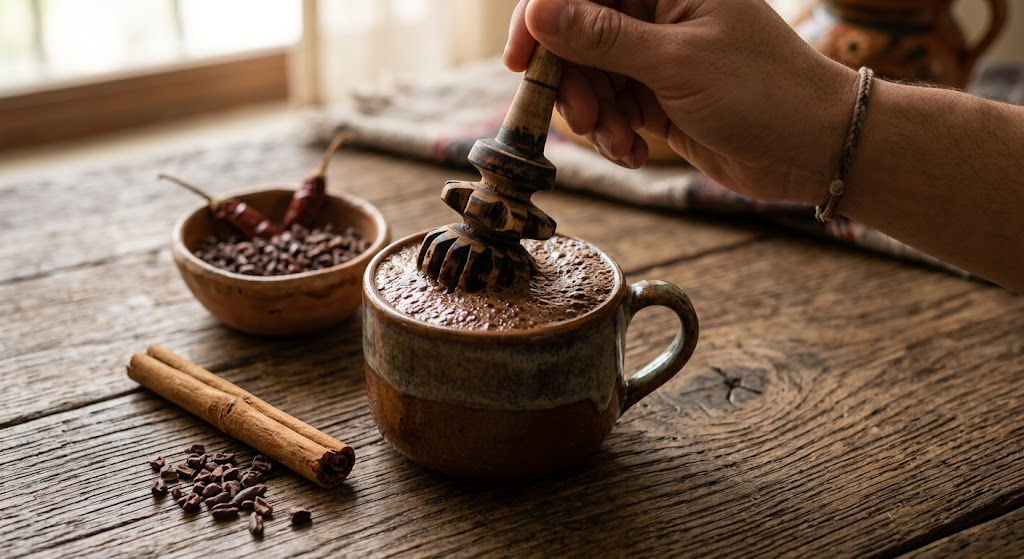
The first time you use a molinillo, you will do it wrong. Almost everyone does. You will grab it like a whisk and stir in circles, and nothing much will happen except a lot of splashing.
Some links in this post are affiliate links. If you buy through them we may earn a small commission at no extra cost to you — it never changes which products we recommend.
The trick is that you do not stir with a molinillo — you spin it. You hold the smooth handle between your flat palms, keep the carved head fully submerged, and rub your palms back and forth so the head spins one way, then the other. The loose carved rings and the fluted grooves drag air down into the chocolate, and within about thirty seconds you get a thick, stable cap of foam that no electric frother produces — because a frother aerates milk, and a molinillo aerates chocolate.
That is the whole case for owning one. It is a five-hundred-year-old tool that does one job better than its modern replacement. If you make Mexican hot chocolate, champurrado or atole more than twice a winter, it earns its counter space, and it is a beautiful object the other ten months. Below are seven worth buying and the honest differences between them. If you would rather go electric, our guide to the best milk frothers for non-dairy milk covers that side.
Our Top 7 Picks for the Best Molinillo
Best Overall: Verve Culture Artisanal Mexican Molinillo, Large 14.5-Inch

The Verve Culture large molinillo is the one to buy if you are only buying one, and the deciding factor is length. At 14.5 inches the handle keeps your hands well clear of a hot pot — which sounds obvious until you have used a 10-inch one over a simmering saucepan and burned your knuckles on the rim.
It is hand-carved from a single piece of wood in Mexico, with the loose rings turned in place rather than assembled from separate pieces. That is the mark of the real thing, and it matters functionally: a large share of “authentic molinillos” sold online are machine-turned generics whose rings barely move. Rings that do not spin do not make foam. These spin.
Key Specifications
- 14.5 inches, hand-carved from a single piece of wood
- Free-spinning turned rings, not assembled
- Made in Mexico by artisan partners
- Traditional fluted grinding head
Pros
- Long enough to keep your hands away from a hot pot
- Documented artisan sourcing rather than anonymous import
- Rings move freely, which is what actually makes the foam
- Good weight and balance for palm-spinning
Cons
- Too long for a single mug — this is a saucepan tool
- Hand wash only, never soak
- Every piece varies slightly in carving
Best Compact: Verve Culture Artisanal Mexican Molinillo, Small 10-Inch

Same maker, same construction, scaled to 10 inches. This is the version to get if you make single mugs rather than a pot for the family, or if a 14-inch wooden object is simply not going to find a home in your kitchen.
It works — the head is the same design and it foams properly — but be realistic about the trade. Ten inches puts your hands closer to the surface, so use a deep mug or a small saucepan rather than a wide, shallow one.
I bought the small one first, because my kitchen is small and I assumed a 14-inch stick would be unwieldy. That was the wrong call. With the short one I had to hold the mug steady with my other hand while my wrist did all the work, and ten seconds in my forearm was complaining. The long one lets you rest the base of the handle in your palm and spin it from the fingers, which is the entire point of the design — and it clears the rim of a tall pot, so you are not steaming your knuckles while you froth.
The small one now lives in a drawer and comes out only for a single cup of coffee. If you are buying one molinillo, buy the long one.
Key Specifications
- 10 inches, hand-carved in Mexico
- Same free-spinning ring construction as the large
- Single-serve and small-batch scale
- Fits in a drawer or utensil crock
Pros
- Small enough to store easily
- Ideal for one or two mugs
- Same artisan construction as the larger version
- Lighter and easier for smaller hands to spin
Cons
- Hands sit close to hot liquid — use a deep vessel
- Not enough reach for a family-sized pot
- Less foam per pass than the 14.5-inch
Best Gift Set: Verve Culture Mexican Molinillo Hot Chocolate Frother Kit

This is the 14.5-inch molinillo sold as a gift kit rather than a bare utensil — it ships in presentation packaging with accompanying material rather than loose in a poly bag. Functionally it is the same tool as our overall pick.
So buy the kit if you are giving it, and buy the bare molinillo if you are keeping it. It is an unusually good present for the kind of cook who already owns a molcajete and a comal, precisely because a molinillo is the piece almost nobody buys for themselves.
Key Specifications
- 14.5-inch artisanal molinillo
- Gift packaging and accompanying material
- Same construction as the standalone large
- Made in Mexico
Pros
- Arrives gift-ready with no extra wrapping needed
- Excellent present for a Mexican-cooking enthusiast
- Full-size 14.5-inch handle and head
- Same artisan quality as the standalone
Cons
- You pay a premium for packaging you will throw away
- No functional advantage over the bare molinillo
- Packaged sets sell out around the holidays
Best Handmade Character: Handmade Molinillo Hot Chocolate Frother, Large

A large hand-carved molinillo whose appeal is precisely that it looks handmade — visible tool marks, slight asymmetry in the carved head, natural colour variation in the wood. If you want a molinillo that reads as an heirloom rather than a product, this is that piece.
The functional consequence of hand-carving is real and worth stating plainly: hand-cut rings vary in how freely they spin, and a tight ring makes less foam. That is the trade you accept for character. If yours arrives tight, working the rings gently by hand for a minute usually frees them.
Key Specifications
- Large hand-carved wooden molinillo
- Handcrafted by Mexican artisans
- Traditional fluted head design
- Natural wood with visible variation
Pros
- Genuine handmade character and variation
- Makes rich foam for chocolate and champurrado
- Beautiful enough to leave out on display
- Supports traditional craft production
Cons
- Ring tightness varies piece to piece
- Unfinished wood needs careful drying after every use
- Sizing and finish are not consistent between units
Best Value Authentic: Premium Wooden Molinillo para Chocolate Mexicano

A straightforward, long-established handmade Mexican molinillo without the brand premium. Construction is the traditional single-piece carve with a fluted head and loose rings — which is the part that actually matters.
This is the sensible pick for a first molinillo, or a second one to keep at a holiday house. As always with wooden kitchen tools, the real differentiator between a good one and a bad one is not price but whether it is carved from one piece. Glued assemblies split at the joint eventually, usually after a season of steam.
Key Specifications
- Handmade in Mexico
- Traditional fluted head with loose rings
- Single-piece wood construction
- Standard full-size handle
Pros
- Real handmade construction without the brand markup
- Long established and consistently available
- Foams chocolate as well as pricier options
- A sensible first molinillo
Cons
- Less documentation about who made it and where
- Plainer finish than the artisan pieces
- Sizing described inconsistently across listings
Best Traditional Craft: Alondra’s Imports Handcrafted Mexican Chocolate Frother

Alondra’s Imports specialises in traditional Mexican housewares, and this molinillo has the more ornate carved detailing you would find in a Mexican market — turned bands, decorative grooving, the full traditional silhouette rather than a simplified export version.
The decorative grooving is not purely cosmetic. Every extra cut edge is another surface shearing the liquid, which is why a properly carved traditional head out-foams a plain turned one. Worth pairing with a batch of tejuino or a pot of champurrado.
Key Specifications
- Handcrafted traditional Mexican molinillo
- Ornate turned and grooved head
- Wooden frother and stirrer in one
- Traditional full-size proportions
Pros
- The most traditional carving detail on this list
- Extra grooving genuinely helps aeration
- Handsome piece to leave on the counter
- Established importer of Mexican housewares
Cons
- More crevices means more careful drying
- Decorative carving can chip if knocked
- Finish varies between individual pieces
Best for Single Mugs: Handmade Molinillo Small Cup Size, Pack of 2

Two small cup-size molinillos in one pack, which turns out to be the practical answer for a household that drinks chocolate rather than ceremonially prepares it. One lives by the kettle, one is in the drying rack, and nobody waits.
These are genuinely mug-scale — too short for a saucepan — so treat them as a companion to a full-size molinillo rather than a replacement for one. They are also the cheapest honest way to find out whether you like using a molinillo at all before committing to a 14-inch artisan piece.
Key Specifications
- Two small cup-size molinillos per pack
- Handmade wooden construction
- Mug and single-serve scale
- Traditional carved head with rings
Pros
- Two for the price of one mid-range molinillo
- Perfect scale for a single mug
- Low-cost way to try the tool before committing
- Easy to store in a utensil jar
Cons
- Far too short for a saucepan — mugs only
- Small heads move less liquid, so expect less foam
- Small handmade pieces vary noticeably in finish
The Ultimate Buying Guide for Molinillos
Why a Molinillo Beats an Electric Frother Here
This is the part most reviews skip. An electric milk frother works by whipping air into milk proteins — it is optimised for milk foam, which is why it is brilliant for a cappuccino. Mexican hot chocolate is a different problem. It contains ground cacao, cinnamon and often masa, and the foam is built from the whole mixture rather than from milk alone. A frother tends to spin the solids to the outside; a molinillo’s rings drag air down through the body of the drink while the fluted head keeps the solids circulating.
It is also the only silent option, and — not nothing — it does not need a charged battery on a holiday morning.
Size: 10-Inch or 14-Inch?
This is the only specification that really changes your experience.
- 14 to 15 inches is the standard and the right default. Long enough to work a full saucepan without your hands over the steam.
- 10 to 11 inches is for single mugs and small kitchens. Genuinely usable, but only in a deep, narrow vessel.
If you are unsure, go long. A long molinillo in a mug is awkward; a short molinillo over a hot pot is a burn risk.
Rings, Grooves and What Actually Makes Foam
Look at the head, not the handle. Three things do the work:
- Loose rings — these must spin freely on the shaft. Pick it up and turn it. If the rings are locked by carving debris or paint, that is a defect, not a design choice.
- Flutes or grooves cut into the head, which shear the liquid as it spins.
- A knob or bulb at the very bottom, which drives circulation from below.
More rings means more aeration, which matters for thick champurrado and matters less for thin chocolate.
Single-Piece Carving vs Assembled
A traditional molinillo is carved from one piece of wood, rings and all — the rings are cut free in place rather than slipped on afterwards. A single carved piece cannot come apart. Glued assemblies eventually split at the joint, usually after a season of steam and drying cycles. If a listing does not say, the giveaway is price: genuine single-piece carving is slow work and is never the cheapest option in a search.
Painted vs Natural
Painted molinillos are traditional and often beautiful, but the paint sits on exactly the part that goes into your drink, and finish quality varies a lot in the unbranded import market. If that bothers you, choose a natural unpainted piece — you lose nothing functionally, and bare wood darkens attractively with use instead of chipping.
Care: The Part That Kills Molinillos
Almost every molinillo that fails does so for the same reason — water.
- Never soak it, and never put it in the dishwasher. Wood swells, the rings seize, and the head cracks.
- Rinse quickly in warm water, use a soft brush in the grooves, and get it out of the water fast.
- Dry it standing head-up, not lying in a drawer. The crevices between the rings hold water, and that is where mould starts.
- Oil it occasionally with food-grade mineral oil if the wood starts looking chalky. Not olive or vegetable oil — those go rancid in the grain.
- Season it before first use with a light wipe of mineral oil, the same way you would a wooden spoon.
If you already care for a matcha whisk, the logic is identical: bamboo and carved wood both die from soaking, not from use.
Technique: How to Actually Use It
- Heat your chocolate, milk or champurrado in a deep, narrow pot — depth is what stops splashing.
- Lower the head fully under the surface. Do not start spinning at the top.
- Put the handle between your flat palms, not in your fist.
- Rub your palms rapidly back and forth so the head spins one direction, then the other.
- Work for 30 to 60 seconds. Lift slightly near the end to pull air in, but keep the head submerged.
If it splashes, your pot is too shallow or your head is too near the surface. It is not a technique problem.
Frequently Asked Questions About Molinillos
What is a molinillo used for besides hot chocolate?
Champurrado (the masa-thickened chocolate drink) and atole are the two other classics, and a molinillo is arguably more necessary for those than for plain chocolate, because they are thick enough that a wire whisk struggles. Some cooks also use one to froth café de olla, and it works on any hot drink you want a head of foam on.
How is a molinillo different from a regular whisk?
A whisk moves through liquid; a molinillo spins in place. A wire whisk incorporates air by dragging thin wires across the surface, which works well for cream but poorly for a dense, solids-heavy chocolate. A molinillo’s grooved head and loose rings shear the liquid from within while the drink circulates around it. The result is a thicker, more stable foam that sits on top rather than collapsing in seconds.
Can you put a molinillo in the dishwasher?
No — and this is the single fastest way to ruin one. Dishwashers combine prolonged soaking with high heat, which swells the carved wood, seizes the loose rings and cracks the head. Rinse in warm water, brush the grooves, and dry it standing up.
Does the number of rings on a molinillo matter?
Yes. Each loose ring is another edge dragging air into the liquid. One or two rings is plenty for thin hot chocolate; three rings aerate thicker drinks like champurrado and atole noticeably better. If you do not know which you will make more of, more rings is the safer buy — it does not hurt thin drinks.
Do I need to season a new molinillo?
It is not strictly required, but a light wipe of food-grade mineral oil before first use helps the bare wood resist absorbing chocolate stains and moisture. Repeat every few months if the wood looks dry or chalky. Avoid cooking oils like olive or vegetable oil, which go rancid in the grain.
Are painted molinillos safe to use?
Molinillos from reputable makers use food-safe finishes, but the painted head does sit in your hot drink, and finish quality varies in the unbranded import market. If you cannot confirm what the finish is, choose a natural unpainted molinillo — you give up nothing functionally.
Final Thoughts
For most people the Verve Culture 14.5-inch molinillo is the right buy: documented artisan sourcing, rings that actually spin, and enough handle to keep your hands off a hot pot. If you work in mugs rather than pots, the 10-inch version does the same job at the right scale, and the two-pack of cup-size molinillos is the cheapest honest way to find out whether you like the tool at all.
Whichever you choose, keep it out of the sink and dry it standing up, and it will outlast every electric frother you will ever own. Then put it to work with a mug of tejuino or a stack of tortillas off a proper comal.
As an Amazon Associate we earn from qualifying purchases. Availability is accurate as of the date of publishing. We do not list prices because they change too often to quote honestly.

Rimi Sultana is a home cook from Bangladesh who has cooked for her family every day for the past five years and writes about it at Smart Cooks. Perpetually testing whether internet-famous recipes actually work in a regular home kitchen. Say hello on Facebook or through the contact page.