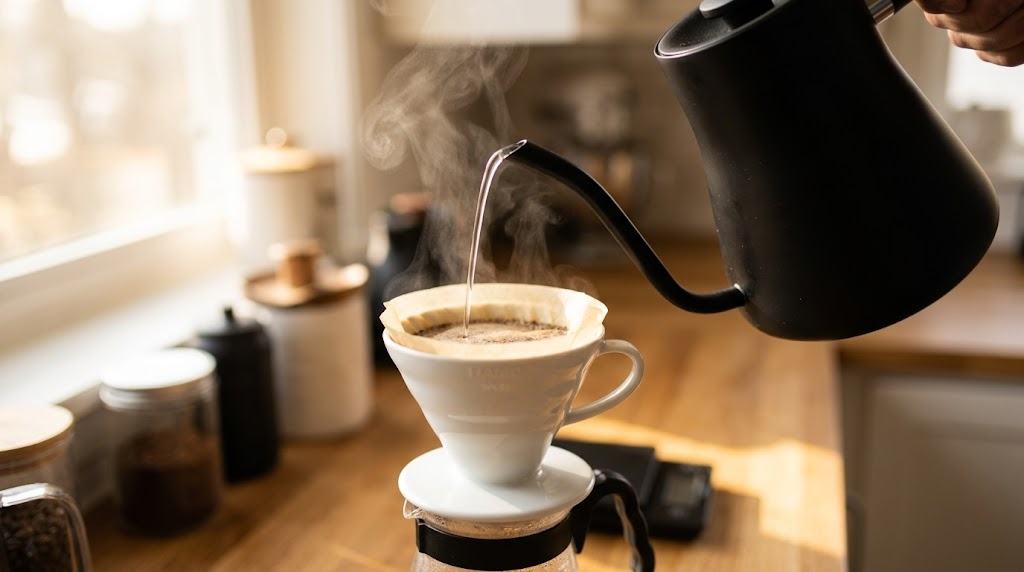
The spout shape isn’t a cosmetic detail — it changes how much control you have over where and how fast water comes out, which matters a lot for some brewing methods and not at all for others.
Some links in this post are affiliate links. If you buy through them we may earn a small commission at no extra cost to you — it never changes which products we recommend.
What Actually Matters
Gooseneck Spouts
The long, narrow, curved spout gives precise control over pour rate and placement, letting you pour in a slow, controlled circular pattern. This precision is specifically valuable for pour-over coffee, where even, controlled saturation of the grounds affects extraction quality.
Standard Spouts
A wider, shorter spout pours faster and with less fine control, which is exactly fine for filling a French press, a teapot, or a mug directly — situations where precise placement doesn’t matter, just getting hot water where it needs to go efficiently.
Temperature Control
Both styles increasingly come with adjustable temperature settings, which matters more for tea (different teas have different ideal steeping temperatures) and delicate pour-over coffee (usually just off boiling) than for something like instant coffee or a French press, where near-boiling water is generally fine.
From My Kitchen: The Gooseneck Kettle I Didn’t Think I Needed
I used a standard kettle for pour-over coffee for a long time and just accepted that my extraction was inconsistent from day to day — sometimes bitter, sometimes weak, without an obvious pattern. Switching to a gooseneck kettle made the actual cause obvious in hindsight: with a standard spout, I’d been unintentionally pouring in an uneven, fast stream that oversaturated some parts of the grounds while barely wetting others. The gooseneck’s controlled, narrow stream let me pour in the slow, even spiral pour-over recipes actually call for, and my results became consistent almost immediately. If you don’t do pour-over coffee, this entire advantage is irrelevant to you — but if you do, it’s a bigger factor than most people expect.
Worth Considering
Greater Goods’ gooseneck electric kettle has reliable temperature control suited to pour-over coffee and tea.
Cosori’s standard electric kettle is a solid, fast-boiling option if precision pouring isn’t part of your routine.
The Spout Is the Whole Difference
A gooseneck kettle exists for one reason: it gives you a slow, narrow, steerable stream. For pour-over coffee that is not a refinement, it is the technique — you are trying to wet the grounds evenly and keep the water level steady, and a standard kettle delivers a wide gush that channels straight through the bed and drains before it has extracted properly. The same applies to anything else where you are pouring onto something rather than into it.
For everything else, a standard kettle is better. It boils faster because the element is larger, it holds more, and it pours quickly when you want a cup of tea rather than a ceremony. Gooseneck kettles typically hold 0.8 to 1 litre, which is enough for two mugs and not enough for a pot of tea for the family — a limitation people discover after buying rather than before.
Quick Comparison
| Gooseneck kettle | Standard kettle | |
|---|---|---|
| Pour control | Slow, narrow, steerable | Fast and wide |
| Pour-over coffee | Essential | Difficult to do well |
| Typical capacity | 0.8–1 L | 1.5–1.7 L |
| Speed to boil | Slower | Faster |
| Everyday tea for several people | Awkward, needs refilling | Ideal |
| Variable temperature | Usually included | Available on better models |
Variable Temperature Is Worth More Than the Spout for Tea
Different teas genuinely want different temperatures, and boiling water ruins several of them. Green tea sits around 75 to 80°C — boiling water makes it bitter and astringent within seconds. Oolong is around 85 to 90°C, white tea around 80, and only black tea and herbal infusions actually want a full 100°C. If you drink green tea and have been wondering why it tastes harsh compared with a teahouse, this is almost certainly why.
Coffee wants 92 to 96°C, which is just off the boil — so a kettle without temperature control is workable if you let it stand for thirty seconds. A hold-temperature function is the genuinely convenient feature, because it means water is ready at the right temperature when you are, rather than needing to be reboiled and cooled again.
Two Kettles Worth Considering
Best for pour-over: Greater Goods Gooseneck Electric Kettle
A properly balanced gooseneck with variable temperature, which is the combination pour-over actually needs. The handle balance matters as much as the spout — a poorly balanced kettle makes a steady slow pour much harder than it should be.
Pros
- Genuine control over pour rate
- Variable temperature for coffee and tea
- Well balanced for slow pouring
Cons
- Around a litre, so not a family tea kettle
- Slower to boil than a standard kettle
Best everyday kettle: Cosori Standard Electric Kettle
Faster, larger and better suited to the way most kettles are actually used. Worth choosing if pour-over is not part of your routine, and worth owning alongside a gooseneck if it is — two kettles is a common and sensible setup.
Pros
- Boils quickly with a large capacity
- Suits household tea and cooking use
- Usually cheaper than a gooseneck
Cons
- Poor control for pour-over coffee
- Not all models offer variable temperature
Frequently Asked Questions
Do I need a gooseneck kettle if I don’t make pour-over coffee?
Not really — the precision pour control is specifically valuable for pour-over and some tea preparation styles. For French press, tea bags, or general hot water needs, a standard kettle does the job just as well.
Does temperature control actually matter for coffee?
Yes, to a meaningful degree — water that’s too hot can over-extract and taste bitter, especially with lighter roasts, while water that’s too cool under-extracts and tastes flat or sour.
Are gooseneck kettles slower to boil than standard ones?
Not inherently — boil speed depends more on wattage and kettle capacity than spout shape. Check the wattage spec directly if boil speed matters to you.
Do I actually need variable temperature?
For black tea, herbal infusions and cooking, no — boiling water is what those want. It becomes genuinely useful if you drink green, white or oolong tea, where boiling water produces measurable bitterness, or if you want coffee water at the right temperature without standing there waiting. If you are choosing between a gooseneck without temperature control and a standard kettle with it, and you drink more tea than pour-over coffee, take the temperature control.
Why does my kettle scale up so quickly?
Hard water. The minerals that cause it precipitate out when water is heated, which is why the deposit forms on the element and the base rather than in the jug. Descale every four to six weeks in a hard water area with a 50-50 solution of white vinegar and water, brought just to a simmer, left for twenty minutes and then rinsed thoroughly two or three times. Scale is not harmful but it insulates the element, so the kettle gets slower and uses more electricity as it builds.
Related: Top 5 electric griddles for pancakes that serve a crowd
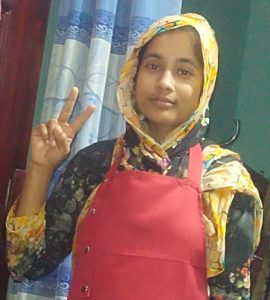
Rimi Sultana is a home cook from Bangladesh who has cooked for her family every day for the past five years and writes about it at Smart Cooks. Perpetually testing whether internet-famous recipes actually work in a regular home kitchen. Say hello on Facebook or through the contact page.