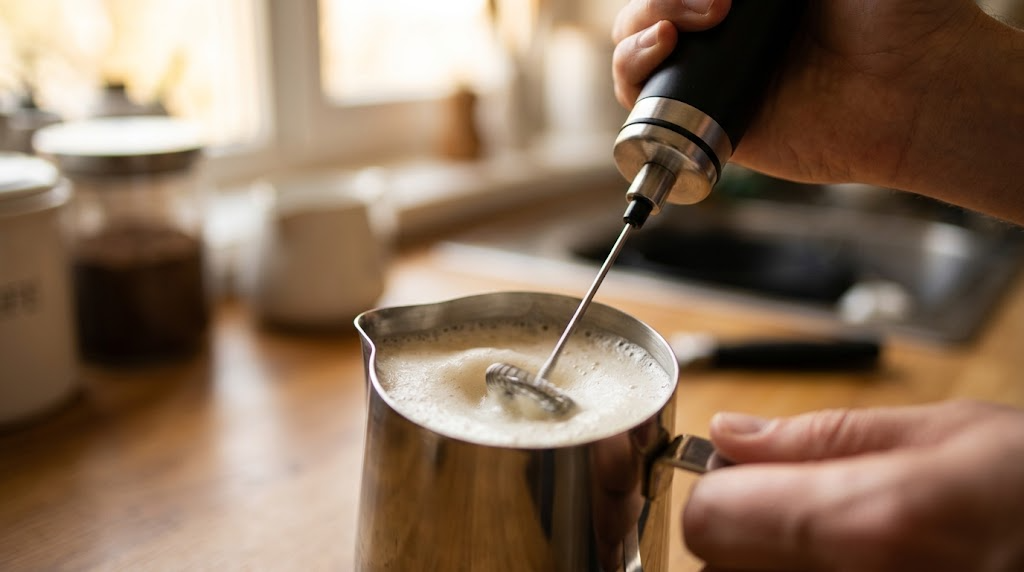
Handheld milk frothers are simple devices, but the ones that fail early almost always fail in the same place — the motor housing where it meets the whisk shaft, from repeated exposure to hot milk and moisture. Knowing what to check for before buying avoids replacing one every few months.
Some links in this post are affiliate links. If you buy through them we may earn a small commission at no extra cost to you — it never changes which products we recommend.
What Actually Matters
Motor Housing Seal
A well-sealed motor housing keeps milk and moisture from seeping into the electronics at the point where the whisk shaft enters the body. This is the single most common failure point in cheap frothers, so a snug, well-fitted seal at that junction is worth checking in reviews before buying.
Whisk Attachment Durability
Some frothers have a detachable whisk head, which is convenient for cleaning but adds a connection point that can loosen or wobble over time. A securely fitted, minimal-play attachment lasts longer under repeated use.
Battery vs. Rechargeable
Battery-powered frothers are simple and don’t need charging, but ongoing battery costs add up with frequent use. Rechargeable models cost more upfront but avoid that recurring expense if you froth milk daily.
From My Kitchen: The Frother That Died From Moisture, Not Wear
My first frother stopped working after only a couple of months, and when I looked closer, the failure wasn’t from the motor wearing out — it was moisture that had worked its way up the whisk shaft into the housing during regular use, since I’d been dipping it fairly deep into hot milk each time. I’ve since learned to keep the froth zone shallow, submerging only the whisk coil itself rather than plunging the whole shaft deep into the cup, which keeps moisture further from the housing seal. A better-sealed frother handles this more forgivingly, but the habit helps regardless of which one you own.
Worth Considering
Zulay Kitchen’s handheld milk frother is a reliable, well-reviewed option with a durable build.
Zulay’s more powerful frother wand is worth it if you froth larger volumes or thicker milk alternatives regularly.
Why Handheld Frothers Fail, and What Lasts
Handheld frothers almost always fail in the same place: where the whisk shaft enters the body. Milk and steam work their way up the shaft into the motor housing, and once moisture reaches the bearing the motor either seizes or starts screaming. This is why the cheapest models often die within months while a better-sealed one runs for years — the difference is not motor power, it is whether the shaft is properly sealed.
The second failure point is the battery compartment. AA-powered frothers left with batteries inside corrode at the contacts, especially in a humid kitchen, and once the contacts are pitted the connection becomes intermittent. A sealed, USB-rechargeable body removes that failure mode entirely. If you are choosing between two similar frothers, the one with a sealed body and a rechargeable battery will almost always outlast the one with a battery door.
Quick Comparison
| Handheld wand | Automatic frothing jug | Steam wand | |
|---|---|---|---|
| Foam quality | Good, airy foam | Good, consistent | Best — true microfoam |
| Heats the milk | No | Yes | Yes |
| Cleaning | Rinse the whisk | Wash the jug | Purge and wipe immediately |
| Counter space | Drawer | Small appliance | Part of the machine |
| Best for | Occasional cappuccino, matcha, hot chocolate | Daily milk drinks without a machine | Latte art and espresso drinks |
Temperature and Milk Matter More Than the Device
Milk foams best between about 60 and 65°C, and it is worth knowing why: the proteins that stabilise the foam start denaturing above roughly 70°C, at which point the foam collapses and the milk itself starts to taste cooked and faintly sweet in an unpleasant way. If your frothed milk tastes off, overheating is the most likely reason — not the frother.
Milk choice does most of the rest. Whole dairy milk foams most reliably because it has both the protein for structure and the fat for texture. Skimmed milk produces a bigger, stiffer foam that collapses faster. Among plant milks, only oat and soy formulated specifically as barista versions foam well, because they have added protein and stabilisers — standard oat milk will disappoint no matter what device you use.
Two Frothers Worth Considering
Best everyday frother: Zulay Kitchen Handheld Milk Frother
The standard against which cheap frothers are judged — a properly sealed shaft, a stainless whisk and enough speed to aerate milk in twenty seconds. It also handles matcha and hot chocolate, which is where most households actually use one daily.
Pros
- Sealed shaft resists the usual failure point
- Fast enough to foam milk in seconds
- Also excellent for matcha and drinking chocolate
Cons
- Does not heat the milk
- Whisk should be rinsed immediately after use
Best for thicker foam: Zulay Powerful Frother Wand
More motor speed means denser foam and less time holding the wand in the jug, which matters if you are making two or three drinks in a row. Worth the step up if you drink cappuccinos rather than occasional lattes.
Pros
- Denser, longer-lasting foam
- Quick enough for several drinks in a row
- Solid build for a handheld
Cons
- Still no heating function
- Higher speed splashes if you start too high in the jug
Frequently Asked Questions
How deep should I submerge a frother in milk?
Only the whisk coil itself needs to be submerged — going deeper than that doesn’t improve frothing and increases the risk of moisture reaching the motor housing over time.
Can I froth plant-based milk with a handheld frother?
Yes, though results vary by milk type — oat and soy milk tend to froth well, while some almond milks froth less readily due to lower protein content.
Why did my frother suddenly stop working?
Moisture reaching the motor housing is the most common cause of early failure, especially if the whisk shaft has been submerged deeper than the coil during regular use.
Why will my oat milk not foam?
Because standard oat milk lacks the protein and stabilisers that hold a foam together. Barista-formulated oat milks are a different product — they have added protein and often a small amount of oil and acidity regulator specifically so they can be foamed and will not split in hot coffee. If your oat milk foams briefly and then collapses into liquid within thirty seconds, it is the milk, not the frother.
Why does my foam collapse so quickly?
Usually because it is froth rather than foam — large, loose bubbles rather than fine ones. Keep the whisk just below the surface for the first few seconds to draw air in, then sink it slightly to fold that air through the milk rather than continuing to pull more in. Then tap the jug firmly on the counter and swirl it before pouring; that breaks the biggest bubbles and produces a texture that holds together for minutes rather than seconds.

Rimi Sultana is a home cook from Bangladesh who has cooked for her family every day for the past five years and writes about it at Smart Cooks. Perpetually testing whether internet-famous recipes actually work in a regular home kitchen. Say hello on Facebook or through the contact page.