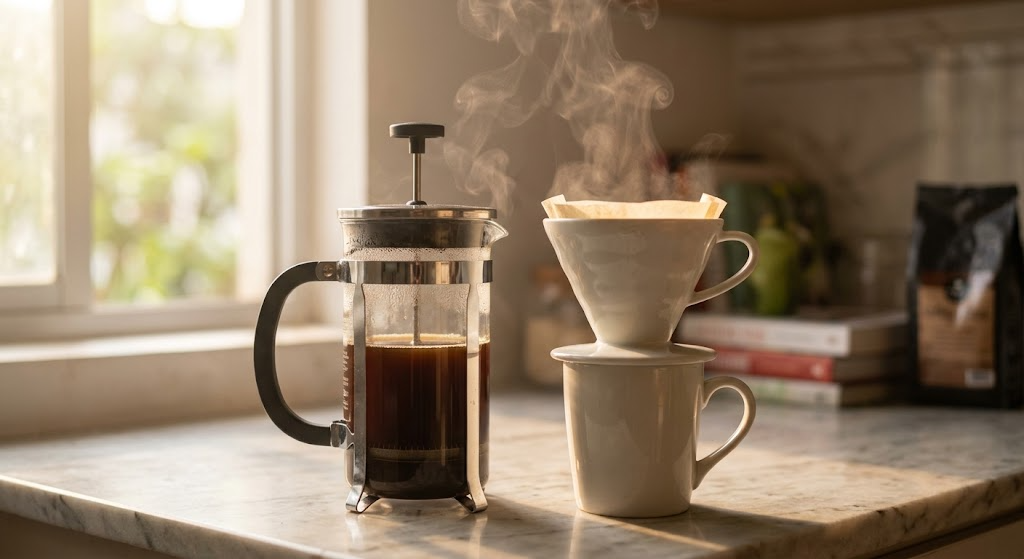
Both are manual brewing methods that avoid the plastic and descaling headaches of an electric drip machine, but they produce genuinely different cups of coffee and demand different amounts of hands-on attention. The choice comes down to what kind of coffee you actually prefer and how much of a ritual you want your morning to be.
Some links in this post are affiliate links. If you buy through them we may earn a small commission at no extra cost to you — it never changes which products we recommend.
How They Actually Differ
French Press
Coffee grounds steep directly in hot water for several minutes before being separated by a mesh plunger. This full immersion method extracts more oils and fine particles, producing a fuller-bodied, heavier cup with some natural sediment at the bottom — a texture some people love and others find gritty.
Pour-Over
Water passes through grounds and a paper (or metal mesh) filter in a controlled, steady pour, extracting flavor as it drips through rather than steeping. This produces a cleaner, brighter cup with more clarity between flavor notes, since the paper filter especially catches oils and fine sediment the French press lets through.
Where Each One Wins
- French press wins on body and richness — if you like a heavier, more full-bodied cup, it delivers that more reliably than pour-over.
- Pour-over wins on clarity and brightness — if you’re drinking a coffee with distinct flavor notes you want to actually taste separately, pour-over usually shows them better.
- French press wins on simplicity — steep, plunge, pour, with less technique-sensitivity than a good pour-over pour.
- Pour-over wins on precision control — you can adjust pour speed and pattern to fine-tune extraction in ways a French press doesn’t allow.
- French press wins on batch size — most models handle multiple cups at once more easily than a single pour-over cone.
From My Kitchen: Why I Keep Both Instead of Picking One
I tried to settle on just one method for a while, assuming I was overcomplicating my morning routine by owning both. What I found is that they’re genuinely suited to different moods and different coffee — a rich, dark roast tastes better to me in the French press, where its bold body comes through, while a lighter, more acidic single-origin coffee tastes noticeably better and more distinct through a pour-over, where the cleaner extraction lets those subtler notes actually show up instead of getting muddied by the extra oils and sediment. If you only drink one style of coffee consistently, picking the method suited to that style makes sense. If your coffee varies, the method probably should too.
Worth Considering
Secura’s insulated stainless steel French press is a sturdy, well-built option that also keeps coffee hotter longer than glass.
The classic Chemex pour-over is a well-regarded, iconic option if you want to try pour-over brewing properly.
Immersion Versus Percolation
A French press is full immersion — the grounds sit in all of the water for the entire brew, then a metal mesh separates them at the end. Pour-over is percolation: water passes through the bed once and drains away, taking soluble compounds with it as it goes. That structural difference produces two genuinely different cups from the same beans, and neither is a lesser version of the other.
The metal filter is the other half of the story. Mesh lets coffee oils and very fine particles through, which gives a French press its heavy, rounded body and a little sediment at the bottom of the cup. Paper filters trap both, producing a cleaner, more transparent cup where the acidity and individual flavour notes come through more distinctly. If you have ever wondered why your filter coffee tastes bright and your press coffee tastes rich, that is the filter talking.
Quick Comparison
| French press | Pour-over | |
|---|---|---|
| Body | Heavy, oily | Clean, light |
| Clarity of flavour notes | Muted by body | Distinct and bright |
| Sediment | Some, by design | None |
| Grind | Coarse | Medium |
| Hands-on time | Minimal — steep and plunge | Continuous 3-minute pour |
| Equipment needed | The press | Dripper, filters, ideally a gooseneck kettle |
Effort Is the Deciding Factor for Most People
A French press is genuinely low effort: grind, add water, wait four minutes, plunge. You can walk away in the middle. Pour-over asks for three minutes of continuous attention, a steady slow pour, and ideally a gooseneck kettle and a scale to do well. Neither is difficult, but one fits a rushed morning and the other does not.
The flip side is control. Pour-over gives you variables to adjust — pour rate, bloom time, how the water is distributed — which means you can improve at it and tune a cup to a particular bean. A French press gives you grind size and time, and then it is what it is. People who enjoy the ritual gravitate to pour-over for exactly the reason people in a hurry avoid it.
Two Options Worth Considering
Best French press: Secura Insulated Stainless Steel French Press
Stainless and insulated solves the two practical problems with a classic glass press: it does not shatter, and the coffee stays hot rather than cooling in the carafe. Still decant after plunging, since insulated or not, coffee left on the grounds keeps extracting.
Pros
- No risk of breakage
- Keeps coffee hot after plunging
- Simple, nothing to run out of
Cons
- You cannot see the brew through the walls
- Mesh needs dismantling to clean properly
Best pour-over: The Classic Chemex
The thick Chemex filters produce an exceptionally clean cup, which is the clearest expression of what pour-over does differently. It is also a brewer that looks good enough to serve from, which is part of why it has lasted.
Pros
- Very clean, clear cup
- Brews and serves in one vessel
- Thick filters remove oils and fines completely
Cons
- Needs proprietary filters
- Requires a steady pour, ideally a gooseneck kettle
Frequently Asked Questions
Which method is easier for a beginner?
French press is generally more forgiving — steeping time matters, but there’s less technique sensitivity than the steady, even pour that a good pour-over cup depends on.
Does French press coffee really have more caffeine?
Not dramatically — caffeine extraction depends more on grind size, water temperature, and brew time than the method itself, though French press’s longer steep can extract slightly more overall.
Why does my French press coffee taste gritty?
This is usually a grind size issue — French press needs a coarse grind, since fine grounds slip past the mesh plunger and end up in the cup as sediment.
Which method is better for dark roasts?
French press, usually. Dark roasts have less delicate acidity to showcase and more body-forming oils, which the mesh filter lets through — the result is rich and rounded. Pour-over’s clarity tends to expose the bitterness in a very dark roast rather than flattering it. The reverse holds for light, fruity roasts, where pour-over lets the acidity and fruit notes come through clearly and a press can muddy them.
Is the sediment in French press coffee a problem?
Only aesthetically. It is simply very fine coffee particles that pass through the mesh, and it is part of what gives the method its body. If it bothers you, three things reduce it: grind coarser, plunge slowly and stop at the surface of the grounds rather than compressing them, and pour the last centimetre out or leave it behind. Decanting the whole brew into a separate jug after plunging also lets the finest particles settle out.
Related: Drip coffee maker vs French press: Brewing methods and flavour differences explained

Rimi Sultana is a home cook from Bangladesh who has cooked for her family every day for the past five years and writes about it at Smart Cooks. Perpetually testing whether internet-famous recipes actually work in a regular home kitchen. Say hello on Facebook or through the contact page.