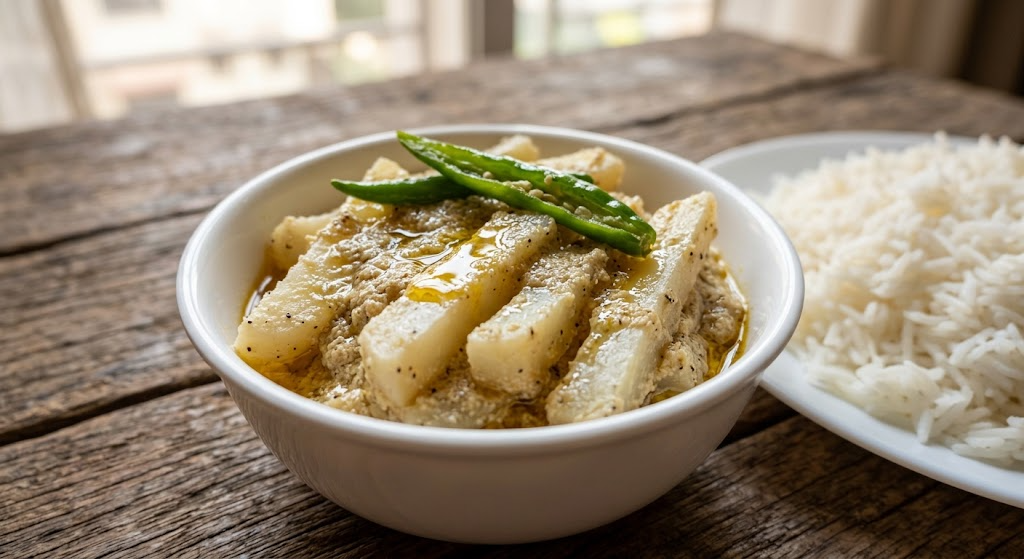
Prep time: 30 min (mostly soaking) | Cook time: 20 min | Serves: 4 | Serve with: plain rice and a thin dal
Aloo posto is four ingredients doing almost nothing, and it is one of the hardest simple dishes to get right. Potatoes, poppy seed paste, mustard oil, green chilli. No onion, no garlic, no tomato, nothing to hide behind. When it works, the posto coats every piece of potato in something creamy and faintly bitter-sweet that tastes like almost nothing else in Indian cooking. When it does not work, it is gritty potatoes in wet sand.
The difference is entirely in the grinding, which is the part most recipes cover in four words.
About Posto (and What You Cannot Substitute)
Posto is white poppy seed. In the West it is expensive and often sold in small packets in South Asian grocery shops, which is worth knowing before you plan a dinner around it.
The blue-black poppy seed sold in most Western supermarkets for baking is not a substitute. It is a different variety, and it will give you a grey dish with a nuttier, harsher flavour that is nothing like posto. If white poppy seed is genuinely unavailable, make a different dish rather than this one with the wrong seed.
Ingredients
- White poppy seeds (posto) – 4 tbsp
- Potatoes – 500 g, peeled and cut into batons about the size of your little finger
- Green chillies – 3 (one goes into the paste, two are slit and added whole)
- Nigella seeds (kalonji / kalojeere) – ½ tsp
- Turmeric – ¼ tsp
- Mustard oil – 3 tbsp, plus 1 tsp raw for finishing
- Salt – to taste
- Sugar – ½ tsp
- Warm water – for soaking and grinding
Equipment
- A small grinder jar — the chutney jar of a mixer grinder, not the large one. This matters more than any other piece of equipment here.
- A kadai or heavy frying pan with a lid
- A fine sieve, if your paste comes out coarse
Method
- Soak the posto. Cover the poppy seeds with warm water and leave them for at least 30 minutes. An hour is better. Dry-grinding unsoaked posto is the single most common reason the dish turns out gritty.
- Grind. Drain most of the water. Put the posto in a small grinder jar with one green chilli, a pinch of salt, and 2–3 tablespoons of fresh water. Grind in short bursts, scraping down the sides, until you have a smooth, thick, pourable paste. The salt and chilli give the blades something to catch on — posto alone just spins.
- Check the texture. Rub a little between your fingers. If it still feels sandy, grind again with a splash more water. If it refuses to go smooth, push it through a fine sieve.
- Start the potatoes. Heat the mustard oil until it just smokes, then lower the heat. Add the nigella seeds and the two slit green chillies. Wait for the seeds to crackle.
- Fry. Add the potatoes, turmeric and salt. Fry on medium heat for 6–8 minutes, turning them so the edges pick up some colour. You are not cooking them through yet, just building a surface.
- Steam them soft. Add about ½ cup of hot water, cover, and let the potatoes cook until a knife goes through easily — roughly 10 minutes. Most of the water should be gone by the end.
- Add the posto. Lower the heat. Stir in the paste and the sugar and cook for 3–4 minutes, stirring gently, until the paste thickens and starts to cling to the potatoes and pull away from the pan. Do not cook it hard or long — posto turns bitter with too much heat.
- Finish. Take it off the heat and drizzle over the raw teaspoon of mustard oil. Cover for two minutes. Serve warm, not hot, with plain rice.
From My Kitchen
The grinder is the whole battle. Four tablespoons of posto in a standard mixer jar simply does not work — the quantity is too small for the blades to reach, so it flies up the sides and sits there while the motor runs and heats it up. I spent a long time thinking my posto was bad quality when the real problem was jar size. Use the smallest jar you own, add a green chilli and a pinch of salt for friction, and use only a little water at a time.
If you have access to a shil nora — the flat grinding stone — it does produce a noticeably better paste. Stone grinding crushes rather than chops, and the result is creamier and does not heat up. Almost nobody keeps one now, mine included, and I want to be honest that a small grinder jar plus soaking gets you most of the way there. The stone is better; it is not the difference between a good dish and a bad one.
One more thing I got wrong early on: I used to cook the posto for as long as I would cook any other masala, five or six minutes on a decent flame, thinking it needed to lose its raw taste. It does not. Posto is bitter by nature and heat brings that bitterness forward. Three or four minutes on low, just until it thickens, and then off the heat.
On the onion question — some Bangladeshi households add sliced onion, and Ghoti households in West Bengal generally do not. I grew up with the version without. Both are real, and anyone who tells you one is inauthentic is describing their own family, not the dish.
Adjusting to Taste
- Creamier: add a tablespoon of grated coconut to the grinder along with the posto.
- Hotter: grind a second green chilli into the paste rather than adding more whole ones — ground chilli spreads its heat through the dish instead of sitting in pockets.
- Different vegetables: the same method works for jhinge (ridge gourd), potol (pointed gourd), or plain thinly-sliced onion. Reduce the steaming step for the softer vegetables.
- The finishing drizzle of raw mustard oil is doing real work. It puts back the sharpness that cooking burned off. Skip it and the dish tastes muted.
Storage
Aloo posto is best the day it is made. It keeps for 2 days refrigerated, but the paste tightens and dulls, and reheating pushes the posto further towards bitterness. If you must reheat, do it gently with a splash of water and a few drops of fresh mustard oil at the end. It does not freeze.
FAQ
Why is my aloo posto bitter?
Usually heat. Poppy seed carries a natural bitterness that intensifies when it is cooked hard or long, so the paste goes in near the end and cooks briefly over low heat. The other cause is a grinder that heats the seeds while struggling with a small quantity — short bursts with rest in between help.
Can I use blue poppy seeds instead of white?
No. They are a different variety with a stronger, nuttier flavour, and they will turn the dish grey. White poppy seed is worth seeking out at a South Asian grocery or ordering online.
Do I have to soak the poppy seeds?
If you want a smooth paste, yes. Poppy seeds are hard and tiny, and dry grinding at home rarely breaks them down completely. Thirty minutes in warm water is the minimum; an hour is better.
Is aloo posto supposed to be dry or saucy?
Dry to just-coating. The finished dish should look like potatoes wearing a thick pale jacket, with no loose liquid in the pan. If it is watery, the paste has not been cooked long enough; if it is stiff, add a spoonful of hot water.
Getting the poppy seeds into a truly smooth paste is what makes or breaks aloo posto — a proper wet grinder makes it far easier than a mortar and pestle. See our guide to the best mixer grinders for Indian cooking for which models handle this kind of wet grinding well.

Rimi Sultana is a home cook from Bangladesh who has cooked for her family every day for the past five years and writes about it at Smart Cooks. Perpetually testing whether internet-famous recipes actually work in a regular home kitchen. Say hello on Facebook or through the contact page.