As an Amazon Associate, Smart Cooks earns from qualifying purchases. Product prices and availability are shown on Amazon and may change.
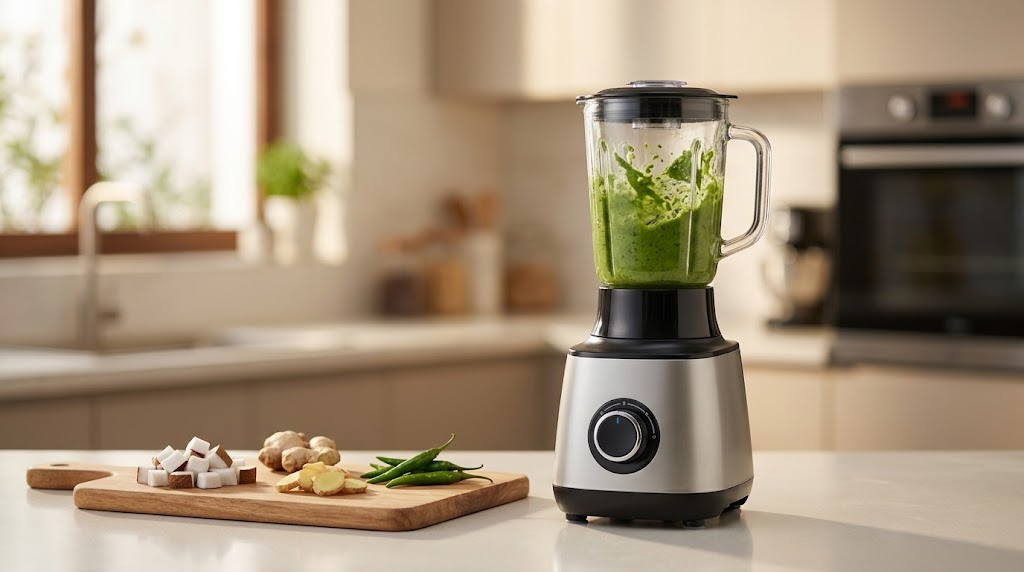
A Western blender and an Indian mixer grinder look like the same appliance and are not. A blender is built to move liquid around a vortex. A mixie is built to grind a stiff, nearly dry paste — soaked dal, wet coconut, ginger and garlic, chutney with barely a spoon of water — against the walls of a small jar. Ask a high-end blender to make coconut chutney with the correct amount of water and it will spin uselessly above the load.
Some links in this post are affiliate links. If you buy through them we may earn a small commission at no extra cost to you — it never changes which products we recommend.
If you are cooking South Asian food outside South Asia, this is usually the appliance that closes the gap between what you make and what you remember.
The 110V Problem, Explained Properly
This is the part that costs people money, so it is worth being precise about.
Mixies sold in India run on 220–240V at 50Hz. North American mains are 110–120V at 60Hz. A step-up transformer fixes the voltage. It does not fix the frequency.
Run a 50Hz induction motor on 60Hz and it spins roughly 20% faster than designed. The motor runs hotter, the bearings wear faster, and the burnout that follows is not covered by any warranty — assuming the warranty was valid outside India in the first place, which it generally is not.
- Buy a model built for 110V/60Hz if you are in the US or Canada. Several Indian brands make them specifically for this market.
- Transformers are a compromise, not a solution. They work, for a while, and they add a heavy box to your counter.
- Check the plate, not the listing. Some listings say “110V” for a unit shipped with a transformer in the box. That is not the same thing.
- Warranty service matters more than for most appliances, because mixie jars, couplers and blades are consumable parts. A brand with a North American service presence is worth paying for.
Our Top 7 Picks for the Best Mixer Grinder
Best Overall: Preethi Blue Leaf Platinum 550W, 3 Jar (110 Volts)

Preethi is the brand most South Indian kitchens name first, and the Blue Leaf Platinum is the model that has held that reputation longest. Built for 110V, so no transformer and no frequency problem.
Three jars covers the real range of work: a large jar for batter and large volumes, a medium for masala and gravy bases, and a small chutney jar for the spoonful-sized grinds that a blender cannot do at all. That small jar is the one you will use most often and the reason a mixie beats a blender for this cooking.
550 watts is the sensible middle. It is enough for soaked dal and wet coconut, and Preethi’s motors are geared for torque at low speed rather than headline wattage, which is what actually matters when the load is stiff.
Pros
- Genuinely built for 110V/60Hz — no transformer needed
- Three jars cover chutney through batter
- Strong reputation for motor longevity
- Jars and spares are readily available
Cons
- Loud, as all mixies are
- Plastic jar lids are the usual first thing to wear
- Not a substitute for a stone wet grinder on large batter batches
Best Value: Preethi Eco Plus Mixer Grinder (110 Volts, USA/Canada)
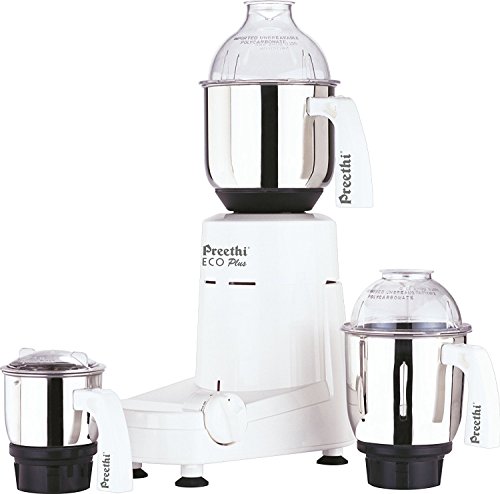
The Eco Plus is the entry point into Preethi’s 110V range and it is a straightforward, honest machine. Same motor philosophy, fewer refinements, lower price.
For a household of one or two, or for anyone who wants to find out whether a mixie changes their cooking before spending more, this is the sensible starting point.
What you give up against the Blue Leaf is mostly jar quality and a slightly less refined coupler design. The grinding performance on chutney and masala is close enough that most people would not identify it blind.
Pros
- True 110V build for North America
- Noticeably cheaper than the Platinum line
- Same reliable Preethi motor approach
- Compact on a small counter
Cons
- Fewer jars than the larger sets
- Jar and lid finish is more basic
- Smaller capacity limits batch size
Best for Large Households: Preethi Eco Plus 4 Jar (110 Volts)

The fourth jar is usually a juicer or an additional wet jar, and its real value is that it stops the constant wash-and-reuse cycle when you are cooking a full meal.
Grinding a masala, then a chutney, then a batter in one session with three jars means washing between each. With four you can stage the work and clean at the end, which for weekend cooking is a genuine time saving.
The same 110V build applies, and it remains the reason to buy this rather than importing a 220V machine.
Pros
- Four jars mean less washing mid-cook
- Built for 110V/60Hz
- Good for cooking full multi-dish meals
- Well-proven Preethi platform
Cons
- Takes up meaningfully more storage space
- Costs more than the 3-jar version
- More parts to keep track of
Best Stainless Jars: Preethi Steele 3-Jar, 550W

Stainless jars instead of the usual polycarbonate. For anyone who grinds a lot of turmeric-heavy masala or ginger-garlic, this is not a cosmetic preference — plastic jars stain permanently and hold smells that survive washing.
Steel jars are also more forgiving of hot ingredients. Grinding warm roasted spices or a hot gravy base in a plastic jar is something manufacturers advise against; steel handles it.
The trade-off is that you cannot see the grind progressing, so you will open the lid to check more often than you would with a clear jar.
Pros
- Steel jars do not stain or retain odour
- Tolerates warm ingredients better than plastic
- Same proven 550W Preethi motor
- More durable jars over the long term
Cons
- Cannot see the contents while grinding
- Heavier jars to lift and wash
- Costs more than the plastic-jar equivalents
Best Everyday Preethi: Blue Leaf 3-Jar, 550W

The standard Blue Leaf sits just below the Platinum and is the model a great many households actually run. Three jars, 550 watts, and the same motor family.
If the Platinum is out of stock or out of budget, this is not a step down in any way you will notice day to day. The differences are in jar finish and small design details rather than grinding capability.
As with every model in this list, confirm the voltage on the specific listing before ordering — Preethi sells both 220V and 110V versions of similar-looking machines.
Pros
- Proven everyday workhorse
- Three jars including a proper chutney jar
- Good torque for stiff, low-water grinding
- Widely available with spare parts
Cons
- Check the listing carefully for voltage
- Plastic jars stain with turmeric
- Loud under heavy load
Most Powerful: BOSS Excel Pro 3-Jar, 750W

Seven hundred and fifty watts with variable speed control, for anyone who regularly grinds in quantity or works with genuinely hard loads — dried spices in bulk, large batches of ginger-garlic paste, coconut in volume.
Extra wattage matters less than people assume for everyday chutney, where torque at low speed and jar geometry do most of the work. Where it does matter is sustained grinding: a higher-rated motor runs cooler doing the same job, and heat is what kills mixies.
Variable speed is genuinely useful for wet grinding, where starting slow stops the load climbing the jar walls before the blades catch it.
Pros
- 750W handles heavy and sustained loads
- Variable speed helps with wet grinding
- Runs cooler on long grinds than 500W machines
- Three jars included
Cons
- Overpowered for small daily chutney
- Larger footprint
- Less established service network than Preethi in North America
Best for Idli & Dosa Batter: Premier Compact Table Top Wet Grinder, 2 L (110V)
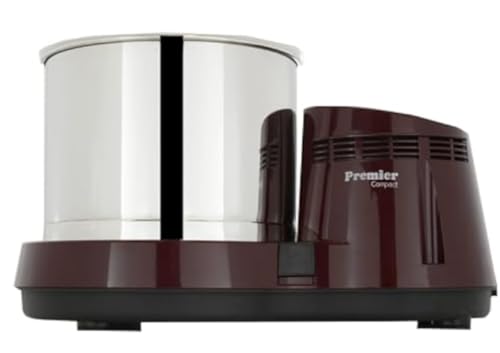
This is a different machine, and if idli and dosa are a regular part of your cooking it is the one that changes the result most.
A wet grinder uses rotating granite stones to crush soaked rice and dal slowly, with almost no heat. A mixie uses fast blades that chop and warm the batter as they go. The batter from a stone grinder is smoother, holds more air, and ferments better — which is why idli from a wet grinder is fluffier in a way that is immediately obvious.
Be honest with yourself about frequency, though. This is a bulky, heavy, single-purpose machine that takes 20–30 minutes per batch. If you make idli twice a year, a mixie is fine. If you make it most weeks, this is the upgrade.
Pros
- Noticeably better idli and dosa batter than any mixie
- Stones grind without heating the batter
- 2 L handles a proper family batch
- 110V, plus atta kneader and coconut scraper attachments
Cons
- Large, heavy and effectively single-purpose
- Each batch takes 20–30 minutes
- Stones need care and occasional dressing
- Not a mixie replacement — it does not do dry grinding
From My Kitchen
I spent an embarrassing amount of time trying to make coconut chutney in a good Western blender before accepting that the machine was not the problem in the way I thought. It was jar geometry. A blender jar is wide at the bottom and tapers up, which is right for liquid and completely wrong for a thick paste that needs to be pushed back down into the blades. A mixie chutney jar is narrow and straight-sided, so the load has nowhere to escape to. Adding more water made the blender work and made the chutney wrong.
On the transformer question — I know several people who imported a 220V mixie and ran it on a step-up transformer, and every single one of them eventually had the motor fail. Not immediately; typically after a year or two, which is long enough that they did not connect the two things. The frequency difference is invisible and it is doing damage the whole time. If you are choosing now, buy the 110V version even if it costs more, because the transformer route costs more in the end.
The small chutney jar is the part I would not give up. It is the only jar in my kitchen that will grind two tablespoons of anything — a spoon of soaked mustard, a bit of ginger and garlic, a small batch of posto — without the load flying up the sides out of reach of the blades. If you are comparing models, count the jars and look hard at the smallest one.
FAQ
Can I use an Indian mixer grinder in the USA with a transformer?
A step-up transformer handles the voltage difference but not the frequency one. A 50Hz motor running on 60Hz spins about 20% faster than designed, which makes it run hot and shortens its life, and the failure will not be covered by warranty. Buying a model built for 110V/60Hz is the more economical choice over any reasonable time frame.
How many watts do I need in a mixer grinder?
500–600W is comfortable for normal home cooking. Higher wattage mainly helps with sustained heavy grinding, where a bigger motor runs cooler doing the same work. Torque at low speed and jar design matter more than the headline number for everyday chutney and masala.
Is a mixer grinder the same as a blender?
No. A blender is built to move liquid; a mixie is built to grind thick, low-water pastes in a narrow jar. A blender cannot make proper coconut chutney without adding too much water, and it cannot grind two tablespoons of anything.
Do I need a wet grinder as well?
Only if you make idli or dosa batter regularly. Stone wet grinders produce smoother, better-aerated batter that ferments more reliably, but they are bulky, slow and single-purpose. For occasional batter, a mixie is adequate.
Why do mixer grinder jars crack?
Usually thermal shock or overfilling. Do not grind hot ingredients in polycarbonate jars, do not fill past the marked line, and give the motor a rest between long grinds. Steel-jar models are more forgiving on all three counts.

Rimi Sultana is a home cook from Bangladesh who has cooked for her family every day for the past five years and writes about it at Smart Cooks. Perpetually testing whether internet-famous recipes actually work in a regular home kitchen. Say hello on Facebook or through the contact page.