As an Amazon Associate, Smart Cooks earns from qualifying purchases. Product prices and availability are shown on Amazon and may change.
A meat thermometer is supposed to remove the guesswork from cooking — except when it’s slow, inaccurate, or just wrong, in which case it adds a false sense of confidence to an undercooked chicken breast. Not all thermometers are built the same, and the differences matter more than the price tag suggests.
Some links in this post are affiliate links. If you buy through them we may earn a small commission at no extra cost to you — it never changes which products we recommend.
What Makes a Thermometer Trustworthy
Response time
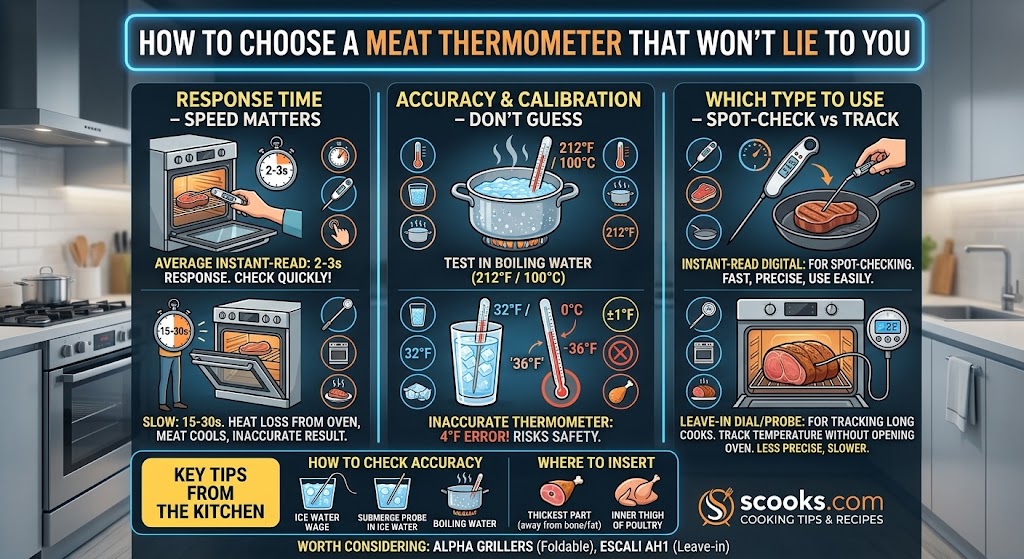
A genuinely fast instant-read thermometer reads within 2-3 seconds. Slower ones can take 15-30 seconds, during which you’re holding an oven door open or letting a steak rest on the counter losing heat — and the reading you get may already be inaccurate by the time it stabilizes.
Calibration and accuracy
Look for a stated accuracy of ±1°F or better. Cheap thermometers can drift several degrees off over time, especially after being dropped, which matters a lot at the boundary between medium-rare and well-done, or between safely-cooked poultry and undercooked poultry.
Instant-read vs. leave-in dial
Instant-read digital thermometers are for spot-checking — you insert, read, and remove. Leave-in dial or probe thermometers stay in the meat throughout cooking, which is useful for large roasts or turkey where you want to track temperature rise without opening the oven repeatedly, but they’re generally less precise and slower to respond than a good digital instant-read.
From My Kitchen
I used a bargain thermometer for a long time that I later found out was reading about 4 degrees low after I checked it against a pot of boiling water (which should read 212°F at sea level). That’s the kind of error that quietly turns a properly cooked chicken thigh into an undercooked one on paper being fine, while actually sitting right at the edge of unsafe. Now I check any thermometer I own against boiling water or ice water occasionally, and it’s changed how much I trust the reading rather than just the number on the display.
Worth Considering
For fast, accurate spot-checks, the Alpha Grillers Instant Read Meat Thermometer has a genuinely quick 1-2 second response and a foldable probe for easy storage. If you’d rather track temperature through a long roast without opening the oven, the Escali AH1 oven-safe dial thermometer can stay in the meat the whole time it cooks.
Accuracy, Speed and Where Thermometers Actually Lie
A thermometer lies in two ways. It can be inaccurate — reading a consistent few degrees off — or it can be slow, showing you a number that was true several seconds ago while the reading is still climbing. The second is more dangerous in practice, because a slow thermometer pulled out too early always under-reads, and under-reading on poultry is the one error with a genuine safety consequence.
Probe placement compounds it. A probe touching bone reads the bone, which conducts heat differently to muscle, and a probe that has gone all the way through into the pan reads the pan. The reading you want comes from the thickest part of the muscle with the tip sitting in the middle of it — which means inserting, watching the number fall as you pass the centre, and reading at the lowest point.
Quick Comparison
| Instant-read digital | Oven-safe dial | Leave-in probe with alarm | |
|---|---|---|---|
| Response time | 2–5 seconds | Slow, up to a minute | Continuous |
| Stays in during cooking | No | Yes | Yes |
| Accuracy over time | Good, often calibratable | Drifts and needs recalibrating | Good |
| Best for | Checking anything, anywhere | Roasts you do not want to open the oven for | Large roasts and smoking |
| Cost | Low to moderate | Low | Moderate |
Calibration Takes Two Minutes
Every thermometer should be checked before you trust it. Fill a glass with crushed ice, top with water, stir, and let it sit for a minute: it should read 0°C. Or use boiling water, which should read 100°C at sea level. If it is off by more than a degree or so, either recalibrate it — most dial thermometers have a nut under the dial for exactly this — or note the offset and correct for it mentally.
Worth knowing alongside that: carryover cooking. A roast pulled at its target temperature will continue rising by several degrees while it rests, which means the correct moment to take it out is below the number you actually want. For a large joint that can be five degrees or more. A thermometer that reads accurately is only half of it; knowing to pull early is the other half.
Two Thermometers Worth Considering
Best instant-read: Alpha Grillers Instant Read Meat Thermometer
Fast enough that the reading settles before the oven door has been open long, which is the main practical requirement. Calibratable, which matters because a thermometer you cannot check is a thermometer you cannot trust after a year.
Pros
- Reads in a few seconds
- Calibratable, so accuracy can be maintained
- Small enough to keep in a drawer by the hob
Cons
- Cannot stay in during cooking
- Battery powered
Best leave-in option: Escali AH1 Oven-Safe Dial Thermometer
Stays in the joint through the whole roast so you are not opening the oven to check, which costs heat every time. Slower than a digital instant-read, but for a large roast where the temperature climbs gradually that matters far less.
Pros
- Stays in the oven, no door opening
- No batteries to fail mid-roast
- Simple and durable
Cons
- Slow to respond compared with digital
- Dial can drift and needs recalibrating
Frequently Asked Questions
How do I check if my thermometer is accurate?
Submerge the probe in a glass of ice water (should read 32°F / 0°C) or in boiling water (212°F / 100°C at sea level, adjusted for altitude). If it’s off by more than a couple of degrees, it needs calibrating or replacing.
Where should I actually insert the thermometer?
Into the thickest part of the meat, away from bone and fat, which read differently than muscle tissue. For poultry, the inner thigh near (but not touching) the bone is the standard spot.
What temperature should chicken actually reach?
74°C in the thickest part of the breast or thigh, measured away from bone. That is the food-safety figure, and it is worth measuring rather than judging by clear juices, which is not a reliable indicator. For a whole bird, check both the breast and the deepest part of the thigh, since they reach temperature at different rates and the thigh is almost always the last to get there.
Why do two thermometers give me different readings in the same roast?
Usually placement rather than a faulty thermometer. A few centimetres of difference in depth can mean several degrees, and one probe may be closer to bone or to a pocket of fat. Test them against each other in ice water first — if they agree there and disagree in the meat, it is placement. If they disagree in ice water, one of them needs calibrating or replacing.

Rimi Sultana is a home cook from Bangladesh who has cooked for her family every day for the past five years and writes about it at Smart Cooks. Perpetually testing whether internet-famous recipes actually work in a regular home kitchen. Say hello on Facebook or through the contact page.