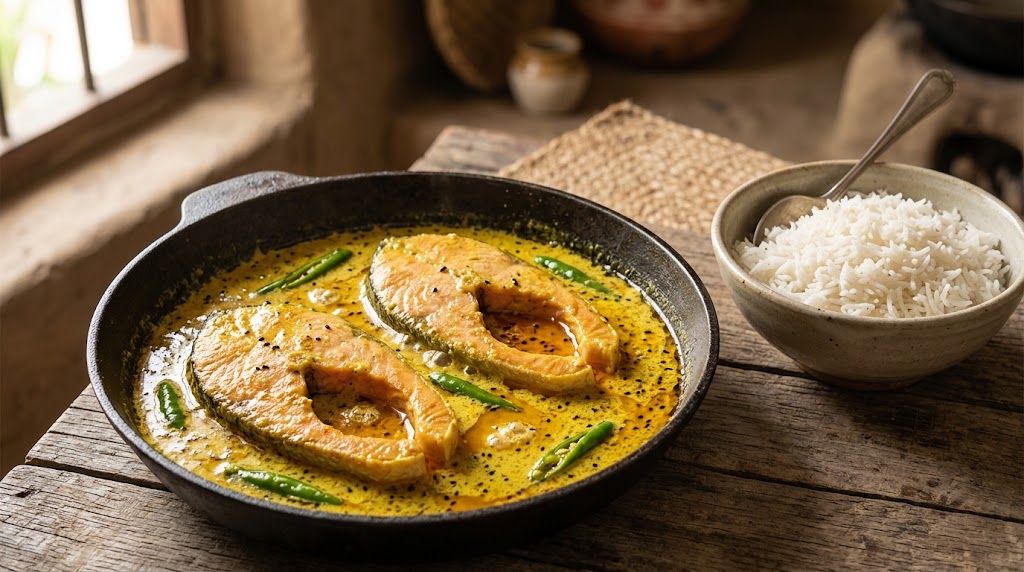
Prep time: 30 min (mostly soaking) | Cook time: 15 min | Serves: 4 | Serve with: plain white rice, nothing else
Shorshe maach — fish in mustard paste — is a Bengali dish built for ilish, the hilsa that arrives with the monsoon and that most people outside the subcontinent will never cook with. Salmon is the substitution the Bengali diaspora landed on, and it works for a specific reason: it is oily enough to stand up to raw mustard without drying out.
I want to be straightforward about what this is. Salmon is not ilish. It has none of ilish’s fine bones, none of that particular sweet oiliness, and a Bengali who grew up on hilsa will know within one bite. What salmon does do is carry a mustard paste better than cod, tilapia or any lean white fish, and that makes this a genuinely good dish in its own right rather than a sad copy.
The entire recipe rests on one thing: making mustard paste that is not bitter.
Why Mustard Paste Turns Bitter
Mustard seeds release their bitter compounds when they are ground dry, ground for too long, or heated by the friction of a hard-working blade. Three things prevent it, and you need all three:
- Soak the seeds first. Twenty to thirty minutes in warm water softens them so they break down quickly instead of being pulverised.
- Grind with salt and a green chilli. Both are traditional and both are functional — they give the blades traction and the salt itself suppresses bitterness.
- Grind in short bursts. Long continuous grinding heats the paste. Pulse, rest, scrape down, pulse again.
A mix of yellow and black mustard seed gives the most balanced result. All black is sharper and more prone to bitterness; all yellow is milder but flatter.
Ingredients
For the mustard paste
- Yellow mustard seeds – 2 tbsp
- Black mustard seeds – 1 tbsp
- Green chilli – 1
- Salt – ½ tsp
- Water – about ⅓ cup for grinding
For the fish
- Salmon – 4 steaks or thick fillet pieces, skin on, about 600 g total
- Turmeric – 1 tsp (½ for marinating, ½ for the gravy)
- Salt – to taste
- Mustard oil – 4 tbsp
- Nigella seeds (kalonji) – ½ tsp
- Green chillies – 4, slit lengthwise
- Sugar – ½ tsp
Equipment
- A small grinder jar — small quantities will not grind in a large one
- A wide, shallow pan that fits the fish in one layer without crowding
- A fine sieve, if the paste needs straining
Method
- Soak the mustard seeds. Cover both kinds of mustard seed with warm water and leave for 20–30 minutes.
- Marinate the fish. Rub the salmon with ½ tsp turmeric and salt. Leave it while you make the paste.
- Grind the paste. Drain the seeds and grind them with the green chilli, ½ tsp salt and a little fresh water, pulsing in short bursts, until smooth. Add water gradually — you want a thick, pourable paste. Strain through a fine sieve if it feels grainy, and taste it: it should be sharp and hot in the nose, not bitter on the tongue.
- Sear the fish briefly. Heat 3 tbsp mustard oil until it just smokes, then lower the heat. Slide in the salmon and cook for about a minute a side — you are firming the surface, not cooking it through. Lift the pieces out.
- Build the gravy. Into the same oil add the nigella seeds and two of the slit chillies. When they crackle, lower the heat and add the mustard paste, remaining ½ tsp turmeric, sugar and about ½ cup of water. Stir and let it come to a bare simmer.
- Return the fish. Slide the salmon back in along with any resting juices. Add the remaining two chillies. Cover and cook on low for 5–6 minutes, spooning gravy over the fish rather than stirring it, until the salmon is just cooked through.
- Finish. Turn off the heat, drizzle over the last tablespoon of raw mustard oil, cover, and rest for five minutes before serving.
From My Kitchen
My first attempt at shorshe was inedible and I blamed the mustard seeds. I had thrown them into the grinder dry, run the machine for a solid minute until the paste looked right, and produced something so bitter it made the back of my throat close. The jar was warm when I opened it, which I did not think anything of at the time. That warmth was the whole problem.
What fixed it was boring: soak the seeds, add salt and a chilli, and grind in bursts of a few seconds with pauses in between. The paste comes out sharp in the nose — that clean wasabi-like burn is what you want — without the flat bitterness on the tongue. If you are ever unsure, taste the raw paste before it goes anywhere near the fish. Bitter paste does not improve with cooking; it gets worse.
The other lesson was about heat and time. I used to give the fish a proper fry, the way you would for a jhol, and then simmer it in the gravy for ten minutes. Salmon does not need that and neither does the mustard. Now the fish gets under a minute a side, purely to set the surface, and the covered simmer is five or six minutes at the lowest flame that will keep a bubble moving. Longer, and two things go wrong at once: the salmon turns chalky and the mustard turns bitter.
On substitutions — I have made this with cod when that was what the shop had. It is edible and it is not the same. Lean white fish gives the mustard nothing to sit against, so the paste sits on top tasting aggressive rather than balanced. If salmon is not available, mackerel or trout are closer to the mark than cod.
Adjusting to Taste
- Milder: shift the ratio towards yellow mustard — 3 tbsp yellow to 1 tbsp black.
- Richer: grind a tablespoon of grated coconut or two tablespoons of soaked poppy seed into the paste. This is common in some households and softens the mustard considerably.
- More gravy: add another ¼ cup of water with the paste, but keep the simmer short regardless.
- The finishing raw oil is not a garnish. Mustard oil loses its pungency when heated, and the raw drizzle at the end puts it back.
Storage
Best eaten the day it is cooked. It keeps for a day in the fridge, but reheating pushes the mustard towards bitterness and firms up the salmon, so warm it gently and briefly with a splash of water. Do not freeze — the paste separates and the texture does not recover.
FAQ
Why is my mustard paste bitter?
Almost always one of three things: the seeds were ground dry, they were ground too long in one go, or the grinder heated them. Soak the seeds first, grind with salt and a green chilli, and pulse in short bursts with pauses. Taste the raw paste before using it — cooking will not fix bitterness.
Can I use ready-made mustard paste or Dijon?
Ready-made Bengali-style mustard paste (kasundi-adjacent pastes sold in South Asian shops) works at a pinch. Dijon and other Western table mustards do not — they are made with vinegar and other seasonings and will take the dish somewhere else entirely.
Is salmon really acceptable for shorshe maach?
As a substitution for ilish, it is the closest widely available fish because of its oil content, and it has become the standard choice in Bengali kitchens outside the subcontinent. It is an adaptation, not a replacement, and it is a good dish on its own terms.
Can I make this without mustard oil?
You will lose a lot. Mustard oil’s pungency is part of the flavour structure here, working with the mustard paste rather than just carrying it. A neutral oil is the fallback if you have no choice; olive oil is not a good fit.
The mustard paste for shorshe salmon needs to be genuinely fine to avoid bitterness — a dedicated spice grinder makes a real difference here. We compared the options in our guide to the best spice grinders.

Rimi Sultana is a home cook from Bangladesh who has cooked for her family every day for the past five years and writes about it at Smart Cooks. Perpetually testing whether internet-famous recipes actually work in a regular home kitchen. Say hello on Facebook or through the contact page.