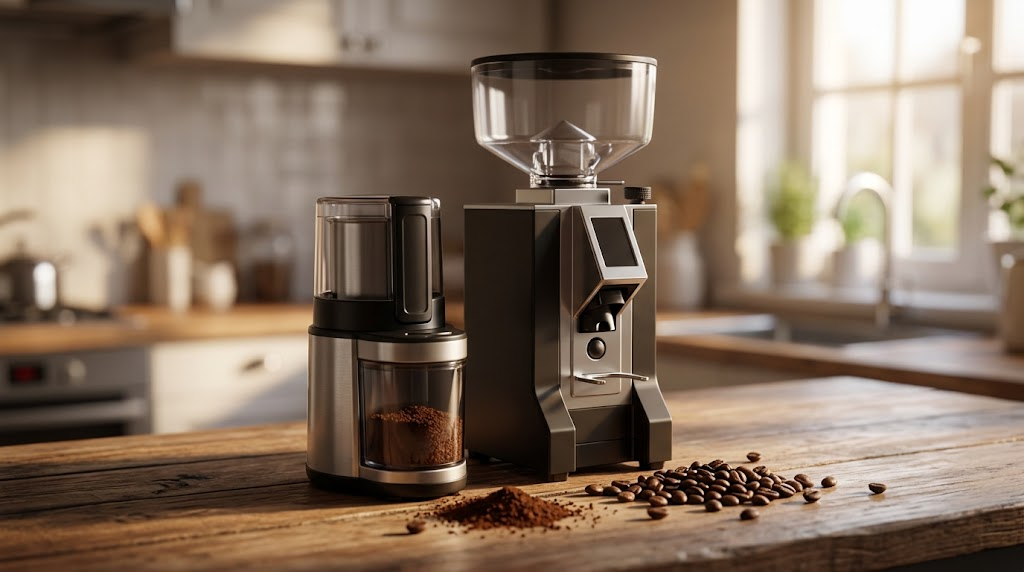
If you’ve ever wondered why your coffee tastes different from the shop’s even with the same beans, the grinder is usually the answer before the machine is. Blade and burr grinders don’t just grind at different speeds — they produce fundamentally different particle shapes, and that changes how your coffee actually extracts.
Some links in this post are affiliate links. If you buy through them we may earn a small commission at no extra cost to you — it never changes which products we recommend.
The Real Difference
Blade grinders chop, burr grinders crush
A blade grinder works like a tiny propeller, chopping beans into whatever size the spinning blade happens to hit. The result is a mix of large chunks and fine dust in the same batch, which means when you brew, the fine particles over-extract (turning bitter) while the large chunks under-extract (turning sour and weak) at the same time. A burr grinder crushes beans between two abrasive surfaces set at a fixed gap, producing particles of a much more consistent size — which is the single biggest factor in even, predictable extraction.
Why consistency matters more than people think
Uneven grounds are the most common reason home coffee tastes muddy or unbalanced compared to a cafe’s, even when the beans and water are identical. This becomes especially obvious with pour-over and drip methods, where extraction time is longer and less forgiving than with something like a French press.
From My Kitchen
I used a blade grinder for a long time because it was cheap and fast, and honestly didn’t think much of it — coffee is coffee. Switching to a conical burr grinder was the first time I actually tasted the difference between beans, rather than just tasting “coffee.” The switch also made me realize how much of the bitterness I’d blamed on the beans themselves was actually just grind inconsistency.
Worth Considering
If you’re ready to switch to burr grinding, the OXO Brew Conical Burr Grinder gives consistent, adjustable grind size for drip, pour-over, and French press. If budget is the main concern and you’re not ready to commit, a basic blade grinder like the BLACK+DECKER blade grinder is still better than pre-ground coffee sitting in a bag for weeks, even with its consistency limitations.
Why Particle Size Distribution Is the Whole Argument
A blade grinder chops. It spins a propeller through the beans, and whatever happens to be near the blade gets hit repeatedly while beans in the corners barely get touched. The result is a mix of dust and boulders in the same batch. A burr grinder crushes beans between two abrasive surfaces set a fixed distance apart, so every particle has to pass through that gap to escape — which means they all come out close to the same size.
This matters because extraction is a function of surface area. The dust in a blade-ground batch over-extracts almost instantly, releasing bitter compounds. The boulders barely extract at all, contributing sour, underdeveloped flavours. Both end up in the same cup, which is why blade-ground coffee so often tastes simultaneously bitter and sour — a combination that is genuinely difficult to achieve any other way.
Quick Comparison
| Burr grinder | Blade grinder | |
|---|---|---|
| Particle consistency | Even | Dust and boulders together |
| Grind size control | Repeatable settings | Guesswork, timed by ear |
| Suitable for espresso | Yes, if rated for it | No |
| Heat added to the beans | Minimal at home speeds | Noticeable on longer grinds |
| Price | Higher | Very low |
| Best for | Any brew method, consistently | Spices, and coffee in an emergency |
What to Look For If You Are Buying a Burr Grinder
Conical burrs are the usual choice at home prices and perform well across brewing methods. What matters more than burr geometry at this level is the number and spacing of the grind settings, and whether the grinder holds its setting — cheap ones drift, so the grind you dialled in last week is not the grind you get today. If espresso is on your list, check specifically that the grinder is rated for it; many otherwise good grinders simply do not go fine enough or adjust in small enough steps.
One practical detail worth knowing: static. Ground coffee clings to the chute and the bin, which is both messy and inconsistent, since some of yesterday’s grind ends up in today’s dose. A drop or two of water on the beans before grinding — the Ross Droplet Technique — eliminates almost all of it and costs nothing.
Two Grinders Worth Considering
Best for consistent brewing: OXO Brew Conical Burr Grinder
Repeatable settings across the range most home brewing needs, from French press through to drip and pour-over. The step up in cup quality from a blade grinder is immediate and obvious, more so than changing beans.
Pros
- Even grind across the range
- Settings hold, so brews are repeatable
- Straightforward to clean
Cons
- Bulkier than a blade grinder
- Not the choice if espresso is your priority
Honest budget option: BLACK+DECKER Blade Grinder
Worth being clear about what this is for. As a spice grinder it is genuinely excellent — whole cumin, coriander and cardamom do not care about particle consistency the way coffee does. As a coffee grinder it will get you through, but it will not make good coffee.
Pros
- Very inexpensive
- Excellent for whole spices
- Compact and simple
Cons
- Inconsistent grind for coffee
- No repeatable settings
Frequently Asked Questions
Is a blade grinder really that much worse?
For espresso or pour-over, yes — the uneven particle size directly hurts extraction. For French press or cold brew, where you’re using a coarse grind and longer steep time, a blade grinder’s inconsistency matters less, though a burr grinder is still better.
Do I need an expensive burr grinder to notice a difference?
No. Even an entry-level conical burr grinder produces far more consistent grounds than any blade grinder, because the mechanism itself — crushing at a fixed gap rather than chopping randomly — is what creates the improvement.
Can I improve results from a blade grinder?
A little. Grind in short pulses rather than holding the button, and shake the grinder between pulses so beans from the corners move into the blade path. That reduces the extremes but does not eliminate them. Sifting the grounds through a fine mesh and discarding the dust genuinely helps and is genuinely tedious. If coffee matters to you, the money is better spent on a basic burr grinder than on better beans ground badly.
Does grinding coffee ahead of time really matter?
More than most people expect. Ground coffee loses its aromatic compounds within minutes because the surface area exposed to air increases enormously — most of what you smell when you open a bag is escaping continuously once ground. Coffee ground a week ago is not spoiled, but it is noticeably flatter. Grinding immediately before brewing is the single free improvement available to anyone who already owns a grinder.

Rimi Sultana is a home cook from Bangladesh who has cooked for her family every day for the past five years and writes about it at Smart Cooks. Perpetually testing whether internet-famous recipes actually work in a regular home kitchen. Say hello on Facebook or through the contact page.