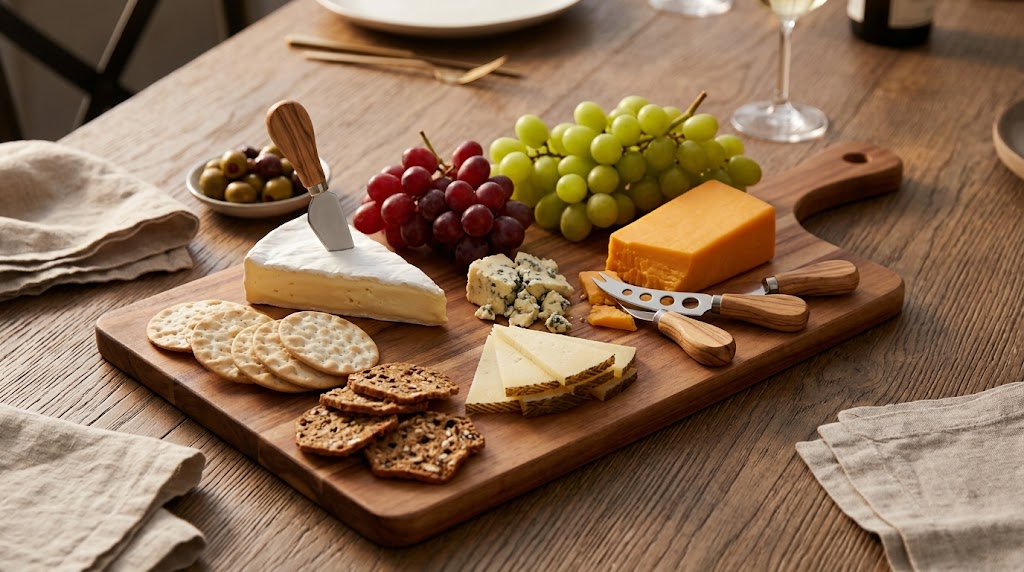
A cheese board looks effortless when it’s done well, but using the wrong knife on the wrong cheese is exactly why soft cheeses end up smeared and hard cheeses end up crumbled instead of cleanly sliced. The tools genuinely matter here more than most people expect.
Some links in this post are affiliate links. If you buy through them we may earn a small commission at no extra cost to you — it never changes which products we recommend.
What Actually Matters
Different Knives for Different Cheese Textures
Soft, creamy cheeses (brie, camembert) need a thin, often perforated or wire blade that doesn’t drag or stick. Hard, aged cheeses (parmesan, aged gouda) need a sturdier, sometimes pointed blade that can break off chunks cleanly. Using one knife for everything is where most at-home boards go wrong.
Spreaders vs Slicers
A dedicated spreader with a flat, flexible blade is meant for soft cheeses you spread onto crackers, while a slicer is meant to cut a clean piece off a block or wedge. Using a slicer to spread soft cheese tends to tear crackers, and using a spreader to cut hard cheese just doesn’t work.
A Fork or Pick Style Tool for Serving
Small forks or picks for guests to serve themselves without touching the cheese directly with their hands is a detail that matters more for hosting than solo snacking, but it’s part of a genuinely complete set if you entertain regularly.
From My Kitchen
I used one all-purpose knife for an entire cheese board for years, and the soft brie always ended up dragged and smeared by the time I got to the harder aged cheddar with the same blade. Switching to a proper set with a dedicated spreader and a separate hard-cheese knife made the whole board look noticeably cleaner, and it wasn’t really about skill — it was just the wrong tool for half the cheeses on the board.
Worth Considering
The ICOSA Living Lunar 6-Piece Cheese Knife Set covers the range from soft spreaders to sturdier slicing knives in one set. For a set that comes with its own holder and stand for serving, the 9-Piece Cheese Knives with Holder is a convenient all-in-one option for entertaining.
Why There Are So Many Blade Shapes
Each cheese knife shape exists to solve a specific failure. Soft cheese sticks to a flat blade, so soft-cheese knives have holes cut through them — an open-work or skeleton blade — which reduces the contact area so brie releases instead of smearing. Hard aged cheese like Parmesan should not be sliced at all; it wants to be broken into shards along its own crystalline structure, which is what the short, wedge-shaped chisel or spade is for. Forcing a hard cheese through a thin blade is how blades bend and knuckles get hurt.
Semi-firm cheeses — gouda, young cheddar, manchego — are the ones that behave like an ordinary ingredient, and a plane or a wire slicer gives even slices without crumbling the edge. The forked tip you see on many cheese knives is not decoration either: it is for lifting the slice you have just cut onto a plate without handling it.
Quick Comparison
| Cheese type | Right tool | Why |
|---|---|---|
| Soft and ripened (brie, camembert) | Open-work blade or wire | Less surface contact, so it does not smear |
| Fresh and crumbly (feta, chèvre) | Wire or thin blade | Cuts without compressing |
| Semi-firm (gouda, cheddar) | Plane or flat blade | Even slices, clean edges |
| Hard aged (parmesan, pecorino) | Chisel or spade | Breaks into shards along the grain |
| Blue | Wire or open-work blade | Avoids dragging the veining through |
How Many You Actually Need
Large sets look impressive and mostly sit unused. Three tools genuinely cover a board: an open-work blade for anything soft, a short chisel or spade for hard aged cheeses, and a plane or wire for semi-firm. A fourth worth having is a small spreader for the soft cheese that ends up on crackers anyway. Beyond that, you are buying variations that will not change how the cheese eats.
What does matter with a set is that there are enough tools for the number of cheeses on the board. Using one knife across a blue, a brie and an aged cheddar transfers flavour in a way people notice immediately — blue cheese in particular will dominate anything the blade touches next. If you regularly serve three or four cheeses, a set of four or more is justified for that reason rather than for the blade variety.
Two Sets Worth Considering
Best quality set: ICOSA Living Lunar 6-Piece Cheese Knife Set
Covers the shapes that matter — open-work, chisel, plane and spreader — with enough pieces that each cheese on a board can have its own tool. Solid enough in the hand to break hard cheese without the blade flexing.
Pros
- Covers the essential blade shapes
- Enough pieces for a multi-cheese board
- Sturdy blades that handle hard cheese
Cons
- More expensive than a basic set
- Needs hand washing to keep the finish
Best value with storage: 9-Piece Cheese Knives With Holder
The holder is the practical feature here — cheese knives are small and odd-shaped, and loose in a drawer they get lost or damaged. Nine pieces is more than most people need, but it means never sharing a blade between a blue and a brie.
Pros
- Storage holder keeps the set together
- Plenty of tools for a large board
- Good value for the number of pieces
Cons
- Individual pieces are not premium quality
- Nine tools is more than most boards need
Frequently Asked Questions
Do I really need multiple cheese knives, or is one enough?
For a genuinely mixed board with both soft and hard cheeses, at least two distinct tools (a spreader and a firmer slicing knife) make a noticeable difference; a single knife is a compromise that works better for some cheeses than others.
What’s the point of a perforated or wire-style cheese knife?
The holes or wire reduce surface contact with sticky, soft cheese, which keeps the cheese from clinging to and dragging on the blade the way a solid flat blade tends to.
Does each cheese really need its own knife?
For a board with a blue cheese on it, yes — blue is strong enough that a blade used on it will carry noticeable flavour into the next cheese, and the whole point of a board is tasting each one distinctly. For a board of mild cheeses it matters less, and wiping the blade between cuts is usually sufficient. The practical compromise most people land on is a dedicated knife for the blue and a shared one for everything else.
How do I stop soft cheese sticking to the blade?
Use an open-work blade or a wire, which is what they exist for. If you only have a flat knife, run it under hot water and dry it before each cut — a warm blade passes through ripened cheese far more cleanly than a cold one. Wiping between cuts helps too. What does not work is pressing harder, which compresses the cheese and makes the smearing worse.
Related: Bread lame vs razor blade: which tool best scores your dough
Related: Top 6 meat tenderizers for tough cuts: tools that make a difference
Related: Top 8 marinade injectors for turkey: precise tools for juicy results
Related: Top 7 egg separators for meringue: tools that actually work

Rimi Sultana is a home cook from Bangladesh who has cooked for her family every day for the past five years and writes about it at Smart Cooks. Perpetually testing whether internet-famous recipes actually work in a regular home kitchen. Say hello on Facebook or through the contact page.