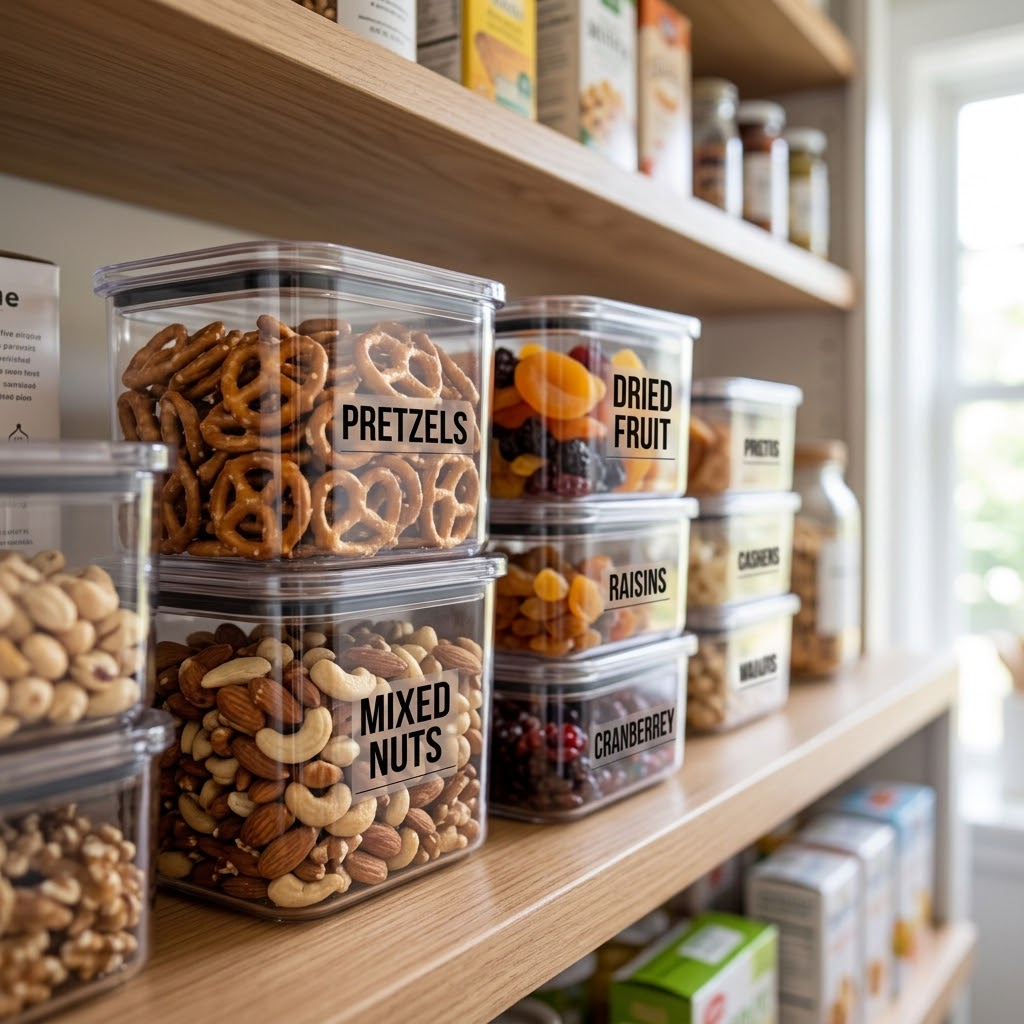
Snack storage sounds like it barely needs a buying guide until you’ve dealt with stale crackers in a container that wasn’t actually airtight, or a pantry shelf full of mismatched containers that don’t stack. A few real details separate containers that keep snacks fresh from ones that just look organized.
Some links in this post are affiliate links. If you buy through them we may earn a small commission at no extra cost to you — it never changes which products we recommend.
What Actually Matters
Actual Airtight Seal vs ‘Airtight’ Marketing
A genuine airtight seal uses a gasket and a locking or push-button mechanism, not just a snap-on lid. Containers marketed loosely as ‘airtight’ without a visible gasket or locking seal often let in more air than expected, which shows up as stale crackers or chips faster than you’d expect.
Stackability for Pantry Space
Uniform, stackable shapes make a real difference in usable pantry space compared to mismatched round containers that waste shelf height. If pantry organization is part of your goal, prioritize a matched set over buying containers individually as needed.
Clear vs Opaque for Visibility
Clear containers let you see what’s inside and how much is left at a glance, which sounds minor but actually reduces both food waste (things don’t get forgotten at the back) and unnecessary snack purchases when you can see you already have some.
From My Kitchen
I switched from mismatched snap-lid containers to a matched set with genuine gasket seals, and the difference in cracker and chip freshness was noticeable within days — things that used to go slightly stale by the end of the week were still crisp. The stackable uniform shape was an unexpected bonus too; my pantry shelf actually fits more now with less wasted space between containers.
Worth Considering
The OXO Good Grips POP Airtight Food Storage Containers use a genuine push-button seal and stack neatly. For a larger matched set at once, the MR.SIGA Airtight Food Storage Container Set covers a full pantry shelf with one purchase.
The Seal Is the Product
Every other feature on a storage container is secondary to whether it actually seals. A true airtight container has a silicone gasket in the lid and a mechanism — latches, a screw thread or a push-button valve — that compresses that gasket against the rim. A container with a plastic lid that simply snaps on is not airtight, however well it clicks, and for anything crisp that difference shows up within a day.
It is worth knowing which direction the problem runs for each food, because it explains what you are protecting against. Crackers, crisps and biscuits go soft because they absorb moisture from the air. Bread, cake and soft cookies go hard because they lose it. An airtight seal solves both, which is why the same container works for opposite problems — it is not adding or removing moisture, just stopping the exchange.
Quick Comparison
| Gasket and latch | Push-button valve | Snap-on lid | |
|---|---|---|---|
| Genuinely airtight | Yes | Yes | No |
| One-handed opening | No | Yes | Yes |
| Parts to maintain | Gasket needs drying | Gasket and valve mechanism | None |
| Stacking | Good | Very good, flat tops | Variable |
| Best for | Long-term pantry storage | Everyday snack access | Short-term, non-crisp foods |
Shape and Stacking Are Not a Minor Detail
Square and rectangular containers use shelf space far better than round ones, which leave wedge-shaped gaps at every join. On a typical pantry shelf that is a meaningful amount of lost space, and it is the reason a matched rectangular set often lets you store noticeably more than the assorted round tubs it replaced. Flat, uniform lids matter for the same reason — containers with domed or ridged tops cannot be stacked reliably.
Clear bodies are worth choosing over opaque ones for a practical reason rather than a decorative one: you eat what you can see. Snacks stored in opaque tubs get forgotten and go stale, and the point of buying good containers is to stop throwing food away. If the set you like is opaque, commit to labelling it, because the alternative is opening five tubs to find the crackers.
Two Sets Worth Considering
Best push-button system: OXO Good Grips POP Airtight Food Storage Containers
The button on the lid both seals the container and acts as the handle, which makes one-handed opening genuinely easy. Flat tops and rectangular bodies stack cleanly, and the seal holds crisp things crisp for weeks rather than days.
Pros
- Reliable airtight seal with one-handed opening
- Rectangular bodies use shelf space efficiently
- Clear bodies so you can see what is inside
Cons
- Button mechanism needs proper drying to avoid smells
- More expensive than basic sets
Best value set: MR.SIGA Airtight Food Storage Container Set
A straightforward latching set that covers a pantry’s worth of sizes for considerably less money. Latches are simpler than button mechanisms, which means fewer parts to fail, at the cost of needing two hands to open.
Pros
- Good range of sizes in one purchase
- Simple latch mechanism, little to go wrong
- Stacks well with uniform lids
Cons
- Two-handed opening
- Gaskets must be dried or they hold odours
Frequently Asked Questions
How can I tell if a container is genuinely airtight before buying?
Look for a visible rubber or silicone gasket around the lid rim and a locking or push-button closing mechanism — a simple snap-on lid without these features usually isn’t truly airtight, whatever the listing claims.
Are glass or plastic containers better for snack storage?
Both work well if the seal is genuinely airtight; glass resists odor and stain absorption better over time, while plastic is lighter and more resistant to breaking if dropped — the seal quality matters more than the material for freshness specifically.
Why do my crackers still go soft in an airtight container?
Usually because they had already absorbed moisture before they went in — sealing damp crackers just seals in the humidity. If a packet has been open in a humid kitchen for a day, crisp them in a low oven for a few minutes and let them cool completely before storing. Warm food in a sealed container is the other common cause: the steam it gives off condenses inside and softens everything.
Can the gaskets go in the dishwasher?
Usually yes, but the important part is drying. Water trapped in the gasket groove is what makes lids develop a musty smell over a few months, and it is easily avoided — pop the gasket out, dry both it and the groove, and refit it. Doing that every few washes rather than every time is enough. Storing containers with the lids off also helps, since a sealed empty container holds whatever moisture was inside it.

Rimi Sultana is a home cook from Bangladesh who has cooked for her family every day for the past five years and writes about it at Smart Cooks. Perpetually testing whether internet-famous recipes actually work in a regular home kitchen. Say hello on Facebook or through the contact page.