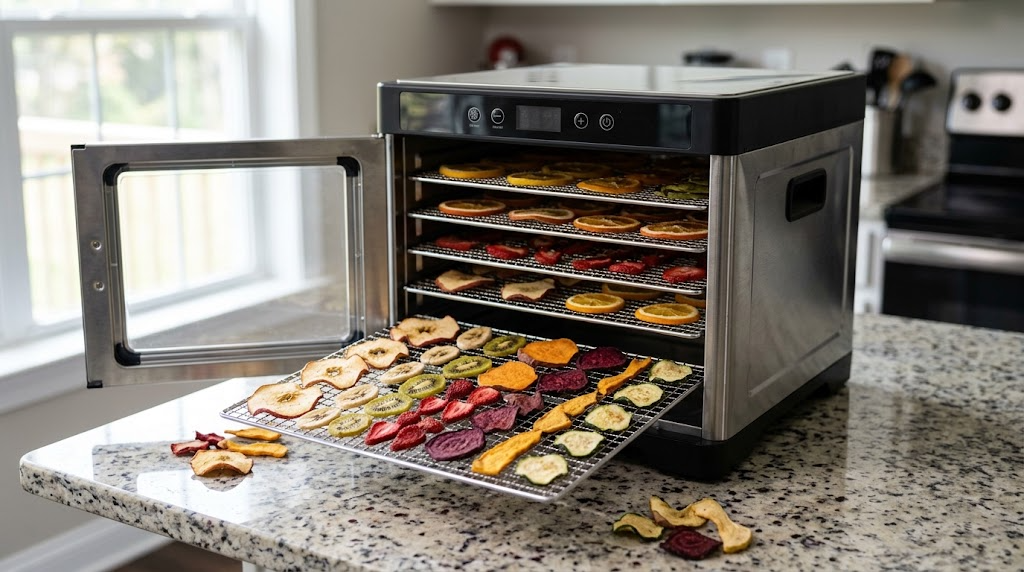
A food dehydrator opens up a whole category of homemade snacks — fruit leather, jerky, dried fruit, kale chips — but the right size and airflow design depends heavily on what you actually plan to dehydrate most.
Some links in this post are affiliate links. If you buy through them we may earn a small commission at no extra cost to you — it never changes which products we recommend.
What Actually Matters
Horizontal Airflow vs Vertical Airflow
Horizontal (rear-mounted fan) dehydrators circulate air evenly across every tray at once, so you don’t need to rotate trays partway through. Vertical airflow models (fan on the bottom or top) are often cheaper, but heat and drying can be less even between trays, sometimes requiring a rotation partway through a batch.
Temperature Range for Jerky vs Fruit
Jerky needs to reach food-safe temperatures (generally 155-165°F for meat) that not every budget dehydrator can hit, while fruit and vegetable snacks dry well at lower temperatures. If jerky is a priority, check the specific max temperature rather than assuming all dehydrators reach it.
Number of Trays vs Counter Space
More trays mean bigger batches, but also a bigger footprint that needs a permanent spot on the counter or in storage, since dehydrating runs for many hours at a time. Expandable models let you start small and add trays later as needed.
From My Kitchen
My first dehydrator had vertical airflow, and I learned the hard way that the top tray dried noticeably faster than the bottom one on a full batch of apple chips — some pieces were perfectly crisp while others near the bottom were still soft after the same run time. Switching to a horizontal-airflow model on my next one fixed that unevenness without needing to rotate trays partway through.
Worth Considering
For serious, even drying with jerky-capable temperatures, the Cosori Food Dehydrator (6 Stainless Steel Trays) has reliable horizontal airflow and a wide temperature range. If you want a slightly smaller footprint to start, the Cosori Food Dehydrator (5 BPA-Free Trays) is expandable if you find you need more capacity later.
Airflow Design Is What Actually Separates Dehydrators
There are two layouts, and the difference shows up in every batch you run. Stackable dehydrators put the fan and heater in the base and push air upward through the trays, which means the bottom tray finishes well before the top one and you have to rotate trays partway through. Shelf-style units put the fan at the back and blow air horizontally across every tray at once, so a batch finishes evenly and you can load it and walk away.
For occasional use, a stackable unit is perfectly serviceable and cheaper. For anything you do in volume — jerky, fruit leather, batches of apple or mango slices — the horizontal layout saves you the rotation routine and produces more consistent results, which matters because unevenly dried fruit is not just a texture problem. Pieces that finish wetter than the rest are the ones that spoil in storage.
Quick Comparison
| Stackable (vertical flow) | Shelf style (horizontal flow) | |
|---|---|---|
| Drying evenness | Uneven — needs tray rotation | Even across all trays |
| Capacity flexibility | Add or remove trays | Fixed number of shelves |
| Noise | Usually quieter | Fan is more audible |
| Cleaning | More awkward, stacked parts | Trays slide out individually |
| Best for | Herbs, occasional fruit | Jerky, batch drying, fruit leather |
Temperature Range, and Why Jerky Is the Exception
Different foods need genuinely different temperatures, and a machine with a narrow range will limit you. Herbs dry best at around 95 to 105°F, where the volatile oils that carry the flavour survive. Fruit sits around 135°F. Vegetables are similar. Jerky is the one that matters for safety rather than quality: meat should reach 160°F, and poultry 165°F, to be safe — which means any dehydrator you plan to make jerky in needs to reach and hold at least 165°F reliably.
An accurate thermostat matters as much as the range. Cheap units can run 15 to 20 degrees off their dial, which is fine for apple slices and not fine for meat. If jerky is on your list, it is worth checking the real temperature with an oven thermometer on a middle tray before you trust the display.
Two Dehydrators Worth Considering
Best for jerky and batch work: Cosori Food Dehydrator, 6 Stainless Steel Trays
Horizontal airflow with a proper temperature range and stainless trays, which is the combination you want if meat is part of the plan. Stainless also avoids the lingering-smell problem plastic trays develop after a few jerky batches.
Pros
- Even drying without rotating trays
- Reaches and holds jerky-safe temperatures
- Stainless trays do not retain odours
Cons
- Larger footprint than a stackable unit
- Fan is audible over long runs
Best for fruit and everyday snacks: Cosori Food Dehydrator, 5 BPA-Free Trays
A more compact option that handles the fruit, vegetable and herb drying most households actually do. Lighter and easier to store than the stainless model, with the same straightforward temperature control.
Pros
- Compact and easier to store
- Good temperature control for fruit and herbs
- Trays are light and simple to wash
Cons
- Plastic trays can hold strong smells over time
- Smaller capacity for large batches
Frequently Asked Questions
Can I make jerky in any food dehydrator?
Only if it reaches the food-safe temperature range for meat (generally at least 155-165°F) — check the specified max temperature before assuming a budget model is suitable for jerky specifically.
How long does dehydrating fruit for snacks usually take?
It varies by fruit and thickness, but most fruit slices take anywhere from 6 to 12 hours at a moderate temperature, which is part of why dehydrators are often run overnight.
Can I just use my oven instead of buying a dehydrator?
For small amounts, yes — set the oven to its lowest temperature, prop the door open with a wooden spoon so moisture escapes, and expect it to take longer and use considerably more electricity. The two real limitations are that most ovens will not go below about 170°F, which is too hot for herbs and marginal for fruit, and that running an oven for eight hours is expensive. It is a reasonable way to find out whether you enjoy dehydrating before committing to an appliance.
Why do some pieces come out leathery and others still wet?
Usually uneven slicing. A piece twice as thick takes far more than twice as long to dry, so a tray with mixed thicknesses can never finish together — which is the strongest practical argument for slicing with a mandoline rather than by eye. The other causes are overcrowded trays with pieces touching, which blocks airflow, and a vertical-flow machine that has not had its trays rotated partway through the run.

Rimi Sultana is a home cook from Bangladesh who has cooked for her family every day for the past five years and writes about it at Smart Cooks. Perpetually testing whether internet-famous recipes actually work in a regular home kitchen. Say hello on Facebook or through the contact page.