There is a category of fruit that defeats every normal juicer: grapes with seeds and skins, elderberries, chokecherries, currants, crabapples — the small, seedy, abundant stuff that arrives by the bucket when you have a productive vine or a generous neighbour. Press them and you fight pulp; simmer and strain them and you stand over a stove all day skimming.
Some links in this post are affiliate links. If you buy through them we may earn a small commission at no extra cost to you — it never changes which products we recommend.
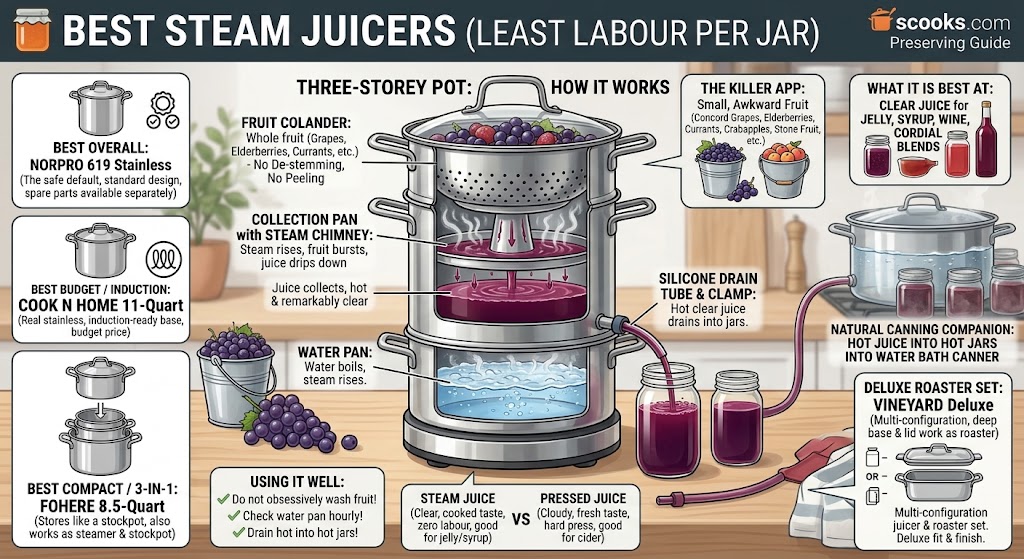
A steam juicer solves the whole problem with almost insulting simplicity. It is a three-storey pot: water boils in the bottom, whole fruit sits in a colander on top, and steam rises through the middle tier, gently bursting the fruit so its juice drips down into the collection pan — from which a silicone tube drains it, hot and remarkably clear, straight into your jars. No pressing, no straining, no peeling, no stirring. You load whole fruit, stems and all, and walk away.
Because the juice comes off steaming hot, it is also the natural companion to a canning setup — hot juice into hot jars into the water bath canner is about as smooth as preserving gets. Here are seven worth buying.
Our Top 7 Picks for the Best Steam Juicer
Best Overall: Norpro 619 Stainless Steel Steamer/Juicer

The Norpro 619 is the steam juicer most preserving households in America actually own, and its advantage is exactly that: decades on the market, a design with the kinks worked out, and a brand whose replacement tubes and clamps you can still buy separately — the part that always wears out first on any steam juicer.
The stainless build is solid, the colander is generously sized for a real picking, and the juice pan collects fast enough to keep up with soft fruit. If you want the safe default that will still be juicing grapes in fifteen years, this is it.
Key Specifications
- Stainless steel three-tier steam juicer
- Silicone drain tube with clamp
- Large fruit colander capacity
- Replacement parts available separately
Pros
- The long-established standard of the category
- Spare tubes and clamps easy to source
- Solid stainless construction throughout
- Handles soft and seedy fruit equally well
Cons
- Costs more than the newer import brands
- Base pan is happiest on gas or coil — check smooth-top limits
- Big three-tier stack to store
Best Value: Cook N Home 11-Quart Stainless Steam Juicer

Cook N Home’s 11-quart is the sensible budget pick because it gets the two fundamentals right at a lower price: a genuinely stainless build, and — unusually at this tier — an induction-ready base. Plenty of budget steam juicers are aluminium; this one is not, and with acidic fruit juice that matters for both flavour and longevity.
The tube and clamp are the generic weak point on all of these; buy a spare length of food-grade silicone tube with it and future-you is covered mid-elderberry-season.
Key Specifications
- 11-quart stainless steam juicer set
- Induction-compatible base
- Silicone juice tube with clamp
- Glass lid to watch progress
Pros
- Real stainless at a budget price
- Works on induction, rare at this tier
- Standard 11-quart family capacity
- Lighter than premium sets
Cons
- Thinner gauge steel than Norpro
- Generic tube and clamp — keep a spare
- Handles run warm during long steams
Best Mid-Range: Cooks Standard 11-Quart Steam Juicer Pot

Cooks Standard sits between the budget imports and the Norpro: heavier-gauge stainless, a better-fitting lid that keeps the steam where it belongs, and tidier fit and finish, without the premium-brand price. A properly seated lid is not a luxury on a steam juicer — escaping steam is literally escaping juice yield.
For someone juicing several weekends every autumn rather than once a year, this is the sweet spot of build quality per dollar.
Key Specifications
- 11-quart stainless steam juicer
- Heavier gauge than budget sets
- Well-seated lid for steam retention
- Full three-tier system with tube
Pros
- Noticeably better build than entry-level sets
- Good steam seal helps yield
- Established cookware brand
- Fair price for the gauge
Cons
- Not much cheaper than the Norpro on sale
- Still a bulky stack to store
- Spares less standardised than Norpro’s
Best Large Capacity: WantJoin 11-Quart Commercial-Grade Steam Juicer

WantJoin builds restaurant-supply equipment, and this steam juicer carries that DNA: heavy stainless, a deep colander that swallows a serious picking of grapes or berries, and handles built for moving a full hot stack. If your fruit arrives by the orchard crate rather than the colander, capacity per batch is the spec that saves your afternoon.
Same universal advice: it is a three-tier tower when assembled, so check your cupboard geometry before ordering.
Key Specifications
- 11-quart heavy stainless construction
- Deep large-capacity fruit colander
- Commercial-grade handles and lid
- Silicone drain tube with clamp
Pros
- Handles big pickings per batch
- Sturdy commercial-style build
- Strong handles for a full hot pot
- Good value for the gauge
Cons
- Heavy even before you add fruit
- Storage-hostile footprint
- Newer brand in the home market
Best Compact: FOHERE 8.5-Quart 3-in-1 Steam Juicer

Not everyone juices by the bushel. The FOHERE 8.5-quart is the apartment-scale steam juicer — small enough to store like a normal stockpot, and honest 3-in-1 design means the tiers also work as a plain steamer and stockpot the other fifty weeks of the year.
For a currant bush, a small grape arbour, or the annual elderberry expedition, this is all the juicer the job needs, and the multi-use argument beats letting a giant single-purpose pot hibernate in the garage.
Key Specifications
- 8.5-quart compact steam juicer
- 3-in-1: juicer, steamer, stockpot
- Stainless steel construction
- Glass lid
Pros
- Stores like ordinary cookware
- Genuinely useful as a steamer year-round
- Right size for small harvests
- Lighter to lift and wash
Cons
- Small colander means more batches for big pickings
- Less headroom for foamy fruit
- Thinner base than premium sets
Best Budget Big Brand Alternative: COSTWAY 11-Quart Steam Juicer with Tempered Glass Lid

COSTWAY’s entry undercuts most of the field while keeping the features that matter day-to-day: an 11-quart stainless stack, a tempered glass lid so you can see the boil without lifting anything, and cool-touch handle wraps that you will appreciate the first time you move a full steamer.
At the budget end the variance between individual units is wider — check the tube clamp seals properly and the tiers nest flat when it arrives, and it will serve for years.
Key Specifications
- 11-quart stainless steam juicer
- Tempered glass lid
- Cool-touch handle wraps
- Full tube and clamp set
Pros
- Aggressive price for full capacity
- Glass lid saves steam and guesswork
- Comfortable handles on a hot pot
- Complete out of the box
Cons
- Unit-to-unit consistency varies at this price
- Thinner steel than mid-range sets
- Generic spares
Best Deluxe Set: VINEYARD Deluxe Stainless Steam Juicer & Roaster Set

The VINEYARD set leans into the fact that a steam juicer is secretly several pots: configured one way it juices, configured another its deep base and lid work as a roaster, and it is explicitly induction-friendly. For a kitchen that resents single-purpose equipment, this is the steam juicer that justifies its shelf.
Guava — and I did not expect it to work at all. Guava is a nightmare in a centrifugal juicer: it clogs, it foams, and what comes out is pink sludge. In the steam juicer nothing happens for a long time and you start to think it has failed, then somewhere around forty minutes the tube begins to run and what comes down it is clear, deep pink, and completely free of pulp.
Open the clamp slowly the first time. I did it fast and got a burst of steam and hot juice across the counter. The trade-off is honest: it takes an hour instead of a minute, and you lose the raw fresh taste because the fruit has been cooked. For juice you intend to bottle and keep, that is a good trade. For a glass right now, it is not.
Key Specifications
- Multi-configuration juicer and roaster set
- Induction-friendly stainless build
- Tempered glass lid
- Full drain tube system
Pros
- Doubles as a roaster between harvests
- Induction compatibility included
- Nice fit and finish
- One stack, several tools
Cons
- Costs more than single-purpose rivals
- More pieces to track and store
- Roaster duty means more wear on the base
The Ultimate Buying Guide for Steam Juicers
How Steam Juicing Actually Works
Three stacked tiers. The bottom is a water pan that must never boil dry. The top is a colander of whole fruit. The middle is the clever part: a collection pan with a central chimney that lets steam rise through to the fruit above. Heat bursts the fruit cells, juice drips into the collection pan, and a silicone tube with a clamp drains it off — pasteurised by the process and clearer than pressed juice, because pulp and skins never enter it.
The trade-off, honestly stated: steam juice is clear, cooked-tasting juice — ideal for jelly, syrup, wine and drinking blends. It is not fresh raw juice; heat is the mechanism. And yields are slightly lower than a hard press, in exchange for zero labour and zero straining.
What It Is Best At
- Grapes — the killer app; seeds and skins stay in the basket and Concord juice comes off ready for jelly
- Elderberries and chokecherries — small, seedy, tedious by any other method
- Currants, gooseberries, aronia — jelly fruit, born for this
- Apples and crabapples — chunked, for clear juice and jelly stock rather than cider
- Stone fruit and rhubarb — syrup and cordial territory
For pressed raw cider, a fruit press is the right tool instead; for tomato sauce, a food mill. The steam juicer’s lane is clear juice from awkward fruit.
Stainless, and Mind Your Cooktop
Buy stainless. Older and cheaper steam juicers are aluminium, which is lighter but reacts with acidic juice over long steams. On cooktops: gas and coil take everything; induction requires a magnetic base (several models above have one); and wide pot bases on glass smooth-tops are subject to the same manufacturer size cautions as big canners — check your stove’s manual.
The Tube Is a Consumable
Every steam juicer drains through a silicone tube pinched by a clamp, and that tube is the part that ages: it stains, stiffens, and eventually the clamp end weeps. This is normal. Buy a spare length of food-grade silicone tubing with the juicer, and favour brands (like Norpro) whose spares are sold separately.
Using It Well
- Do not wash the fruit obsessively or de-stem small fruit — stems and seeds stay in the colander; that is the point.
- Keep the base topped up. A dry base pan scorches and can warp; check hourly on long steams.
- Drain hot into hot jars. The juice comes off near-boiling — run it straight into clean hot jars and process in the water bath canner per a tested recipe.
- First drain-off is the strongest. Flavour concentration falls as steaming continues; taste as you go and stop while it is worth having.
- Expect 45 to 90 minutes per load depending on the fruit.
Frequently Asked Questions About Steam Juicers
Do I need to remove stems and seeds first?
No — that is the entire argument for the machine. Whole grape clusters, stems and all, go straight in the colander; seeds, skins and stems never touch the juice. The only prep worth doing is halving or chunking large hard fruit like apples so the steam penetrates faster.
Is steam-juiced juice already pasteurised?
It comes off the machine at near-boiling temperature, effectively hot-pack ready. For shelf-stable storage, run it hot into jars and process in a water bath per a tested recipe; for the fridge or freezer, cool it and use it like any fresh juice within the week.
Why is my yield low?
Usually underripe or under-steamed fruit, or a leaky steam path. Ripe soft fruit gives up far more juice; make sure the lid seats properly and the tiers nest flat so steam is not escaping around the seams. Some fruit simply yields less — and gently crushing firm berries in the colander partway through helps.
Can I make jelly straight from steam juice?
Yes — it is the classic pipeline, and the juice’s clarity is why steam-juicer jelly is brilliantly clear. Use a tested jelly recipe with proper proportions of juice, sugar and pectin; steam juice is slightly more dilute than hard-pressed juice, so follow recipes written for it or reduce slightly first.
Can a steam juicer make apple cider?
Not cider in the fresh-pressed sense. Steam gives you clear, lightly cooked apple juice — lovely, but a different drink from raw cider’s cloudy pressed character. If cider is the goal, you want a fruit press; if apple jelly stock or clear juice for canning is the goal, the steam juicer wins.
What else can the pot do?
Ignore the middle tier and you own a large steamer and stockpot: tamales, seafood, bulk vegetables, stock. The multi-configuration sets lean into this, but every steam juicer secretly moonlights.
Final Thoughts
The Norpro 619 is the buy-once answer — the proven design with spare parts you can actually get. On a budget, the Cook N Home covers the fundamentals with induction thrown in, and small-harvest kitchens are better served by the compact FOHERE than by a dormant giant.
Whole fruit in, water topped up, juice run hot into jars — then straight to the water bath canner while everything is still steaming. It is the least labour per jar in all of preserving.
As an Amazon Associate we earn from qualifying purchases. Availability is accurate as of the date of publishing. We do not list prices because they change too often to quote honestly.

Rimi Sultana is a home cook from Bangladesh who has cooked for her family every day for the past five years and writes about it at Smart Cooks. Perpetually testing whether internet-famous recipes actually work in a regular home kitchen. Say hello on Facebook or through the contact page.