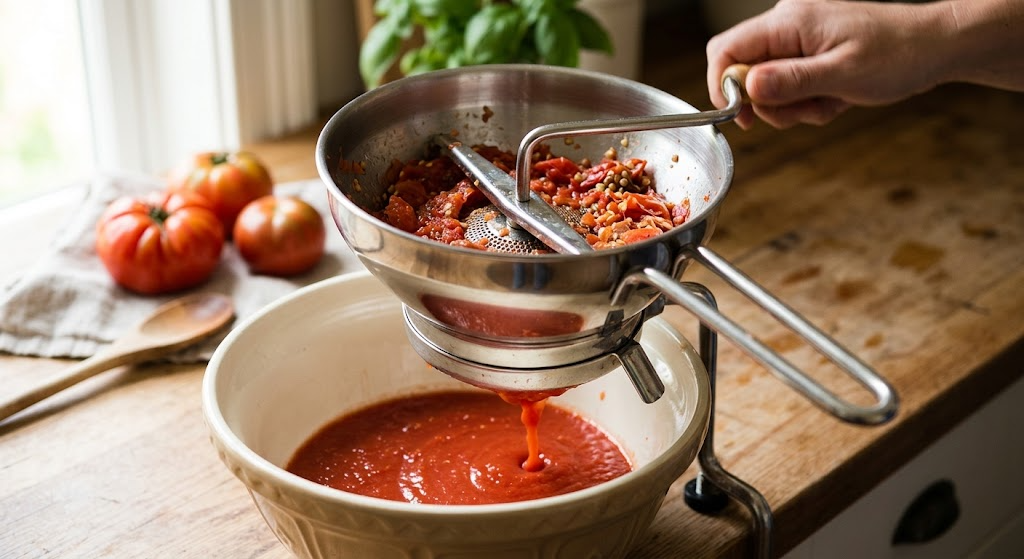
There is a moment in tomato season when you realise the problem is not cooking the sauce. It is the skins and the seeds. Blanching and slipping tomatoes one at a time is fine for four tomatoes and unbearable for forty, and a blender does not solve it — it pulverises the skins into the sauce, which turns it a dull orange and gives it a faintly bitter, papery texture.
Some links in this post are affiliate links. If you buy through them we may earn a small commission at no extra cost to you — it never changes which products we recommend.
A food mill solves this in one motion. You crank cooked fruit or vegetables against a perforated disc; the pulp goes through, the skins and seeds stay behind and get scraped out. No peeling, no straining, no seeds. It is the reason a proper passata tastes cleaner and looks redder than anything you can make in a blender.
The real decision is not which brand but which kind. A hand-crank mill is perfect up to about a dozen pounds; past that your forearm gives out and you want a tomato press instead. Below are seven covering both ends, plus an honest guide to which one your actual volume calls for. If you are putting the results up in jars, pair this with our water bath canner guide.
Our Top 7 Picks for the Best Food Mill and Tomato Press
Best Overall: OXO Good Grips Stainless Steel Food Mill, 2.3 Quart
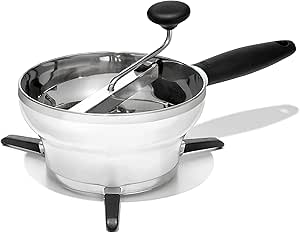
The OXO is the food mill to buy if you want one that simply works and does not fight you. Three interchangeable discs cover fine, medium and coarse, the 2.3-quart hopper is large enough to be worth filling, and — the detail that separates good mills from irritating ones — it has legs that grip and a hook that sits securely on the rim of a bowl or pot rather than sliding off mid-crank.
The crank turns smoothly and the whole thing comes apart for washing, which matters because tomato pulp dries into cement in the seams. Stainless throughout, so no staining from tomato acid.
For a household doing a few pounds of tomatoes, a batch of applesauce, or mashed potatoes that need to be genuinely lump-free, this is the right amount of tool.
Key Specifications
- 2.3-quart stainless steel hopper
- Three grinding discs: fine, medium, coarse
- Non-slip legs and a secure bowl hook
- Fully disassembles for cleaning
Pros
- Stays put on the bowl instead of sliding
- Smooth crank action even with fibrous produce
- Three discs cover sauce, puree and applesauce
- Stainless resists tomato acid staining
Cons
- Slow past about ten pounds of tomatoes
- Discs must be swapped by hand mid-job
- Takes up real cupboard space
Best Value: Hungry Artisan Stainless Steel Food Mill with 3 Discs

Sold specifically at the tomato-sauce-and-canning crowd, this is a straightforward stainless mill with the same three-disc arrangement as the OXO at a lower price. Mechanically there is not much to a food mill — a hopper, a disc, a curved blade and a crank — and this one gets the fundamentals right.
The difference you feel against the OXO is in the details: the crank handle is less comfortable over a long session, and the grip on the bowl rim is less confident. For an afternoon of sauce that is a minor irritation; for a whole weekend it adds up.
Key Specifications
- Stainless steel food mill
- Three interchangeable milling discs
- Sized for tomato sauce and canning batches
- Dishwasher safe components
Pros
- Real stainless at a noticeably lower price
- Three discs included
- Handles tomatoes, apples and berries alike
- Straightforward to disassemble and wash
Cons
- Crank handle less comfortable over long sessions
- Bowl grip is less secure than the OXO
- Brand has a shorter track record
Best Premium: Louis Tellier Professional Stainless Steel Food Mill & Ricer N.5

Louis Tellier has been making these in France for professional kitchens for a very long time, and the difference is in the build: heavier gauge steel, a blade that maintains contact with the disc properly rather than flexing away from it, and a mechanism that does not develop play after a few seasons.
That last point is the real argument. Cheap mills wear at the pivot, the blade lifts off the disc, and suddenly you are cranking hard and getting nothing through. This one does not do that.
It also works as a ricer, which makes it a serious tool for mashed potatoes as well as sauce. Buy it if you mill often enough that a mill wearing out would annoy you. If you make sauce twice a year, the OXO is plenty.
Key Specifications
- Professional-grade stainless steel
- Doubles as a food mill and a ricer
- French-made, restaurant-grade construction
- For purees, sauces and compotes
Pros
- Built to survive commercial use
- Blade keeps proper contact with the disc over years
- Riced potatoes as well as milled sauce
- Genuinely a lifetime tool
Cons
- By far the most expensive here
- Heavier to handle and store
- Overkill for occasional use
Best Compact: Hungry Artisan Compact Food Mill for Applesauce and Tomato Sauce

Full-size food mills are bulky, and a lot of people who would use one do not own one because there is nowhere to put it. This compact version keeps the three-disc system in a smaller hopper that stores in a normal cupboard.
The trade is refill frequency — you will be topping it up constantly on a big batch. But for a few pounds of apples for sauce, a jar or two of passata, or milling raspberries for a seedless coulis, it is the right size and it is not living in the back of a cupboard being resented.
Key Specifications
- Compact stainless steel food mill
- Three milling discs included
- Sized for small-batch sauce and puree
- Stores in a standard cupboard
Pros
- Fits in kitchens where a full mill does not
- Same three-disc versatility
- Lighter and easier to handle
- Ideal for berries and small fruit batches
Cons
- Frequent refilling on large batches
- Not the tool for a bushel of tomatoes
- Small hopper means more splashing
Best Manual Tomato Press: Norpro 1951 “The Original” Sauce Master

This is the point where you stop milling and start pressing. A tomato press works on a completely different principle from a food mill: you feed whole tomatoes into a hopper, an auger drives them against a cone-shaped screen, pulp exits one way and skins and seeds are ejected out the other — continuously, without stopping to scrape.
The practical consequence is enormous. A food mill needs the fruit cooked first and needs emptying every few minutes. A press takes raw tomatoes and runs until you stop feeding it. If you are doing a bushel, this is the difference between an afternoon and a whole day.
The Sauce Master has been the standard entry-level press for decades, clamps to a counter or table, and takes optional screens for berries, pumpkin and grapes.
Key Specifications
- Manual clamp-on tomato press and strainer
- Auger and cone screen — continuous separation
- Takes raw tomatoes, no pre-cooking needed
- Optional screens for berries, grapes and squash
Pros
- Dramatically faster than a food mill on volume
- No pre-cooking or peeling required
- Ejects skins and seeds continuously
- Long-established, widely supported design
Cons
- Needs a sturdy counter edge to clamp onto
- Plastic body feels less solid than metal presses
- More parts to wash afterwards
- Overkill for small batches
Best for Bushels: Weston Metal Tomato Strainer with 1-Gallon Hopper

An all-metal press with a gallon hopper, which changes the rhythm of the work: you load a big batch and crank continuously instead of feeding tomatoes in a handful at a time. The dual mount system lets you clamp it or bolt it down properly, and a press that does not shift while you crank is a genuinely different experience from one that does.
This is the tool for someone with a productive garden or a standing order at a farm stand. Weston also makes a motor unit that fits the same body, so you can start manual and upgrade if the volume grows.
I have only ever done this with a hand-crank mill, and the honest number is that five kilos of tomatoes takes me a little over half an hour, blanching included. That is fine for a Sunday batch of sauce for the week. It is not fine for a crate.
The arithmetic that finally made me understand the press is simple: with a mill you turn the handle once for every spoonful, so your arm is the bottleneck and the work scales straight up with the fruit. Everyone I know who cans in real quantity moved to a press within a season, and none of them went back. But if you are making a jar or two at a time, the mill is the right tool and the press is just a storage problem.
Key Specifications
- All-metal tomato strainer with 1-gallon hopper
- Dual mount system for clamping or bolting
- Stainless contact surfaces
- Compatible with an add-on motor unit
Pros
- Handles bushel-scale batches comfortably
- Metal build far more rigid than plastic presses
- Mounts securely so it does not walk while cranking
- Upgradeable to motorised later
Cons
- Expensive for occasional use
- Heavy and awkward to store
- Significant assembly and cleanup
- Needs a solid surface to mount on
Best Electric: Weston Deluxe Electric Tomato Strainer, Food Mill and Sauce Maker

At some volume, cranking stops being romantic. A motorised strainer turns a bushel of tomatoes into passata in a fraction of the time and without the forearm ache, and it is the honest answer for anyone processing serious quantities from a garden every year.
It handles the same jobs a manual press does — tomatoes, apples, berries, squash — with the same skin-and-seed ejection, just driven by a motor. The costs are the obvious ones: price, storage space, and more components to clean, which is not nothing when everything is coated in tomato.
Only worth it if you genuinely process at volume. For a few pounds a year, this is an appliance that will live in a cupboard reproaching you.
Key Specifications
- Electric motorised tomato strainer
- Separates skins and seeds automatically
- Handles purees, jellies and sauces
- Weston, an established preserving-equipment brand
Pros
- Processes bushels without physical effort
- Far faster than any manual option
- Consistent output across a long session
- Handles fruit as well as tomatoes
Cons
- Expensive
- Bulky to store
- More parts to clean than a manual press
- Unjustifiable for small batches
The Ultimate Buying Guide for Food Mills and Tomato Presses
Food Mill or Tomato Press? Decide by Volume
These are different machines for different scales, and buying the wrong one is the main way people end up disappointed.
A food mill is a hopper with a perforated disc and a curved blade. You cook the fruit first, put it in, and crank; pulp goes through the holes, skins and seeds stay behind and have to be scraped out every few minutes. It is versatile — sauce, applesauce, seedless jam, soup, riced potatoes — and it is the right tool up to roughly ten or twelve pounds of tomatoes at a sitting.
A tomato press (or strainer) uses an auger driving produce against a cone screen. It takes raw tomatoes with no pre-cooking, and it ejects skins and seeds continuously so you never stop to clear it. It is far faster at volume and considerably less versatile.
- Under ~10 lb at a time, varied uses: buy a food mill
- Half a bushel or more, mostly tomatoes: buy a press
- Multiple bushels every year: buy an electric press
Why Not Just Use a Blender?
Because a blender does not remove anything — it pulverises. Tomato skins blended into sauce dull the colour from red to orange and add a papery, slightly bitter note; blended seeds add real bitterness. A food mill takes them out of the sauce entirely. It is genuinely the difference between homemade sauce that tastes like a restaurant’s and homemade sauce that tastes homemade in the wrong way.
A blender also aerates, which lightens the colour further and can make sauce foam as it cooks.
Discs and What They Do
Most mills ship with three discs, and using the right one matters more than people expect.
- Fine — seedless berry coulis, smooth passata, baby food, silky soups
- Medium — the everyday choice for tomato sauce and applesauce
- Coarse — rustic sauces, chunky apple butter, mashed potatoes with some texture
If a mill only offers one disc, it is a medium, and you lose the ability to make a genuinely smooth puree or a properly rustic sauce.
Stainless Steel, Always
Tomatoes are acidic and will pit, stain and eventually corrode aluminium and cheap plated steel, and older tinned mills can lose their coating. Stainless throughout — hopper, disc, blade and shaft — is worth insisting on. Plastic bodies are fine on presses where the contact surfaces are stainless, but check that the screen itself is metal.
Stability: The Underrated Spec
You are applying real force with one hand while the other holds the mill. A mill that slides off the bowl mid-crank at the moment of maximum tomato is a memorable experience. Look for grippy legs, a proper hook that catches the bowl rim, and a hopper wide enough to bridge the pot you will actually use. On presses, look at how it mounts — a clamp on a thin table edge will walk; a bolt-down or dual-mount will not.
Cleaning, Honestly
This is the part nobody mentions and the reason mills end up unused. Tomato pulp sets hard in seams and disc perforations within about twenty minutes.
- Rinse immediately after use, before anything dries
- Disassemble completely — a mill you cannot take apart cannot be cleaned properly
- Use a brush on the disc, from the underside outward, to push pulp back out of the holes
- Dry thoroughly before storing, especially any carbon-steel parts
What Else It Is Good For
A food mill is not a once-a-year tool if you let it out of the cupboard. It makes seedless raspberry and blackberry coulis, smooth apple butter, genuinely lump-free mashed potatoes, pumpkin puree from actual pumpkins, silky vegetable soups without a blender’s foam, and baby food. The versatility is the argument for a mill over a press for most households.
Frequently Asked Questions About Food Mills
Do I need to peel tomatoes before using a food mill?
No — that is the entire point. You cook the tomatoes down until soft, then mill them; the skins stay behind on the disc and get scraped off. With a tomato press you do not even need to cook them first. Peeling and seeding by hand is exactly the work these tools exist to eliminate.
Can I use a food mill for applesauce?
Yes, and it is arguably the best use for one. Cook the apples down whole, quartered, unpeeled and uncored, then mill — the skins, cores, seeds and stems all stay behind. It removes the entire peeling and coring step from applesauce, and the skins add colour and pectin to the sauce as they cook.
What is the difference between a food mill and a potato ricer?
A ricer presses food once through a single perforated plate, in a straight line, and is optimised for potatoes. A food mill has a rotating blade that scrapes food against a disc continuously, handles much larger volumes, and separates out skins and seeds — which a ricer does not do. Some mills, like the Louis Tellier, do both jobs.
Will a food mill remove tomato seeds?
Yes, with the fine or medium disc. This is a meaningful quality difference: tomato seeds are noticeably bitter, which is why blended sauce tastes sharper than milled sauce made from the same fruit.
Are electric tomato strainers worth the money?
Only at real volume. If you process several bushels a year from a garden, an electric strainer saves hours and a great deal of physical effort every season and pays for itself in willingness to keep doing it. If you make sauce from a few pounds of tomatoes a couple of times a year, a hand mill does the job and does not need a shelf.
Can I put a food mill in the dishwasher?
Most all-stainless mills are dishwasher safe, but check yours — some have plastic parts or bearings that do not like it. Either way, rinse it under the tap immediately after use rather than leaving it for the dishwasher later. Dried tomato pulp in disc perforations is genuinely difficult to remove.
Final Thoughts
For most households the OXO Good Grips food mill is the right buy — three discs, a hopper big enough to be useful, and legs that actually stay put on the bowl. If you mill often enough to care about a mill wearing out, the Louis Tellier is a lifetime tool. And if you are staring at half a bushel of tomatoes, stop thinking about mills entirely and get a press; it is a different category of speed.
Whatever you choose, rinse it the moment you finish, take it fully apart, and get the disc clear before the pulp sets. Then put the results in jars — our water bath canner guide covers acidifying and processing tomatoes safely.
As an Amazon Associate we earn from qualifying purchases. Availability is accurate as of the date of publishing. We do not list prices because they change too often to quote honestly.

Rimi Sultana is a home cook from Bangladesh who has cooked for her family every day for the past five years and writes about it at Smart Cooks. Perpetually testing whether internet-famous recipes actually work in a regular home kitchen. Say hello on Facebook or through the contact page.