
The defining feature of an effective sous vide machine for steak is its ability to maintain a steady temperature within a narrow margin, typically plus or minus 0.1°C (0.18°F). This precision ensures that the steak cooks evenly throughout without overcooking the edges or leaving the centre underdone. Machines that lack accurate temperature control risk creating uneven textures and can diminish the characteristic tenderness sous vide aims to achieve.
Some links in this post are affiliate links. If you buy through them we may earn a small commission at no extra cost to you — it never changes which products we recommend.
Another critical factor is the circulation mechanism. An immersion circulator must move water efficiently to avoid cold spots and temperature gradients within the cooking vessel. Without sufficient water circulation, parts of the steak may cook slower or faster, leading to inconsistent doneness. Selecting a machine with robust pump power and reliable thermal control is essential for steak cooks seeking repeatable, restaurant-quality results.
What actually matters
Sous vide machines differ primarily in three technical areas: temperature precision, heating power, and user interface. These factors together determine how well the device performs for steak cooking.
Understanding these differences helps buyers avoid common pitfalls like slow heating, temperature fluctuations, or complicated controls that hinder regular use.
Temperature precision and heating power not only influence cooking speed but also impact the texture and safety of the steak. For example, maintaining ±0.1°C precision over a 24-hour cook ensures that collagen breakdown occurs evenly, resulting in tender meat without the risk of bacterial growth that can happen if temperatures dip below safe thresholds. Heating power ranging from 800 to 1100 watts affects how quickly the bath reaches the target temperature; a higher wattage can reduce preheat time by up to 30%, which is critical when cooking multiple steaks in succession or when time is limited.
Water circulation rates, often measured in liters per minute, play a vital role in eliminating temperature stratification. A flow rate of at least 8 liters per minute is recommended for standard containers to maintain uniform heat distribution. Insufficient circulation can cause temperature gradients of up to 2°C within the bath, leading to uneven cooking and potential food safety concerns. Consequently, machines with stronger pumps ensure more consistent doneness, especially important for thicker cuts or larger quantities of steak.
User interfaces, while sometimes overlooked, significantly affect the cooking experience. Digital controls with precise temperature inputs and timers reduce human error, allowing cooks to replicate results reliably. Advanced models with app connectivity can monitor cooking remotely, send alerts, and even adjust temperature mid-cook, which is advantageous for long sous vide sessions lasting over 12 hours. However, these features come with trade-offs such as increased cost and dependence on stable WiFi connections.
Temperature precision and stability
Temperature precision refers to how closely the machine can maintain the set point, usually within ±0.1°C (±0.18°F). Stability means avoiding fluctuations over long cooking periods, sometimes 1 to 48 hours for steaks. A sensor monitors water temperature continuously and signals the heater to adjust power. Poor sensors or controls cause swings that result in unevenly cooked meat.
Maintaining this precision is critical because the enzymatic processes that tenderize steak occur optimally within narrow temperature ranges. For instance, collagen begins to break down at around 54°C (129°F), but if the temperature overshoots significantly, the meat fibers can tighten, resulting in a tougher texture. Conversely, if the temperature fluctuates below the target, the steak may remain undercooked or develop unsafe bacterial levels. Therefore, machines equipped with high-quality thermistors and PID (Proportional-Integral-Derivative) controllers provide superior temperature regulation, ensuring consistent results.
Long-duration cooks, such as 24-hour or longer sous vide steaks, stress the importance of temperature stability. Even minor fluctuations of ±0.2°C over several hours can affect the final texture and moisture retention. Some premium machines employ advanced algorithms to minimize overshoot and undershoot during heating cycles, maintaining a near-constant temperature that preserves the steak’s juiciness and tenderness.
Heating power and water circulation
Heating power, measured in watts, affects how quickly the water bath reaches the target temperature and recovers after adding cold ingredients. Most steak sous vide machines range from 800 to 1100 watts, balancing speed and energy use. A built-in pump circulates water at a certain flow rate (litres per minute), smoothing temperature distribution. Weak circulation or low wattage can cause temperature stratification, creating hotspots or cool zones around the steak.
For example, a 1000-watt machine can typically heat 10 liters of water from room temperature to 55°C (131°F) in approximately 15 minutes, whereas an 800-watt unit may take closer to 20 minutes under the same conditions. This difference is significant when preparing multiple steaks in a session or when time constraints apply.
Water circulation is equally vital. Pumps with flow rates below 6 liters per minute may fail to eliminate cold pockets, especially in larger containers or when cooking multiple bags simultaneously. This can result in uneven cooking, where some parts of the steak reach the desired doneness while others lag behind. Enhanced circulation designs, such as 3D water flow systems, improve thermal uniformity by distributing heat more evenly around the food, reducing cooking time variability and improving texture consistency.
Energy consumption also correlates with heating power. While higher wattage machines heat faster, they use more electricity during the initial heating phase. However, efficient insulation of cooking vessels and lids can reduce ongoing energy use by minimizing heat loss, making overall cooking more economical.
User interface and additional features
Controls vary from simple dial knobs to digital touchscreens with app connectivity. While app control offers remote monitoring and recipe guidance, it adds complexity and reliance on wireless signals. Timers and alarms help manage cooking duration precisely, but some users prefer tactile buttons for reliability. Accessories such as lids, racks, or vacuum bags, though not part of the core machine, influence the overall sous vide experience.
Digital interfaces allow users to set temperatures to the exact 0.1°C increment and program cooking times up to 99 hours and 59 minutes, accommodating a wide range of recipes from quick steaks to slow-cooked roasts. Some models include pre-programmed modes tailored for specific cuts and doneness levels, simplifying the cooking process for beginners.
App-enabled machines can notify users when the water reaches the target temperature, when cooking is complete, or if the water level drops below safe thresholds. This remote oversight is particularly useful for long cooks or busy home cooks who want to multitask without worrying about overcooking.
Additional accessories such as vacuum sealers, reusable bags, and insulated containers contribute to cooking efficiency and food safety. Vacuum sealing removes air to enhance heat transfer and prevent bag floating, while insulated containers and lids reduce evaporation and heat loss, maintaining stable temperatures and saving energy over extended cooking periods.
From My Kitchen
Once, while cooking a thick ribeye sous vide, I noticed the water temperature was fluctuating more than expected. The steak’s edges appeared more cooked than the centre. This happened because the immersion circulator was loosely attached to a wide, shallow container that allowed heat to escape and water to stagnate. Swapping to a deeper pot with a lid and securing the circulator tightly fixed the issue. The temperature stabilized within ±0.1°C, and the steak cooked evenly throughout. This taught me that even the best machine needs an appropriate vessel and setup to perform well.
In addition to choosing the right machine, the setup environment greatly influences results. For instance, using a container with poor insulation can increase heating time by 20–30% and cause temperature fluctuations up to ±0.5°C. Using a lid reduces evaporation and heat loss, maintaining consistent temperature and saving energy during long cooks. I found that adding a rack to keep the steak bags off the container bottom prevents direct heat spots and promotes even circulation.
Furthermore, the thickness and cut of the steak affect cooking parameters. Thicker cuts require longer cooking times to reach the centre temperature, and insufficient circulation can cause the outer layers to overcook while waiting for the core to reach target doneness. Monitoring water temperature stability during the cook is essential, as even small deviations can impact texture and safety. Investing time in proper setup and understanding machine capabilities ensures steak sous vide results that rival professional kitchens.
| Pick | Best for | Heating power (watts) | Watch out for |
|---|---|---|---|
| Sous Vide Cooker WiFi ISSV-200-W | App control and fast heating | 1000 | Limited brand recognition |
| Rocyis Sous Vide Kit | Budget with quiet operation | 1000 | No container included |
| Anova Culinary Nano 2.0 | Compact and beginner-friendly | 800 | Lower wattage limits batch size |
| Anova Culinary 3.0 WiFi | High-end with full connectivity | 1100 | High price |
| Yedi Infinity Sous Vide | Comes with accessory kit | 1000 | Warranty limited to one year |
| Homtone All-in-One 8 Quart | Larger capacity with integrated design | Unknown | Higher price, fewer reviews |
| homenote Sous Vide Container Kit | Complete container with accessories | N/A | Not a cooker, container only |
| 5G WIFI Sous Vide Machine | Fast heating with recipes | 1100 | Lower rating, less known brand |
| CATTLEMAN Sous Vide Cooker | Multi-use with wine chiller function | 1000 | Niche functionality |
| Homtone Sous Vide Cooker 3D Water Circulation | Enhanced water movement design | Unknown | Lower rating |
From My Kitchen
Once, while cooking a thick ribeye sous vide, I noticed the water temperature was fluctuating more than expected. The steak’s edges appeared more cooked than the centre. This happened because the immersion circulator was loosely attached to a wide, shallow container that allowed heat to escape and water to stagnate. Swapping to a deeper pot with a lid and securing the circulator tightly fixed the issue. The temperature stabilized within ±0.1°C, and the steak cooked evenly throughout. This taught me that even the best machine needs an appropriate vessel and setup to perform well.
In addition to choosing the right machine, the setup environment greatly influences results. For instance, using a container with poor insulation can increase heating time by 20–30% and cause temperature fluctuations up to ±0.5°C. Using a lid reduces evaporation and heat loss, maintaining consistent temperature and saving energy during long cooks. I found that adding a rack to keep the steak bags off the container bottom prevents direct heat spots and promotes even circulation.
Furthermore, the thickness and cut of the steak affect cooking parameters. Thicker cuts require longer cooking times to reach the centre temperature, and insufficient circulation can cause the outer layers to overcook while waiting for the core to reach target doneness. Monitoring water temperature stability during the cook is essential, as even small deviations can impact texture and safety. Investing time in proper setup and understanding machine capabilities ensures steak sous vide results that rival professional kitchens.
Worth Considering
Best for app control and fast heating: Sous Vide Cooker WiFi ISSV-200-W

This machine combines a 1000-watt heater with 3D fast heating and WiFi app control, allowing precise temperature calibration and cooking alerts. It suits cooks who want remote monitoring and recipe guidance. It’s less common in the market, which might affect customer support.
Brand: InkSous · Price when checked: $93.99 · Rating: 4.5 out of 5 (15,082 ratings)
Pros
- 1000 watts for relatively fast heat-up
- WiFi and app connectivity with timer alarm
- Calibration feature improves temperature accuracy
Cons
- Brand is less established
- App may depend on stable 2.4G WiFi network
Best budget option with quiet operation: Rocyis Sous Vide Kit

With 1000 watts and a noise level under 40 dB, this cooker is a discreet choice for tight kitchens. It offers a digital touchscreen and precise temperature control from 25°C to 92.5°C (77°F to 198.5°F). However, it does not include a container, so you must supply your own pot.
Brand: Rocyis · Price when checked: $69.99 · Rating: 4.4 out of 5 (15,082 ratings)
Pros
- Quiet operation under 40 dB
- Accurate temperature sensor with 0.1°C increments
- Digital timer up to 99:59 hours
Cons
- Container not included
- Stainless steel pump may add weight
Best compact and beginner-friendly: Anova Culinary Nano 2.0

This 800-watt immersion circulator is smaller and simpler than full-size models, making it a good entry point for home steak cooks. It connects to the free Anova app for control and recipe ideas. Its lower wattage limits how much water it can heat quickly, so larger batch cooking can be slower.
Brand: 4.6 4.6 out of 5 stars · Price when checked: $68.70 · Rating: 4.4 out of 5 (58 ratings)
Pros
- Compact and easy to store
- App control with recipe library
- Precise temperature control
Cons
- Lower power means slower heat-up
- Limited capacity for large quantities
Best premium with full connectivity: Anova Culinary Sous Vide Precision Cooker 3.0
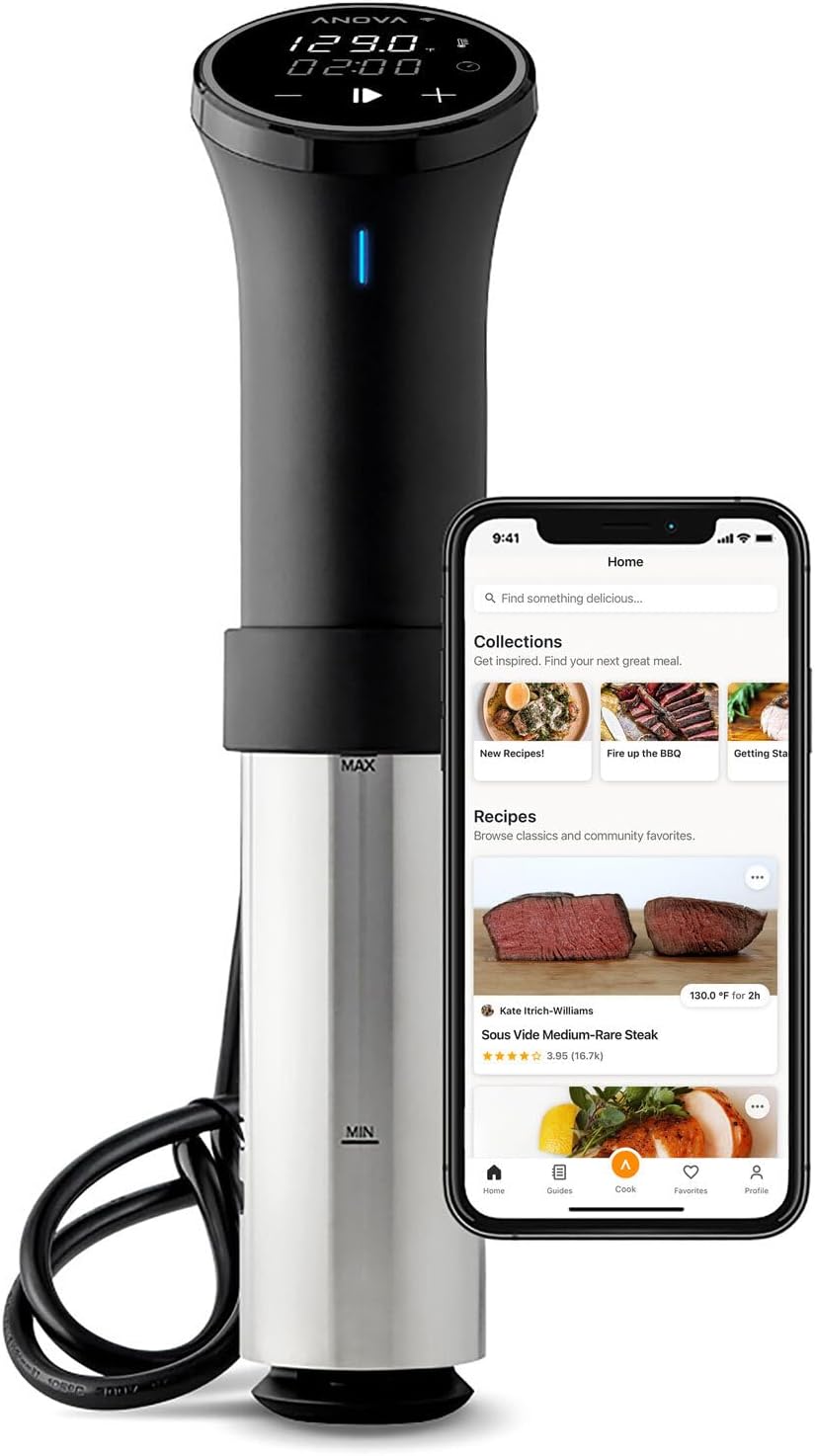
Offering 1100 watts and stainless steel construction, this cooker combines robust heating with WiFi connectivity. It supports control via the Anova app or the device itself. The premium price tag may deter casual users, but it delivers consistent performance for serious steak enthusiasts.
Brand: 4.4 4.4 out of 5 stars · Price when checked: $3500 · Rating: 4.4 out of 5 (58 ratings)
Pros
- High 1100 watt heating power
- Stainless steel for durability
- WiFi and app control options
Cons
- Expensive compared to similar models
- Some users report app connectivity issues
Best with accessory kit included: Yedi Infinity Sous Vide Cooker

This 1000-watt cooker comes with 20 reusable vacuum bags, a hand pump, container clips, and recipe book, providing a well-rounded starter pack. Its BPA-free materials add peace of mind. The one-year manufacturer warranty is standard but limited compared to some competitors.
Brand: YEDI HOUSEWARE · Price when checked: $89.99 · Rating: 4.4 out of 5 (13,738 ratings)
Pros
- Complete accessory kit included
- 1000 watt heater with precision temperature
- BPA, PFOA, PTFE, lead and cadmium free
Cons
- One-year warranty only
- Accessory quality varies by user
Best for larger batch cooking: Homtone All-in-One 8 Quart

Designed for bigger volumes, this 8 quart sous vide machine integrates the circulator and container. It offers a practical solution for cooking multiple steaks or larger cuts simultaneously. The price is higher and user feedback is limited, so it may not suit those prioritising portability or extensive user reviews.
Brand: Homtone · Price when checked: $149.99 · Rating: 4.6 out of 5 (7 ratings)
Pros
- Integrated all-in-one design
- Larger 8 quart capacity
- Simple controls
Cons
- Higher price
- Limited customer reviews
Best complete container kit: homenote Sous Vide Container

This kit includes a 12 quart BPA-free container, lid, rack, sleeve and cookbook but does not include a circulator. It’s ideal if you already own a sous vide machine and want a high-quality cooking vessel to improve water temperature stability and reduce evaporation.
Brand: homenote · Rating: 4.7 out of 5
Pros
- Large 12 quart capacity
- Includes lid and rack to aid cooking
- BPA-free materials
Cons
- No circulator included
- Not a standalone sous vide solution
Best fast heating with recipes: 5G WIFI Sous Vide Machine

With 1100 watts and app-guided recipes, this immersion circulator aims to provide quick heat-up and ease of use for steak cooks. Its WiFi connectivity supports remote monitoring. Lower user ratings suggest some reliability or usability issues to consider before purchase.
Brand: 5G · Rating: 4.1 out of 5
Pros
- High 1100 watt power
- 5G WiFi for stable connection
- Preloaded recipe guidance
Cons
- Lower overall user rating
- Less established brand
Best niche multi-use: CATTLEMAN Sous Vide Cooker with Wine Chiller

This 1000 watt sous vide cooker doubles as a wine chiller, offering multi-functionality in a single device. It’s a good fit for users who want more from their kitchen gadget but less suited for those focusing solely on sous vide steak cooking due to its niche features.
Brand: CATTLEMAN · Rating: 4.6 out of 5
Pros
- Multi-use as sous vide cooker and wine chiller
- 1000 watt power
- Includes recipe guide
Cons
- Specialised, not focused on sous vide alone
- May have compromises in each function
Best enhanced water circulation: Homtone Sous Vide Cooker 3D Water Circulation

This model emphasises 3D water circulation to improve temperature consistency around the steak. It supports precise temperature control and an 8 quart capacity. However, its lower user rating and less known brand suggest buyers should be cautious and consider alternatives.
Brand: Homtone · Rating: 3.9 out of 5
Pros
- 3D water circulation for even heat
- Precise temperature settings
- Adequate 8 quart capacity
Cons
- Lower user rating (3.9)
- Limited brand reputation
Who should consider skipping sous vide machines for steak
Sous vide cooking demands patience and equipment investment that may not suit everyone. If you prefer quick steaks with a traditional sear or have limited kitchen space, a sous vide machine might feel cumbersome.
Those who cook steaks infrequently may find it easier to rely on tried-and-true pan or grill methods. Also, without vacuum sealing equipment or suitable containers, the full benefit of sous vide is hard to achieve. Consider your cooking frequency, space, and willingness to manage longer cook times before committing.
Related reading
- The Best Kitchen Gadgets on Amazon
- Best FoodSaver Vacuum Sealer: Top Models & Reviews for 2026
- Top Rated Vacuum Sealers for Freezing Meat
Frequently Asked Questions
What temperature should I set for sous vide steak?
The ideal temperature depends on your preferred doneness. For medium rare, set around 54.4°C (130°F). Medium is about 60°C (140°F), and medium well reaches 65.5°C (150°F). Sous vide allows precise control, so you can target exact textures by adjusting temperature within ±1°C increments.
How long should I cook steak sous vide?
Typical cooking times range from 1 to 4 hours depending on thickness. For a 1-inch (2.5 cm) steak, 1 to 2 hours is sufficient. Thicker cuts up to 2 inches (5 cm) may benefit from 3 to 4 hours. Unlike traditional methods, sous vide maintains doneness without overcooking, so longer times mostly affect tenderness.
Do I need a vacuum sealer for sous vide steak?
Vacuum sealing removes air around the steak, improving heat transfer and preventing floating bags. While vacuum sealers provide the best results, heavy-duty zipper bags with water displacement methods can suffice for home cooks. However, air pockets increase cook times and risk inconsistent cooking.
Related: Top 7 oven thermometers for inaccurate ovens: precise temperature checks

Rimi Sultana is a home cook from Bangladesh who has cooked for her family every day for the past five years and writes about it at Smart Cooks. Perpetually testing whether internet-famous recipes actually work in a regular home kitchen. Say hello on Facebook or through the contact page.