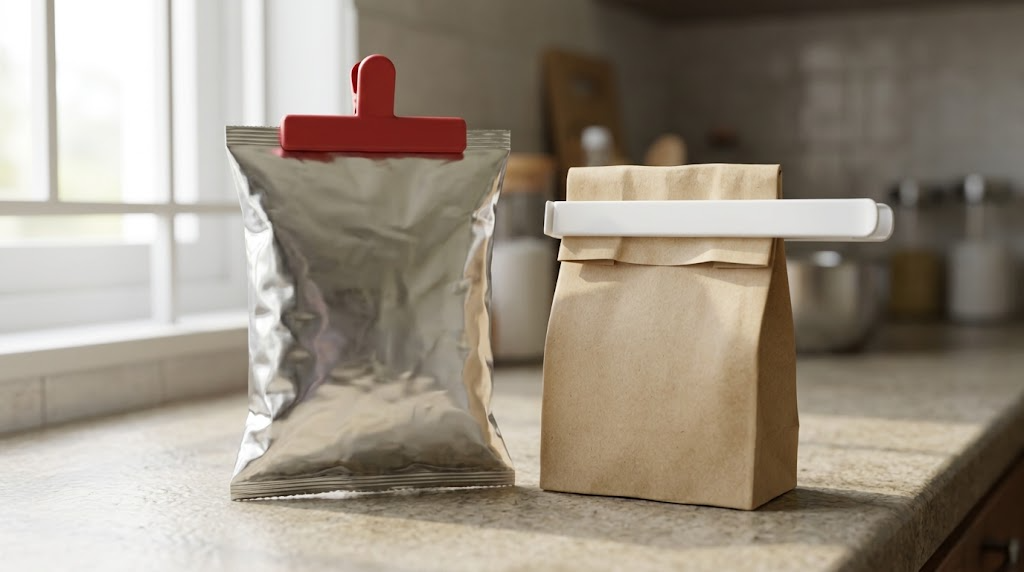
A half-eaten bag of chips left with just a fold and a rubber band goes stale embarrassingly fast. Chip clips and bag sealers both promise to fix this, but they don’t actually work the same way, and one is noticeably better at it.
Some links in this post are affiliate links. If you buy through them we may earn a small commission at no extra cost to you — it never changes which products we recommend.
What Actually Matters
Seal Quality, Not Just Grip
A clip that grips the bag shut isn’t the same as a clip that actually seals out air. Clips with a rubber or silicone gasket along the clamping edge press the bag material together tightly enough to meaningfully slow staleness, while bare plastic or metal clips mostly just hold the fold in place.
Size Range for Different Bags
Snack bags come in wildly different widths, from a slim pretzel bag to a wide family-size chip bag. A set with a range of clip sizes handles this better than a single uniform size that’s either too small to close a wide bag or oversized for a narrow one.
Material Durability
Plastic clips can crack over time, especially with repeated flexing on stiffer bags. Stainless steel clips with a silicone-coated grip tend to hold up longer and don’t leave sharp edges that catch on other pantry items.
From My Kitchen
I used binder clips from my desk drawer to seal snack bags for longer than I’d like to admit, and it worked fine until I noticed chips sealed that way went soft nearly a day faster than ones I’d started sealing with an actual gasketed chip clip afterward — the difference was more noticeable than I expected.
Worth Considering
The HOUSE AGAIN stainless steel chip clips are silicone-covered, which avoids sharp metal edges and grips well without crushing the bag opening. For a bigger assortment covering different bag widths, the 9-pack airtight chip bag clips mix large and small sizes for different snack bags.
What Actually Goes Stale, and How Fast
Two separate things happen to an open bag of snacks. Over hours and days, crisps and crackers absorb moisture from the air and go soft — that is humidity, and it is the problem you notice. Over weeks, the fats in them oxidise and turn rancid, which is oxygen, and it is the problem you notice only as a slightly stale, cardboard taste you cannot quite place. A clip handles the first reasonably well. Only a proper seal handles the second.
That distinction tells you which tool you need. If a bag of crisps is finished within three or four days, a good clip is genuinely enough and a bag sealer is overkill. If you buy in bulk, or keep nuts and seeds for months, oxygen is the real enemy and a heat sealer — which welds the bag shut rather than pinching it — makes a measurable difference to how they taste at the end of that period.
Quick Comparison
| Chip clip | Heat sealer | Vacuum sealer | |
|---|---|---|---|
| Blocks humidity | Good if the fold is tight | Very good | Excellent |
| Blocks oxygen | Poor | Good | Excellent |
| Reopening the bag | Instant, unlimited | Cut and reseal, bag shortens | Cut and reseal |
| Best timescale | Days | Weeks to months | Months |
| Cost and storage | Negligible | Small appliance | Larger appliance |
The Fold Matters More Than the Clip
Most clips are blamed for a job the user did not set up properly. Press the air out of the bag first, then fold or roll the top down two or three times so you are clipping through multiple layers rather than one, and put the clip across the middle of that roll. A single fold with a clip on it leaves gaps at both ends of the clip where air moves freely, which is why people conclude clips do not work.
Clip width matters for the same reason. A clip narrower than the bag leaves the corners open regardless of how well you fold, so match the clip to the bag rather than buying one size for everything. For large bags, two clips at either end of the fold work better than one in the middle.
Two Options Worth Considering
Best everyday clips: HOUSE AGAIN Stainless Steel Chip Clips
Stainless with a strong spring, which is the thing that separates a clip that holds a thick folded bag from one that slowly loses tension and slides off. Metal also avoids the brittleness plastic clips develop after a year in a warm kitchen.
Pros
- Strong spring holds a multi-layer fold
- Stainless, so no cracking over time
- Wide enough for standard snack bags
Cons
- Strong springs are hard for small hands
- Will not help with long-term oxygen exposure
Best value multipack: 9-Pack Airtight Chip Bag Clips
Having enough clips is more useful than having better clips, because the bag that goes stale is always the one you had no clip for. A multipack in mixed widths covers everything from a nut pouch to a family bag of crisps.
Pros
- Enough clips to actually cover the pantry
- Mixed widths suit different bag sizes
- Cheap to replace if one goes missing
Cons
- Springs are lighter than stainless clips
- Plastic can become brittle over time
Frequently Asked Questions
Do bag clips actually keep snacks fresh longer than folding the bag?
Yes, meaningfully — folding alone still leaves gaps for air to seep in, while a properly gasketed clip presses the bag material together tightly enough to noticeably slow staleness, especially for anything with a high fat content like chips.
Are clip-style sealers better than rolling and using a rubber band?
A tight roll with a rubber band can work reasonably well in a pinch, but it takes more effort each time and doesn’t seal as consistently as a clip designed specifically for the job, especially on stiffer or wider bags.
Do chip clips actually keep crisps fresh?
For a few days, yes, provided you press the air out and fold the bag two or three times before clipping. What they cannot do is stop slow oxidation over weeks, because the fold is not an airtight seal — air still moves through it gradually. For anything you are keeping longer than about a week, decanting into an airtight container with a gasket lid works far better than any clip.
Can I reseal a snack bag with a household iron?
With foil-lined bags, yes — that is exactly what a heat sealer does, just with better control. Fold the bag top flat, lay a sheet of baking parchment over it to protect both the bag and the iron, and press for a couple of seconds on a medium setting. Test on the empty top edge first, since too much heat melts straight through. Plain plastic bags that are not foil-lined often do not seal cleanly this way.

Rimi Sultana is a home cook from Bangladesh who has cooked for her family every day for the past five years and writes about it at Smart Cooks. Perpetually testing whether internet-famous recipes actually work in a regular home kitchen. Say hello on Facebook or through the contact page.