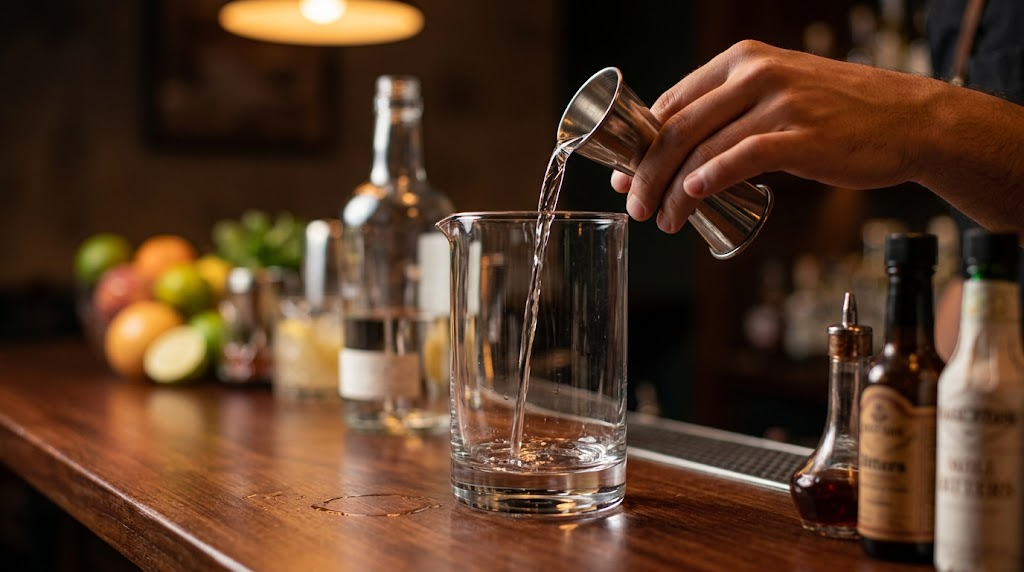
Eyeballing a pour looks effortless in movies, but at home it’s the fastest way to end up with a cocktail that’s either watery or way too strong. A jigger is the one tool that actually fixes this, once you know how to use it properly.
Some links in this post are affiliate links. If you buy through them we may earn a small commission at no extra cost to you — it never changes which products we recommend.
What Actually Matters
Filling to the Line, Not the Brim
The most common beginner mistake is filling a jigger all the way to the rim and calling it one measurement. Most jiggers are marked with an interior line just below the rim — that’s your actual 1oz or 2oz mark, with a small gap left to prevent spills.
Reading It at Eye Level
Pour on a flat, stable surface and check the measurement at eye level, not from above looking down. Looking down at an angle makes the liquid line appear higher than it actually is, throwing off your measurement more than people expect.
Double-Sided Design Saves Steps
A jigger with two different measurements on each end — like 1oz and 2oz — lets you measure two common pours without switching tools mid-drink, which matters when you’re making several cocktails back to back for guests.
From My Kitchen
My first few cocktails at home were rough — I was pouring straight from the bottle, guessing, and ending up with drinks that tasted nothing like the recipe promised. Once I started using an actual jigger and filling to the internal line instead of the rim, the same recipes suddenly tasted balanced, and I finally understood why bartenders bother with them at all.
Worth Considering
The A Bar Above Japanese-style jigger has ten internal measurement lines etched inside, which is genuinely useful once you start following recipes with odd amounts like 0.75oz. For something simpler with just the two standard measurements, the Professional Bartender Jigger covers the basics well.
Why Bartenders Measure Everything
A cocktail is a ratio, and the margin for error is smaller than it looks. A Daiquiri at 2 : 1 : 0.75 works; the same drink with a quarter-ounce too much lime tastes thin and sour, and a quarter-ounce too much syrup tastes cloying. That is a difference of roughly 7 ml — about a teaspoon and a half — which is well inside the error range of free-pouring. Bartenders measure not because they lack skill but because the drink is defined by proportions they cannot afford to guess at.
The other reason is repeatability. If you free-pour a drink that turns out excellent, you have learned nothing you can use again. If you measured it, you have a recipe. Almost everyone who starts weighing or measuring drinks reports the same thing: their cocktails do not just get better, they get consistently good, which is the harder problem.
Quick Comparison
| Japanese-style jigger | Standard bell jigger | |
|---|---|---|
| Shape | Tall, narrow, sharply tapered | Short and wide |
| Interior markings | Usually several graduations | Often just the two ends |
| Accuracy at small volumes | Good — narrow bore magnifies the level | Poor — a wide base hides small differences |
| Pouring control | Precise, narrow lip | Spills more easily |
| Typical sizes | 1 oz / 2 oz with 0.25 increments | 0.75 oz / 1.5 oz |
The Sizes That Actually Matter
A 1 oz / 2 oz jigger with interior markings at 0.25, 0.5 and 0.75 covers virtually every classic cocktail. The older 0.75 oz / 1.5 oz bell jigger is still common and still works, but it forces you to combine pours for anything that is not one of its two volumes, and every extra pour is another chance to overshoot. If you are buying your first jigger, buy the 1 / 2 with internal graduations.
One habit worth adopting: fill to the line, not to the brim. A jigger filled to the rim carries a meniscus that can add several millilitres, and if you are pouring two or three ingredients that way, the drink ends up noticeably larger and weaker than intended. Fill to the marking, pour with the jigger fully inverted so nothing is left behind, and the numbers stay honest.
Two Jiggers Worth Considering
Best overall: A Bar Above Japanese-Style Jigger
The tall, narrow shape is the reason to buy this style — a small volume difference shows up as a visibly different level, so you can actually see when you have overshot. Interior graduations mean you rarely need a second measure for a single ingredient.
Pros
- Interior markings for quarter-ounce increments
- Narrow bore makes small volumes easy to read
- Pours cleanly without dribbling
Cons
- Tall shape tips more easily on a crowded bar
- Costs more than a basic bell jigger
Best budget option: Professional Bartender Jigger
A straightforward, inexpensive way to stop free-pouring, which is the single biggest improvement most home bars can make. Less refined to read than a Japanese-style jigger, but the drinks it produces are dramatically more consistent than eyeballed ones.
Pros
- Cheap enough to buy a spare
- Sturdy and easy to clean
- Does the core job properly
Cons
- Fewer interior graduations
- Wider bore makes small pours harder to judge
Frequently Asked Questions
What sizes should a beginner’s jigger have?
1oz and 2oz cover the vast majority of standard cocktail recipes. Once you’re comfortable, a jigger with additional lines for 0.5oz and 0.75oz makes it easier to follow more precise recipes without estimating.
Can I use a shot glass instead of a jigger?
Shot glasses vary wildly in actual volume between brands, so they’re unreliable for consistent cocktails. A proper jigger is calibrated to an exact measurement, which matters more once you’re trying to replicate a drink you liked.
Can I just use a measuring spoon or shot glass?
Measuring spoons work for small quantities — a tablespoon is a half ounce, which covers many syrup and liqueur measures — but they are slow and awkward to pour from. Marked shot glasses are the better substitute, provided the markings are moulded into the glass rather than printed on the outside, since printed ones wear off in the dishwasher within months. What genuinely does not work is an unmarked shot glass, since sizes vary wildly between them.
Should I measure by weight instead?
Some bartenders do, and for syrups it is arguably more accurate since a viscous syrup clings to the inside of a jigger. For home use it is usually more fuss than it is worth, because you need to zero the scale between every ingredient while the ice is melting. The exception is batching — if you are making eight drinks at once for guests, scaling by weight is faster and more accurate than eight rounds of jigger pours.

Rimi Sultana is a home cook from Bangladesh who has cooked for her family every day for the past five years and writes about it at Smart Cooks. Perpetually testing whether internet-famous recipes actually work in a regular home kitchen. Say hello on Facebook or through the contact page.