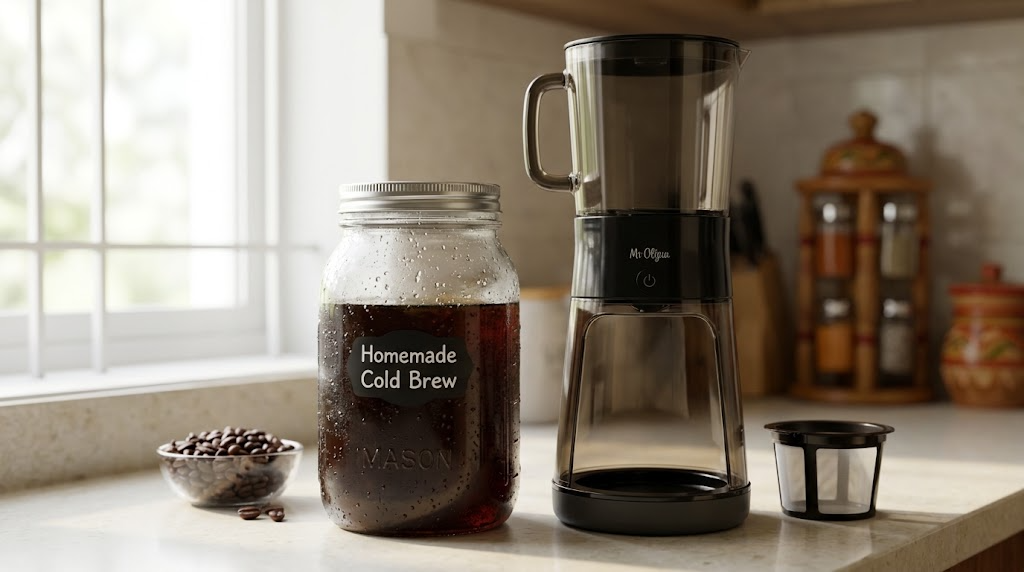
Cold brew technically just needs coarse grounds, cold water, and time — you can genuinely make it in any jar with a strainer. So the real question with a dedicated cold brew maker isn’t whether it works, it’s whether the convenience is worth the counter space and cost.
Some links in this post are affiliate links. If you buy through them we may earn a small commission at no extra cost to you — it never changes which products we recommend.
What a Dedicated Maker Actually Adds
Built-In Filtration
A dedicated cold brew maker usually has a fine mesh or filter insert built into the design, so you steep and then simply lift the filter out, leaving clean concentrate behind. A jar setup means straining through cheesecloth or a separate strainer afterward, which is messier and loses some liquid in the process.
Storage-Ready Design
Many cold brew makers double as the storage pitcher, so once brewing is done, it goes straight into the fridge without transferring to another container. A jar-and-strainer setup usually means dirtying an extra vessel for storage.
Consistent Grounds-to-Water Ratio
Dedicated makers often have fill lines or clear markings that make hitting a consistent ratio easier batch after batch, which matters if you want your cold brew concentrate to taste the same every time.
From My Kitchen: What Actually Changed When I Bought One
I made cold brew in a large mason jar with cheesecloth for over a year before buying a dedicated maker, and honestly, the coffee itself tasted essentially the same either way — cold brew’s flavor comes from the steep time and ratio, not the equipment. What changed was the process: straining a full jar through cheesecloth over a bowl was messy and I usually lost a noticeable amount of liquid caught in the cloth. The dedicated maker’s built-in filter meant I could just lift it out clean, with far less waste and no separate straining step. If a bit of mess and a lost splash of coffee doesn’t bother you, a jar works fine. If you make cold brew often, the convenience adds up.
Worth Considering
Takeya’s deluxe cold brew maker has a well-designed airtight lid and built-in filter that make the process noticeably less messy.
Zulay’s large-capacity cold brew maker is worth it if you brew bigger batches at once.
What a Dedicated Maker Actually Adds Over a Jar
Cold brew is not a technique that needs equipment. Coffee, cold water, twelve to eighteen hours, then filter — a jar does all of it. What a dedicated maker adds is the filtering stage, which is the part that is genuinely annoying without one. Straining a jar of steeped grounds through a paper filter is slow, messy and usually requires two passes, and the coffee left behind in the grounds is coffee you paid for.
A maker with a built-in mesh basket lets you lift the grounds out in one motion. That is the whole value proposition, and whether it is worth paying for depends entirely on how often you make cold brew. Once a summer, a jar and a sieve are fine. Twice a week through July and August, lifting a basket out instead of filtering is a real quality-of-life improvement.
Quick Comparison
| Dedicated cold brew maker | Jar and filter | |
|---|---|---|
| Filtering effort | Lift the basket out | Slow pour through a filter, often twice |
| Clarity of the result | Good, sometimes slight fines | Very good with a paper filter |
| Storage of the finished brew | Same vessel, sealed | Needs decanting into a bottle |
| Cost | Moderate | Essentially nothing |
| Best for | Regular cold brew drinkers | Occasional batches |
The Variables That Actually Change the Taste
Grind size matters most. Cold brew wants a coarse grind, similar to French press or slightly coarser — fine grounds over-extract during such a long steep and produce a muddy, bitter concentrate, as well as clogging any mesh filter. The second is ratio: around 1:5 coffee to water by weight for a concentrate you will dilute, or 1:8 for something drinkable straight from the fridge.
Time is more forgiving than people assume. Twelve hours at room temperature or eighteen in the fridge both work, and an extra few hours will not ruin a batch the way over-extracting hot coffee would — cold water simply extracts far more slowly and selectively. What does ruin it is leaving the grounds in beyond about 24 hours, at which point bitterness finally catches up.
Two Makers Worth Considering
Best overall: Takeya Deluxe Cold Brew Maker
The airtight seal and the lift-out mesh basket are the two features that matter, and both are well executed. It brews and stores in the same vessel, which removes the decanting step that makes the jar method tedious.
Pros
- Lift-out basket removes the filtering chore
- Airtight lid, so it stores in the fridge cleanly
- Fits comfortably in a fridge door
Cons
- Mesh lets a few fines through
- Capacity suits one or two people rather than a crowd
Best for larger batches: Zulay Large-Capacity Cold Brew Maker
Worth choosing if you drink cold brew daily through summer, since brewing a bigger batch less often is the real convenience. Same basket principle, more volume, and it saves the weekly rebrew.
Pros
- Large batch means brewing less often
- Same lift-out basket convenience
- Sturdy enough for regular handling
Cons
- Takes up a full fridge shelf
- Heavy when full
Frequently Asked Questions
Can I really make good cold brew in just a jar?
Yes — the coffee quality depends mostly on grind size, ratio, and steep time, all of which you control the same way regardless of the container. A dedicated maker mainly improves convenience, not the coffee itself.
How long should cold brew steep?
Most recipes call for 12 to 24 hours at room temperature or in the fridge, with longer steeps producing a stronger, more concentrated result.
Do I need special coarse-ground coffee for cold brew?
Yes, this part does matter regardless of equipment — a coarse grind is important, since fine grounds over-extract during the long steep and can also clog filters more easily.
Does cold brew need to steep in the fridge or on the counter?
Both work and they produce slightly different results. Room temperature extracts faster, so twelve hours is usually enough and the result tastes a little fuller and rounder. The fridge extracts more slowly — sixteen to eighteen hours — and gives a cleaner, brighter cup. Neither is unsafe over these timescales. If your kitchen is very warm, use the fridge, because extraction accelerates with temperature and a hot kitchen can push a batch bitter.
Why is my cold brew cloudy and gritty?
The grind is too fine. Fines pass straight through mesh filters and settle as sediment in the bottom of the glass, and they also over-extract, which is why gritty cold brew usually tastes harsh as well. Go coarser — the grounds should look like coarse sea salt. If your grinder cannot manage that consistently, filtering the finished concentrate once through a paper filter will clean it up.
Related: Top 8 drip coffee makers for morning routines that deliver consistent brews

Rimi Sultana is a home cook from Bangladesh who has cooked for her family every day for the past five years and writes about it at Smart Cooks. Perpetually testing whether internet-famous recipes actually work in a regular home kitchen. Say hello on Facebook or through the contact page.