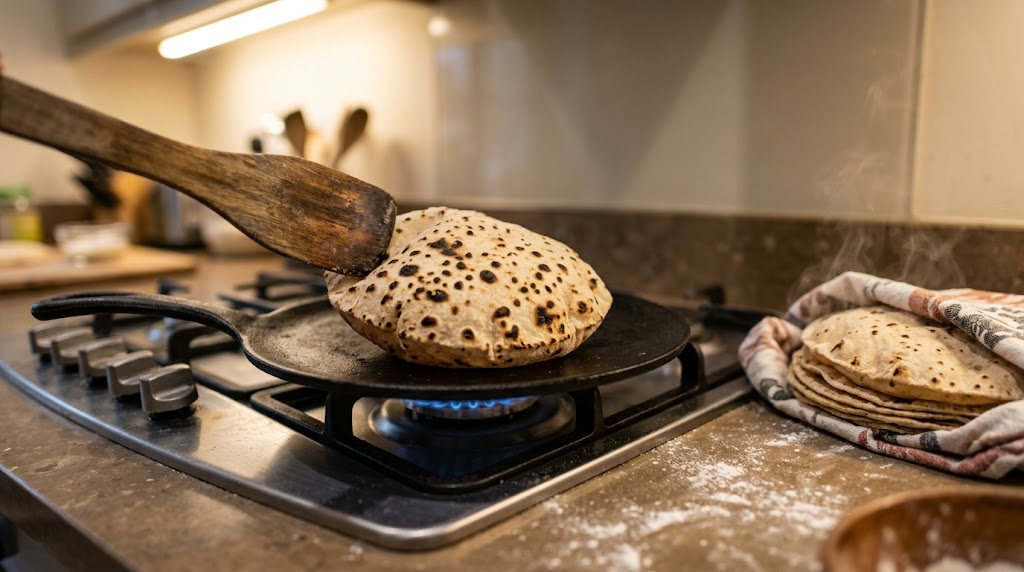
A tawa is the least interesting-looking pan in any South Asian kitchen and the one that gets used most. Roti, paratha, dosa, chila, the quick reheat of yesterday’s luchi — all of it happens on a flat disc of metal that costs less than a mid-range saucepan.
Some links in this post are affiliate links. If you buy through them we may earn a small commission at no extra cost to you — it never changes which products we recommend.
Buying one is mostly a decision about two things: material and shape. Everything else is noise. Cast iron holds heat and gives roti the dark blistered spots you want but takes minutes to warm up and needs seasoning. Thin iron heats fast and is what phulka-makers actually reach for. Nonstick is the weeknight compromise and the only sensible choice for dosa if you are not confident. Flat, concave and convex are three different tools that happen to share a name.
Below are seven that cover those cases honestly, including which ones are wrong for you. This guide pairs with our masala dabba guide and the kadai roundup if you are building out a South Asian kitchen from scratch.
Flat, Concave or Convex — Pick the Shape First
- Flat tawa — the default. Roti, paratha, dosa, uttapam, quesadillas, grilled sandwiches. If you buy one tawa, buy this.
- Concave tawa (dips in the middle) — holds oil in the centre. Better for shallow-frying, poori-adjacent things, and vegetables. Not ideal for dosa, because batter pools.
- Convex tawa (domes upward) — this is the roomali roti / khakhra shape. It is a specialist tool and most home kitchens never need one.
Then material. Cast iron for flavour, heat retention and browning; light iron for speed and phulka work; nonstick for dosa and low-fat cooking; hard-anodized as a middle path.
Our Top 7 Picks for the Best Tawa
Best Overall: Victoria 12-Inch Cast Iron Tawa Dosa Pan

Victoria is a Colombian foundry that has quietly become the default recommendation for cast iron tawas in North America, and the 12-inch is the size that suits most households: big enough for a full-size roti or a respectable dosa, small enough to store and to lift with one hand.
The surface arrives pre-seasoned with flaxseed oil rather than a generic vegetable blend, which means it comes closer to usable out of the box than most. The loop handle opposite the main handle is not decorative — a cast iron tawa this size is heavy, and two-handed lifting is how you avoid dropping it on a glass cooktop.
The trade-off is the one every cast iron pan asks for: it takes three or four minutes on medium to come up to a proper working temperature, and it stays hot long after you have turned the flame off. Plan the first roti as a sacrifice while the pan settles.
Pros
- Genuinely even heat once hot — the blistering on roti is noticeably better than on thin pans
- Pre-seasoned with flaxseed oil, so it needs less work before first use
- Loop handle makes a heavy pan manageable
- Works on gas, electric, induction and in the oven
Cons
- Slow to preheat — not a grab-and-go pan
- Heavy enough that some people find it awkward to store
- Needs drying and occasional oiling or it will rust
Best for Dosa: Hawkins Futura 30 cm Nonstick Induction Dosa Tava

Thin, crisp dosa on cast iron is a skill. Thin, crisp dosa on a good nonstick tava is much closer to a procedure, and that difference matters if dosa is something you want to make on a Tuesday rather than as a project.
At 30 cm this is properly dosa-sized, and the Futura body is thick hard-anodized aluminium rather than the flimsy pressed stuff, so it spreads heat instead of developing a hot ring where the burner sits. The induction base means it works on every hob type.
Understand what you are buying, though: nonstick is a consumable surface. Treat it with moderate heat and wooden or silicone tools and it will last years; run it screaming hot for the crispest possible dosa, which is the temptation, and you will shorten its life considerably.
Pros
- 30 cm gives you a genuinely full-size dosa
- Thick hard-anodized body spreads heat evenly
- Batter releases cleanly — a big deal for beginners
- Induction compatible
Cons
- Nonstick means moderate heat only and no metal tools
- Will not develop the char that cast iron gives
- The coating is a wear item, not a lifetime surface
Best Budget Cast Iron: PANCA Pre-Seasoned Cast Iron Tawa, 24 cm

If you want to find out whether cast iron suits how you cook before spending properly, this is the sensible way in. At 24 cm it is a roti-and-paratha pan rather than a dosa pan, and it is light enough to handle one-handed, which the 12-inch pans are not.
It arrives pre-seasoned, and like most budget cast iron it benefits from two or three rounds of your own oiling and heating before the surface really settles. That is normal and not a defect.
The honest limitation is thickness. Budget cast iron is generally thinner than premium cast iron, so it holds slightly less heat and recovers slightly slower between rotis. In practice, for one or two people, you will not notice.
Pros
- Low-risk way to try cast iron
- 24 cm is easy to lift, store and hand-wash
- Works on gas and induction
- Right size for standard chapati
Cons
- Too small for full-size dosa
- Needs a few extra seasoning rounds to reach its best
- Thinner than premium cast iron, so slightly less heat retention
Best for Phulka: Light Iron Roti Tawa, 26 cm

Phulka — the roti that puffs into a ball over an open flame — is not really a cast iron job. You want a pan that heats fast, cooks the roti in under a minute, and lets you flip it straight onto the burner while it is still pliable. Thin pressed iron does exactly that.
This is the pan style you will find in most South Asian kitchens for daily roti, and its virtues are speed and lightness rather than heat retention. It comes up to temperature in about a minute and it weighs little enough to lift and tilt repeatedly without your wrist complaining.
It is bare iron, so it will rust if you leave it wet. It also warps if you subject it to sudden extreme temperature changes, which mainly means: do not run a hot tawa under cold water.
Pros
- Heats in about a minute — the fastest pan here
- Light enough for constant flipping and tilting
- The right tool if you make roti daily
- Inexpensive
Cons
- Rusts readily if not dried and oiled
- Thin metal can warp with thermal shock
- Poor heat retention — not for dosa or anything that needs steady heat
Best Large: Victoria 15-Inch Cast Iron Tawa

The 15-inch is for people who are cooking for a household rather than a couple: full-diameter dosa, several parathas at once, or a whole batch of chapati staged while you finish a curry.
Everything good about the 12-inch applies, only more so, and the same is true of the drawbacks. This pan is genuinely heavy. Check it fits your burner and your storage before you commit — on a small apartment hob it will overhang, and the edges will run cooler than the middle.
For large families or anyone who regularly cooks for guests, it is the better buy. For one or two people it is more pan than the job needs.
Pros
- Full-size dosa without compromise
- Cook multiple parathas simultaneously
- Excellent heat retention across a batch
- Same flaxseed pre-seasoning as the 12-inch
Cons
- Heavy — two hands, always
- Overhangs small burners, giving uneven edge heat
- Storage is a genuine consideration
Easiest to Find: Lodge Round Cast Iron Griddle, 10.5 Inch

Lodge does not call this a tawa and it is not designed as one, but it is a flat, pre-seasoned cast iron disc of roughly the right size, and it is stocked almost everywhere in North America. If you want cast iron this week rather than after a shipping wait, this is the practical answer.
It cooks roti and paratha well. The differences from a purpose-made tawa are real but modest: the rim is slightly more pronounced, the handle is a stub rather than a full grip, and the surface is a little rougher out of the box than Victoria’s.
At 10.5 inches it is on the small side for dosa. Treat it as a roti and paratha pan and it does the job.
Pros
- Available almost everywhere, often same-day
- Lodge pre-seasoning and a long track record
- Genuinely inexpensive
- Oven and grill safe like any Lodge piece
Cons
- Not designed as a tawa — the geometry is a compromise
- Short stub handle is awkward on a heavy pan
- Too small for proper dosa
- Rougher initial surface than premium options
Best Traditional Cast Iron with Handle: Cast Iron Roti Tawa, 26 cm

This is the shape most people picture when they think tawa: a flat cast iron disc with a single long handle, 26 cm across, sized for chapati rather than dosa.
The long handle is the reason to choose this over a loop-handled pan. It lets you lift and tilt with one hand while the other works the roti, and it keeps your knuckles further from the flame. On a heavy cast iron pan that leverage is worth having.
As with all bare cast iron, the first few uses are a settling-in period. Cook something fatty on it early — paratha with ghee is ideal — and the surface will improve quickly.
Pros
- Traditional geometry that suits roti and paratha
- Long handle gives good one-handed control
- Cast iron heat retention at a modest price
- Induction and gas compatible
Cons
- Handle gets hot — keep a cloth nearby
- Slow preheat, as with all cast iron
- Needs seasoning maintenance
How to Season and Keep a Tawa
- First use: wash, dry completely on the flame, then rub a thin film of neutral oil over the surface and heat until it just smokes. Cool, and repeat two or three times.
- After every use: scrape with a stiff brush or coarse salt while still warm. Soap occasionally is fine on a well-established surface; soaking never is.
- Dry it on the flame, not on a rack. Residual water is what causes rust, and a cast iron pan looks dry long before it actually is.
- If it rusts: scrub the rust off with steel wool, wash, dry, and re-season. Rust is a setback, not a death sentence.
- Nonstick tawas want none of the above — just moderate heat, soft tools, and no dry preheating.
From My Kitchen
The mistake I made, and that I see repeated constantly, was expecting one tawa to do every job. I bought a good cast iron pan, loved it for paratha, and then spent months blaming myself for bad dosa. The pan was not the problem and neither was my technique — cast iron holds heat so well that by the third dosa the surface is hotter than the batter wants, and the batter grabs before you can spread it.
What actually fixed my dosa was owning two pans. The cast iron does roti, paratha, and anything that wants char. A separate nonstick tava does dosa and chila. Between them they cost less than one premium skillet and they cover everything. If you are choosing your first tawa and dosa matters to you, start with nonstick and add cast iron later — not the other way round, which is the order most people do it in.
One small thing on seasoning: the fastest way I have found to bring a new cast iron tawa up to a genuinely usable surface is not repeated oil-and-bake cycles, it is cooking parathas on it. Four or five ghee-heavy parathas do more for the surface than three rounds of careful seasoning, and you get dinner out of it.
FAQ
Cast iron or nonstick tawa — which should I buy first?
It depends on what you cook most. If that is roti and paratha, buy cast iron; the browning and heat retention are worth the maintenance. If it is dosa, chila or anything thin and batter-based, buy nonstick first. Most households that cook South Asian food regularly end up with both.
Why does my roti stick to a new cast iron tawa?
The seasoning is not established yet. New cast iron, even pre-seasoned, needs several cooking sessions before the surface becomes genuinely slick. Cook something fatty on it early — parathas are ideal — and the problem resolves itself within a week of normal use.
Can I use a tawa on an induction hob?
Cast iron and plain iron tawas work on induction without any special features, because the material itself is magnetic. Aluminium and hard-anodized tawas only work if the manufacturer has bonded an induction base — check the listing, because many are gas-only.
What size tawa should I buy?
24–26 cm for chapati and paratha, which suits most households. 30 cm and up if dosa is a regular thing. Buying larger than your burner is a common mistake — the pan edge stays cool and food cooks unevenly.
Rimi Sultana is a home cook from Bangladesh who has cooked for her family every day for the past five years and writes about it at Smart Cooks. Perpetually testing whether internet-famous recipes actually work in a regular home kitchen. Say hello on Facebook or through the contact page.