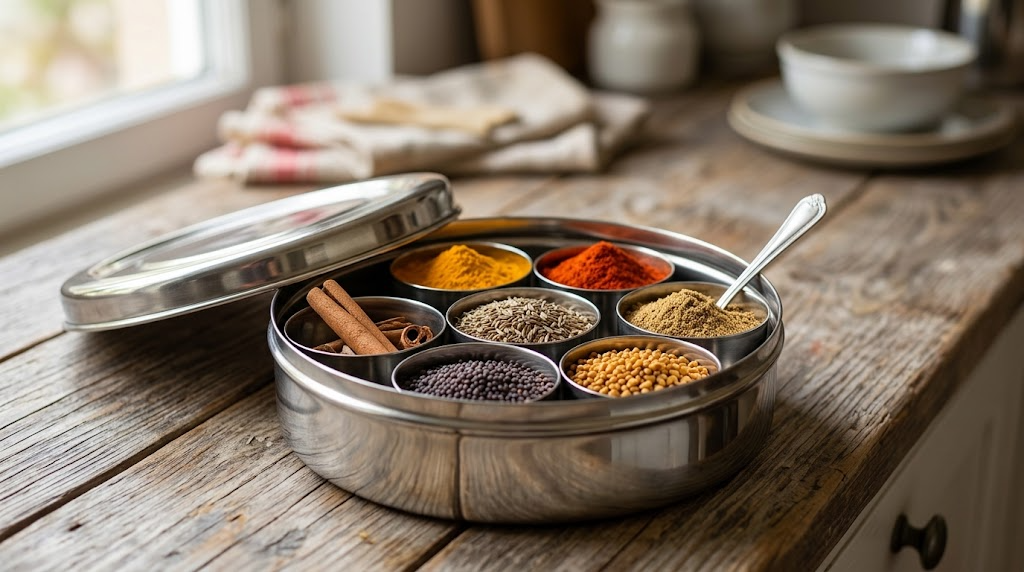
Here is what a spice rack gets wrong about South Asian cooking: the jars. When tarka is in the pan — oil hot, cumin seeds thirty seconds from perfect — nobody has time to find a jar, twist a lid, shake, twist it back, and find the next one. Whole spices go in by the pinch and the half-spoon, in sequence, fast. The masala dabba exists for exactly that tempo: one round tin, one lid, seven small bowls of your working spices open at once, a spoon riding on top.
Some links in this post are affiliate links. If you buy through them we may earn a small commission at no extra cost to you — it never changes which products we recommend.
It is the single most-touched object in millions of kitchens across India and Bangladesh, and its design has not changed in generations because it does not need to: stainless bowls that lift out for refilling, an inner lid or tight outer seal to keep humidity off the turmeric, and a size that lives beside the stove, not in a cupboard.
This is a guide written with real affection — a dabba is usually the first thing set up in a new kitchen and the thing that goes in the suitcase when someone moves abroad. Here are seven worth buying, and how to load one properly.
Our Top 7 Picks for the Best Masala Dabba
Best Overall: Vinod 7-in-1 Stainless Steel Spice Box with Lid

Vinod is a proper Indian stainless housewares brand — the kind whose tins your grandmother’s kitchen might actually contain — and this 7-bowl dabba is the standard article done right: honest-gauge stainless that does not dent at a look, bowls that sit snug without rattling, and a lid that seats flat and true.
Seven bowls is the traditional count for a reason: it maps onto the working set of an everyday South Asian kitchen — cumin, coriander, turmeric, chilli, mustard seed, garam masala, and the seventh for whatever your house cooks most. Buy this one if you want the real thing without a decision tree.
Key Specifications
- 7-compartment stainless masala dabba
- Established Indian brand construction
- Removable bowls with spice spoon
- Flat-seating outer lid
Pros
- Proper gauge stainless, no rattle and no dents
- The traditional 7-bowl working layout
- Bowls lift out for refills and washing
- A brand with an actual track record
Cons
- No transparent lid — you learn the layout by heart
- Round footprint takes real counter space
- One spoon; you will want a second
Best With Inner Lid: Nature’s Own 9-Compartment Masala Dabba

The inner lid is the humidity technology of the dabba world — a second flat plate that rests directly over the bowls under the main lid, so opening the tin does not bathe all nine spices in kitchen steam. In a monsoon climate, or any kitchen where rice is always boiling, that second seal is why the turmeric still pours in September.
Nine compartments extends the working set to the whole-spice tier — cardamom, clove, cinnamon — without a second tin. If your cooking runs biryani-deep rather than weeknight-wide, nine is your number.
Key Specifications
- 9 stainless compartments
- Inner sealing lid over the bowls
- Spice spoons included
- Larger working capacity
Pros
- Inner lid genuinely protects against humidity
- Nine bowls cover whole and ground tiers
- Solid stainless throughout
- Right for serious spice rotations
Cons
- Bigger diameter — measure your shelf
- More bowls means more refill admin
- Inner lid is one more thing to wash
Best Classic Budget: Priya 7-Bowl Stainless Dabba with Spoon

The Priya is the dabba as commodity classic: seven bowls, a spoon, honest stainless, familiar price. It is what half the diaspora actually owns, bought from the local Indian grocery in the first month of a new city, still in service fifteen years later.
At the budget end, gauge is the thing to check on arrival — thin steel dents and thin lids warp. This one sits on the right side of that line, which is exactly why it earns its slot over anonymous alternatives.
Key Specifications
- 7-bowl classic format
- Stainless steel with spoon
- Standard 8 to 9 inch diameter
- Budget price point
Pros
- The proven, ubiquitous standard
- Cheapest honest entry to a real dabba
- Light enough to shelf anywhere
- Replacement-friendly price
Cons
- Thinner gauge than Vinod
- No inner lid
- Basic finish
Best Traditional Wood: Ajuny Handcrafted Wooden Spice Box with Glass Lid

The wooden dabba is the heirloom-aesthetic branch of the family: a handcrafted square box, fixed compartments, and a sliding glass lid that turns the spices themselves into the display. On an open shelf it is as much an object as a tool, and glass means you see levels at a glance instead of lifting lids.
Two honest trade-offs: wood asks to stay dry (wipe, never wash the box), and fixed compartments mean refilling in place rather than lifting bowls out. It trades a little workflow for a lot of beauty — know which you are optimising for.
Key Specifications
- Handcrafted wooden box, 9 x 9 inches
- 9 fixed compartments
- Sliding glass display lid
- Artisan-made
Pros
- Genuinely beautiful on an open shelf
- Glass lid shows contents and levels
- Handcrafted character
- Makes a lovely gift
Cons
- Wood must be kept dry — no washing the box
- Fixed compartments are slower to refill
- Glass lid can seat loosely with wood movement
Best Large Capacity: KSJONE Large Stainless Spice Tin

Household scale is real: a family cooking two South Asian meals a day empties standard dabba bowls weekly, and constant refilling from big packets is the hidden chore of the small tins. The large-format KSJONE fixes it with deeper bowls in a wider tin — the same one-lid workflow, twice the runway between refills.
It is also the right scale if your cooking spoon is honest &mdashh; some of us measure cumin in gestures, not teaspoons.
Key Specifications
- Large-diameter stainless tin
- Deep high-capacity bowls
- Classic lift-out bowl format
- Curry-kitchen working scale
Pros
- Refill half as often
- Deep bowls suit generous cooking
- Same fast open-tin workflow
- Sturdy build at size
Cons
- Genuinely big — measure the shelf first
- Heavy when fully loaded
- Overkill for occasional cooks
Best Design Details: KSJONE 7-Jar Designer Masala Dabba

The designer variant of the classic: etched lid, finished edges, and a presentation polish that moves the dabba from backstage tool to something you can set on the table when guests ask — and with this kind of box, they ask.
Underneath the finish it remains a proper 7-bowl stainless dabba, which is the point. Decoration on top of function is a gift; decoration instead of function is a regret.
Key Specifications
- 7-bowl stainless dabba
- Decorative etched lid and finish
- Spoons included
- Gift-grade presentation
Pros
- Looks as good as it works
- Real dabba function underneath
- Strong gift for a new kitchen
- Etching hides fingerprints and wear
Cons
- Finish costs a premium
- Etched surfaces need gentler scrubbing
- Same no-window layout memorisation
Best Sealed Bowls: Stainless Dabba with 12 Individually-Lidded Spice Bowls

Twelve bowls, each with its own small lid, inside the sealed main tin — the belt-and-braces build for humid climates, long storage, or the spice collection that has outgrown seven working staples. Individual lids also make each bowl portable: the biryani set travels to the pot, the chai set to the kettle.
The trade is speed: twelve small lids is not tarka tempo. Plenty of households run both — a fast open seven by the stove, and a sealed twelve as the reserve bench.
Mine runs clockwise from the handle side, and the order is not decorative — it is the order things go into the pan. Panch phoron first, then whole jeera, then haldi, chilli powder, dhania powder, a little garam masala, and salt in the centre bowl. Once your hand knows the positions you stop looking into the box at all, and that is the whole argument for a dabba over a spice rack.
Haldi runs out first, always, by a wide margin — I refill it twice for every one time I refill anything else. Garam masala I deliberately keep in the smallest quantity, because it goes stale fastest and a dabba is a working box, not storage.
Key Specifications
- 12 bowls with individual lids
- Sealed outer stainless tin
- Portable per-bowl format
- Large collection capacity
Pros
- Best humidity protection of the group
- Bowls travel to the pot individually
- Covers a full extended spice set
- Doubles as backstock storage
Cons
- Twelve lids is slow for daily tarka
- Most expensive format here
- Lids are small and losable
The Ultimate Buying Guide for Masala Dabbas
Why a Dabba Beats a Spice Rack for This Cooking
Spice racks optimise for storage; dabbas optimise for sequence. South Asian cooking front-loads its seasoning — whole spices bloomed in hot oil in a specific order, ground spices layered in moments later — and the cost of hunting jars mid-tarka is burnt cumin. One lid, seven open bowls, one spoon: the dabba is a mise en place that never gets put away. Racks still have a job — the deep collection, the backstock — and our guide to organising spices in a small kitchen covers that half.
The Classic Seven (and What Actually Goes in Yours)
Tradition suggests; your cooking decides. A common working set: cumin seeds, ground coriander, turmeric, red chilli powder, black mustard seeds, garam masala, and a seventh that tells you whose kitchen it is — panch phoron in a Bengali house, whole dried chillies, fenugreek, or amchur elsewhere. The only rule that matters: the dabba holds the spices you touch daily. Everything else lives in the backstock.
What Separates a Good Tin From a Cheap One
- Steel gauge — thin tins dent and thin lids warp until they no longer seal; weight in the hand is the tell
- An inner lid if your kitchen runs humid — it is the difference between powder and clumps in month three
- Bowls that lift out smoothly for refilling but do not rattle in transit
- A lid that seats flat — spin it on and check; wobble now is a stale-spice guarantee later
- Diameter checked against your shelf — 8 to 9 inches is standard, the large tins notably more
Keeping the Spices Alive
The dabba’s one weakness is the whole-tin-open moment: light, air and steam touch everything at once. Work with the lid off for seconds, not minutes, and keep the tin beside the stove but not over it — heat is the fastest killer of ground spice. Refill bowls from sealed backstock packets rather than storing months of supply in the tin; small amounts often refreshed beats large amounts slowly dying. And ground spices fade in months, not years — when the colour dulls and the smell needs coaxing, the bowl is telling you something.
The Grinding Upgrade
A dabba full of freshly ground spices is a different instrument entirely. Whole cumin and coriander, toasted thirty seconds on a dry pan and ground weekly, will re-teach you what those words mean — and the stone tools in our molcajete guide (or the spice-specialist ChefSofi in it) are precisely the companion purchase. Grind weekly, refill the bowls, cook loudly.
Frequently Asked Questions About Masala Dabbas
What spices go in a masala dabba?
Whatever you reach for daily — the traditional starting seven is cumin seed, ground coriander, turmeric, red chilli, black mustard seed, garam masala, and a house choice like panch phoron or fenugreek. It is a working set, not a museum display; if a bowl has not been touched in a month, evict it for something you use.
How long do spices stay fresh in a dabba?
Ground spices at their best for two to three months in a well-sealed tin away from heat and light; whole spices several times longer. The dabba’s job is convenience, not preservation — keep backstock sealed elsewhere and refill in small amounts. An inner-lid dabba stretches every one of those numbers in a humid kitchen.
Can I put the dabba bowls in the dishwasher?
Stainless bowls and tins, yes — though a rinse and dry is usually all they need, and a wooden dabba box should never see water at all (wipe it dry). The real rule is dryness: a bowl going back in with a damp base will clump its first refill.
Why does my turmeric clump?
Humidity, almost always — the open-tin moment in a steamy kitchen, or a damp spoon dipped straight in. Use a dry spoon, work fast with the lid, choose an inner-lid tin in humid climates, and refill small amounts often. A grain of rice in the bowl is the old trick and it does no harm.
Is a masala dabba only for Indian and Bangladeshi cooking?
Not remotely — it is a mise en place tin. Load it with a taco set (cumin, oregano, chilli, smoked paprika), a baking set, or a barbecue-rub set; any cuisine that seasons in fast sequence benefits. The format is universal; the tradition just perfected it first.
What size dabba should I buy?
Standard 8-to-9-inch, 7-bowl tins suit most kitchens cooking these cuisines a few times a week. Daily-cooking households should size up to large or 9-bowl formats to halve the refill chore. If counter space is the constraint, remember it earns its footprint only if it lives within arm’s reach of the stove.
Final Thoughts
The Vinod 7-in-1 is the dabba to buy: the traditional tin from a real brand, at the honest gauge. Humid kitchen or deeper rotation, take the Nature’s Own with the inner lid; open-shelf kitchen, the wooden Ajuny is the beautiful answer; and the sealed twelve is the reserve bench for a collection with ambitions.
Load it with the seven you actually cook, park it a hand’s reach from the flame, and grind whole spices when you can. Some tools organise a kitchen; this one runs it.
As an Amazon Associate we earn from qualifying purchases. Availability is accurate as of the date of publishing. We do not list prices because they change too often to quote honestly.

Rimi Sultana is a home cook from Bangladesh who has cooked for her family every day for the past five years and writes about it at Smart Cooks. Perpetually testing whether internet-famous recipes actually work in a regular home kitchen. Say hello on Facebook or through the contact page.