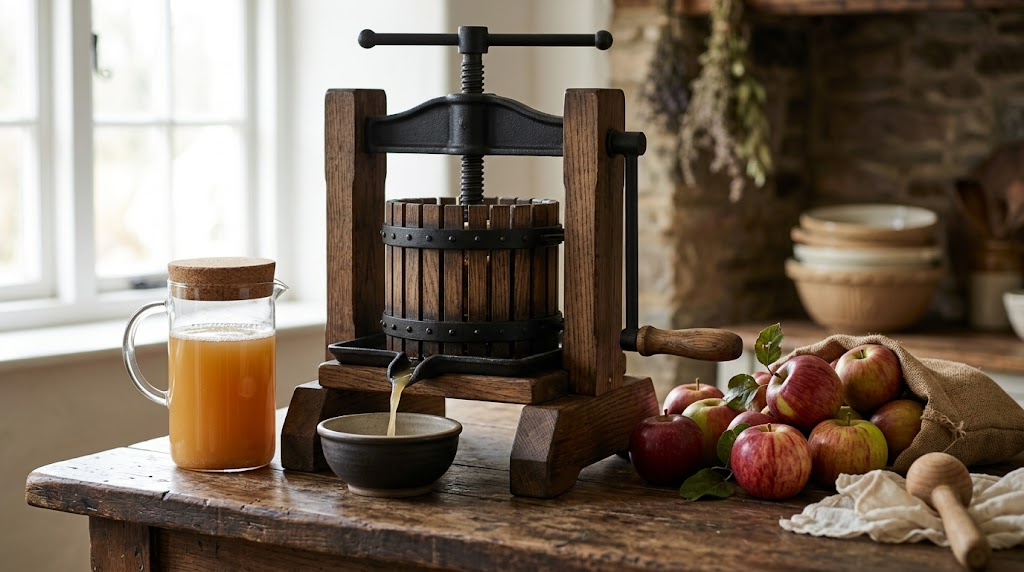
Real cider — the cloudy, sweet-sharp, smells-like-October kind — cannot be made in a juicer. A centrifugal juicer chokes on bushel quantities, and cooking the apples (as a steam juicer does) makes a different, clearer drink entirely. Pressed cider is a mechanical product: crushed apples squeezed cold, pulp and all the aromatics that heat destroys arriving intact in the glass. If you have ever wondered why orchard-stand cider embarrasses the supermarket bottle, that is the entire answer.
Some links in this post are affiliate links. If you buy through them we may earn a small commission at no extra cost to you — it never changes which products we recommend.
Home pressing has one open secret, and most first-year press owners learn it the expensive way: the press is only half the machine. Whole apples cannot be pressed — they are structural. They must first be crushed into a coarse pomace, and without a crusher (a “scratter”), you will stand there processing apples through a food processor in batches, hating your life. The guide below treats crusher and press as the pair they are.
Timing note, since it is why we are publishing this now: press season is September through November. If you are reading this with apples on the tree, order this week, not next month.
Our Top 7 Picks for the Best Fruit and Cider Press
Best Overall Starter: SQUEEZE master 1.6-Gallon Solid Wood Basket Press

The 6-litre basket press is the honest first press: a cast-iron screw driving a pressure plate down into a slatted hardwood basket, juice streaming out between the slats into the tray. It is the same machine cider makers have used for two centuries, at a size one person can carry, load and clean without ceremony.
1.6 gallons of basket handles roughly a large boxful of crushed apples per load — right for a backyard tree, a farmers-market case, or the first season of finding out whether cidering is your thing. It also presses grapes, pears and berries, and honey from crushed comb.
Key Specifications
- 1.6 gallon (6 L) hardwood basket
- Cast iron screw and frame
- Slatted basket with juice tray
- Multi-fruit capable
Pros
- Right size to learn on and store easily
- Classic screw-press mechanics, nothing to break
- One person can run it solo
- Handles grapes, pears and berries too
Cons
- Needs a crusher for apples — budget for the pair
- Small basket means several loads for big harvests
- Wood basket needs drying care like any wood
Best Crusher (The Essential Companion): SQUEEZE master 7-Litre Manual Fruit Crusher
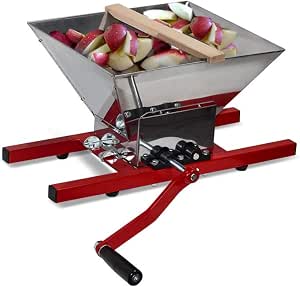
This is the unglamorous machine that decides whether pressing day is two hours or eight. A crank-driven hopper with toothed rollers reduces whole apples to pomace as fast as you can feed them — and pomace, not apples, is what a press actually presses. Crushed fruit yields roughly twice the juice of chunked fruit, because the press is squeezing broken cells instead of fighting structure.
If the budget only stretches to one premium item, counter-intuitively, make it the crusher — a good crusher feeding a modest press outperforms a big press fed by a food processor.
Key Specifications
- 7-litre hopper manual crusher
- Toothed crushing rollers, hand crank
- Mounts over a bucket or tub
- For apples, pears and grapes
Pros
- Turns the worst job of pressing day into minutes
- Dramatically improves press yield
- Feeds any press on this list
- Simple mechanics, easy cleaning
Cons
- A second machine to store
- Hand-cranking a big harvest is a workout
- Hard fruit wants a confident feeder
Best Mid-Size: SQUEEZE master 3.17-Gallon Basket Press

The 12-litre is the size for the household whose apple ambitions survived year one: double the basket of the starter, still light enough to carry to the garden tap, and geometry that one strong pair of arms can still drive to full pressure.
This capacity tier is where pressing stops being an experiment and starts producing storable quantities — a good afternoon yields gallons, which is exactly when our canning guides start mattering to you.
Key Specifications
- 3.17 gallon (12 L) hardwood basket
- Cast iron screw press
- Mid-size frame and tray
- Multi-fruit capable
Pros
- Serious output without a two-person machine
- Still storable in a normal garage
- Same proven screw mechanics
- The natural year-two upgrade
Cons
- Heavier to move and clean
- Still manual effort at full load
- Crusher remains non-optional
Best Large Manual: SQUEEZE master 4.75-Gallon Press with T-Handle

Eighteen litres of basket is orchard-scale manual pressing — the size for a family with several trees, a cider-day tradition, or a neighbourhood that shows up with buckets. The T-handle matters at this scale: two hands, real leverage, and the last quarter-turn that gets the last pint out of the pomace.
Be realistic that a press this size is an event, not an appliance — it wants two people, a tarp, and a hose nearby. That is also, to be fair, the fun of it.
Key Specifications
- 4.75 gallon (18 L) hardwood basket
- T-handle screw for two-handed leverage
- Heavy cast frame
- Orchard-scale batches
Pros
- Big honest capacity per load
- T-handle leverage reaches full extraction
- Turns pressing into the annual event it should be
- Handles a crowd’s worth of buckets
Cons
- Two-person territory when full
- Significant storage footprint
- Cleanup is proportional to capacity
Best Stainless: VEVOR 3.96-Gallon Stainless Steel Manual Press

The stainless-basket press trades the beautiful hardwood slats for a metal basket that shrugs off the two things that age wooden presses: staining and damp. No soaking before use, no bleaching after grape season, no checking for mould in June — hose it, dry it, done.
VEVOR’s 15-litre lands at the practical mid-large size, and stainless is the sensible call if your press will live somewhere damp or work double duty on deeply staining fruit like elderberries and grapes.
Key Specifications
- 3.96 gallon (15 L) stainless basket
- Stainless frame components
- Manual screw operation
- Heavy-duty build
Pros
- Easiest cleaning and storage of any press here
- No staining, swelling or mould worries
- Good capacity tier
- Handles pigment-heavy fruit carelessly
Cons
- Less traditional charm, if that matters to you
- Metal basket drains slightly differently — use a press bag
- Heavy unit
Best High Volume: SQUEEZE master 10.7-Gallon Hydraulic Press

At some point arms stop scaling and hydraulics start. A bottle-jack drives this 40-litre press to pressures no screw-and-muscle rig reaches, which means both enormous batches and measurably drier pomace — the yield difference is real, and at volume it is the whole economics of the machine.
This is the press for a small orchard, a cider-curious homestead, or a syndicate of neighbours splitting the cost and the season. For one backyard tree it is glorious overkill.
Key Specifications
- 10.7 gallon (40 L) capacity
- Hydraulic jack pressing system
- Stainless contact surfaces
- Orchard and homestead scale
Pros
- Massive per-load throughput
- Hydraulic pressure extracts driest pomace
- Less physical effort than big screw presses
- The shared-purchase sweet spot
Cons
- Serious money and serious storage
- Setup and cleanup are a project
- Absurd for small harvests
Best Classic Blue: SQUEEZE master 1.6-Gallon Press, Blue Edition

Functionally the starter press above in a painted blue frame — listed separately because it frequently prices differently, and between identical machines you should simply buy the cheaper one on the day.
The number people want before they buy is the yield, so here is the arithmetic that matters: on a hand press, roughly a kilo of apples gives you a little over half a litre of juice — but only if the fruit has been properly crushed first. Load whole apples into the basket and you will get well under half that, because the press is squeezing intact fruit instead of pulp. That is the mistake almost everyone makes on their first attempt, and it is why the crusher matters more than the press does.
Translated into a home batch: a full carrier bag of apples is about one large bottle of cider. If that sounds like a lot of apples for one bottle — it is.
Key Specifications
- 1.6 gallon (6 L) basket press
- Blue-painted cast frame
- Same screw mechanics as the classic
- Multi-fruit capable
Pros
- Identical function to our starter pick
- Often the cheaper twin — check both
- Same easy one-person handling
- Looks cheerful on pressing day
Cons
- No functional difference to pay extra for
- Painted frames chip with hard outdoor use
- Crusher still required
The Ultimate Buying Guide for Fruit and Cider Presses
Crush First, Press Second — The Rule That Decides Your Yield
An apple is a pressure vessel; a press cannot usefully squeeze one whole. Crushing to pomace — coarse, chunky, applesauce-adjacent — ruptures the cells so the press can do its work, and the difference is not marginal: properly crushed fruit roughly doubles the juice of roughly-chunked fruit. A dedicated crusher is fastest; a food processor pulsing in batches works for small runs; freezing and thawing the apples first (which bursts cells) is the slow, free trick that genuinely works for a boxful.
Screw vs Hydraulic, Wood vs Stainless
- Screw presses are the classic: simple, repairable, satisfying, and limited by your arms at the top sizes. Right for almost everyone.
- Hydraulic presses use a jack for higher pressure and drier pomace — the volume answer, at a volume price.
- Wood baskets are traditional and lovely; they want pre-soaking before use, prompt cleaning after, and dry storage.
- Stainless baskets clean with a hose and never stain or mould — the low-ceremony choice, best used with a press bag.
Sizing Honestly
- 6 L — one backyard tree, first seasons, easy solo handling
- 12 to 15 L — several trees or serious market hauls; the year-two size
- 18 L — the annual neighbourhood cider day
- 40 L hydraulic — homestead scale, or a press shared between households (genuinely the best-value ownership model in this category)
As a planning number: expect very roughly one gallon of cider per 13 to 16 pounds of apples, varying with variety, ripeness and crush quality.
Pressing Day, Run Well
- Blend varieties. The best cider is a mix — sweet apples for body, tart for backbone, a few aromatic ones for the top notes. Single-variety cider is usually flatter than you expect.
- Use a press bag or cloth liner in the basket — cleaner juice, easier pomace removal, better yield.
- Press slowly. Tighten, wait for the stream to slacken, tighten again. Racing the screw sprays juice and strains the frame.
- Sanitise everything juice touches, and work in shade — fresh juice starts fermenting on its own schedule, not yours.
- Compost the pomace or feed it to very grateful chickens.
After the Press: Keeping It
Fresh-pressed cider is raw. Refrigerated, it holds about a week (and gets fizzy-interesting toward the end); frozen, months. For shelf-stable cider or juice, heat and process it in a water bath canner per a tested recipe. Food-safety agencies note raw cider risks for vulnerable groups — children, pregnant women, immunocompromised people — and gentle pasteurisation (heating to about 160°F) addresses it while keeping most of the character. And if the plan was fermentation all along: clean juice, an airlock, and patience — the hard cider makes itself.
Care of the Press
Rinse wood immediately after pressing — dried pomace sets like resin — scrub with plain hot water, dry completely in air, and store the basket loose so it breathes. Pre-soak a wooden basket for an hour before each season so the slats swell tight. Oil the screw threads annually, keep the frame’s paint touched up, and a press becomes a multigenerational object; neglect the drying step once and June finds the mould for you.
Frequently Asked Questions About Cider Presses
How many apples do I need for a gallon of cider?
Plan on roughly 13 to 16 pounds per gallon — a standard bushel (about 42 pounds) yields around three gallons with a decent crush. Yield swings with variety, ripeness and above all crush quality; the same apples badly crushed can give half as much.
Can I press apples without a crusher?
You can, and you will regret the method eventually: food-processor batches, or freezing-and-thawing the fruit to burst its cells. Both work for small runs. But a crusher is the single upgrade that most transforms pressing day, and pomace fineness is the biggest lever on yield you control.
What is the difference between cider and apple juice?
In American usage, cider is the raw, unfiltered, unpasteurised (or gently pasteurised) pressed juice, cloudy with fruit solids; apple juice is filtered and pasteurised to clarity and shelf life. Same fruit, different processing — and the flavour gap between them is the reason cider presses sell every September.
Is homemade raw cider safe to drink?
Fresh, chilled, and consumed promptly, pressed cider from sound clean fruit has been an autumn staple forever — but raw is raw: food-safety agencies flag it for young children, the elderly, pregnant women and immunocompromised people, and dropped or ground-contact fruit raises the stakes. Heating to about 160°F pasteurises it gently. Wash the fruit, cull the rot, chill fast, and make an informed choice for your table.
Can the same press do grapes and berries?
Yes — basket presses are fruit-agnostic. Grapes press beautifully (crush first, as ever); soft berries barely need crushing at all; pears press like slightly stubborn apples. Use a press bag for small and seedy fruit, and expect pigmented fruit to stain a wooden basket permanently — the classic argument for stainless.
Should I buy a press or share one?
Pressing is used hard for six weekends and stored for forty-six — the economics of sharing are unusually good. A neighbourhood 18-litre or a syndicated hydraulic press, with a shared cleaning ritual and a rotating pressing day, is how a lot of the world’s best home cider actually gets made.
Final Thoughts
Start with the 6-litre basket press and the crusher together — the pair is the machine. Graduate to 12 to 18 litres when the harvest demands it, go stainless if damp storage or dark fruit is your reality, and go hydraulic only when your arms file a formal complaint.
Blend your apples, crush them properly, press slowly, chill fast. And if the kitchen end of this pipeline interests you, the water bath canner and steam juicer guides are the other two stations of a very good autumn.
This article is general information. Raw cider carries food-safety considerations for vulnerable groups; gentle pasteurisation addresses them.
As an Amazon Associate we earn from qualifying purchases. Availability is accurate as of the date of publishing. We do not list prices because they change too often to quote honestly.

Rimi Sultana is a home cook from Bangladesh who has cooked for her family every day for the past five years and writes about it at Smart Cooks. Perpetually testing whether internet-famous recipes actually work in a regular home kitchen. Say hello on Facebook or through the contact page.