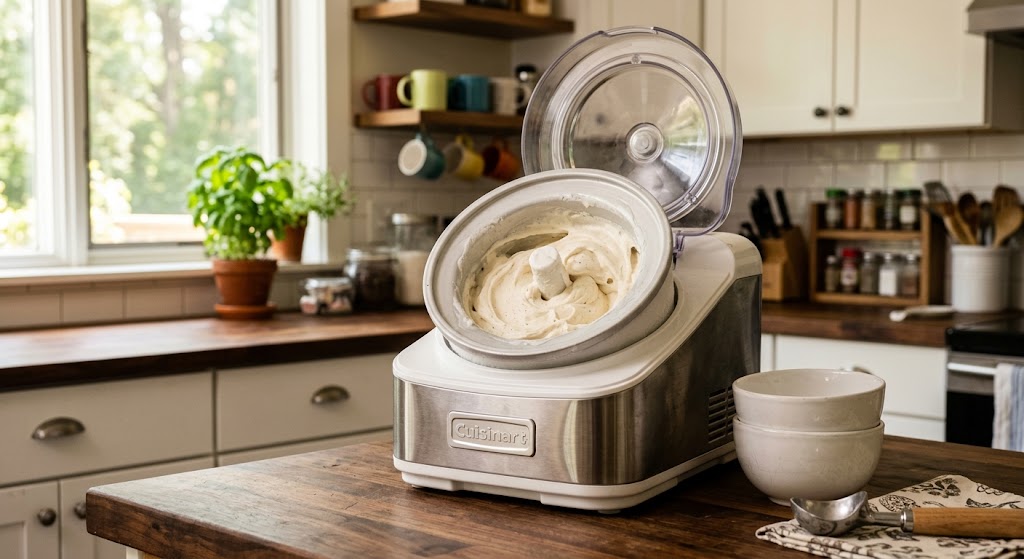
Ice cream makers split into two fundamentally different mechanisms, and almost none of the marketing copy makes that clear upfront. There are freezer-bowl machines, where you pre-freeze a canister for 12–24 hours before churning, and compressor machines, which have a built-in freezing unit and can churn back-to-back batches with no pre-freeze wait. Everything else — capacity, mix-in features, price — matters less than picking the right mechanism for how you’ll actually use it.
Some links in this post are affiliate links. If you buy through them we may earn a small commission at no extra cost to you — it never changes which products we recommend.
What Actually Matters
Freezer-Bowl vs. Compressor
A freezer-bowl machine is cheaper and takes up less counter space, but it demands planning: forget to freeze the bowl the night before, and you’re not making ice cream that day. A compressor machine costs more and is heavier, but it’s ready whenever you are, and you can make a second flavor right after the first without waiting a day. If you make ice cream spontaneously or often, the compressor pays for itself in convenience. If it’s an occasional weekend project, a freezer-bowl model is hard to beat on value.
Capacity vs. Counter Space
Most home machines run 1.5 to 2 quarts, which is enough for a family dessert but not much extra. Larger 4-quart models exist and make sense if you’re serving a crowd regularly, but they’re bulky to store. Measure your cabinet or counter space before you buy — this is the spec people regret ignoring most often.
Single-Serve Machines Are a Different Category
Machines like the Ninja Creami don’t churn a liquid base the traditional way — they blast-freeze a base solid, then shave and re-spin it into ice cream texture. It’s a genuinely different process with its own learning curve and its own strengths (single servings, easy protein-ice-cream style recipes), not just a smaller version of a regular churn machine.
From My Kitchen: The Freezer-Bowl Mistake I Made Twice
I own a freezer-bowl machine, and twice now I’ve decided at 4pm that today was ice cream day, pulled the bowl out of the freezer, and discovered it was only half-frozen because I’d used it a few days earlier and hadn’t given it enough time to fully re-freeze. A half-frozen bowl doesn’t churn properly — the base stays soupy instead of thickening, no matter how long you run the machine. Now I keep the bowl permanently in the freezer between uses rather than pulling it out for space, specifically so it’s always ready. If you go with a freezer-bowl model, this is the one habit that actually matters.
A Few Worth Considering
Cuisinart’s automatic 1-quart freezer-bowl machine is a straightforward, no pre-freeze surprises option if you’re trying the freezer-bowl style for the first time.
Nostalgia’s 4-quart electric machine is worth a look if you regularly make ice cream for a group and want the extra capacity.
The Ninja Creami is the one to consider if single servings and quick turnaround matter more to you than a traditional churned texture.
Whynter’s compressor model is the pick if you want to skip pre-freezing entirely and don’t mind paying more for that convenience.
Quick Comparison of the Four Machine Types
| Type | How it works | Best for |
|---|---|---|
| Freezer-bowl | Pre-frozen bowl churns one batch | Most households, occasional batches |
| Compressor | Self-chilling, churn on demand | Frequent use, several flavours |
| Bucket and rock salt | Ice and salt around a canister | Large batches, outdoor and nostalgic use |
| Freeze-then-spin | Freezes a pint solid, then shaves it | Single portions, protein and low-sugar bases |
The Three Specifications Worth Checking
Capacity first, and read it honestly. A machine rated at 1.5 litres makes about a litre of finished ice cream, because you can only fill the bowl to roughly two-thirds to leave room for expansion. For one or two people, a 1 quart machine is the right size and a larger one just means half-empty bowls and poorer aeration. For a family that finishes a batch in two sittings, size up.
Paddle design second. A paddle that scrapes the bowl wall closely produces smoother ice cream, because the frozen layer forming against the wall gets folded back into the mix rather than staying put. Third, noise and duty cycle: compressor machines are considerably louder, and a few budget machines are only rated for one batch before needing to cool, which matters if you planned on two.
The Cleaning Question People Forget
A machine with a motor unit that cannot be immersed, a paddle with a seam that traps mixture, and a bowl with an awkward lip is a machine you will use less often. Dairy residue sets hard and turns sour quickly, so everything that touches the base needs washing within the hour, not later. Before buying, look at how many parts come apart and whether the paddle is a simple shape — it is a mundane detail that decides how often the machine actually comes out.
Four Machines Worth Considering
Best for most households: Cuisinart Automatic 1-Quart Freezer-Bowl Machine
The default recommendation for a reason — right size, low price, genuinely good results, and simple enough to clean quickly. The only requirement is freezer space for the bowl and 24 hours of planning.
Pros
- Sensible batch size and low price
- Quiet and simple to operate
- Few parts to wash
Cons
- Bowl needs a permanent freezer shelf
- One batch per freeze cycle
Best for large batches: Nostalgia 4-Quart Electric Machine
The ice-and-rock-salt approach makes far more at once than any home freezer-bowl machine, which suits parties and gatherings. It is messier and needs ice on hand, but the capacity is in a different league.
Pros
- Makes a very large batch at once
- No pre-frozen bowl required
- Good for gatherings and outdoor use
Cons
- Needs a supply of ice and rock salt
- Messy and bulky to store
Best for single portions: Ninja Creami
Not a churn machine at all — it freezes a pint solid and then shaves it smooth. Excellent for protein, low-sugar or fruit-only bases that would come out icy in a traditional machine, and for having several flavours ready at once.
Pros
- Handles low-fat and low-sugar bases well
- Single-portion pints, several flavours at once
- No bowl in the freezer, just pints
Cons
- Loud while running
- Denser texture than churned ice cream
Best if you make it often: Whynter Compressor Model
Self-chilling, so there is no planning and no freezer shelf sacrificed. The right choice once ice cream is a weekly habit rather than an occasional project.
Pros
- Churn on demand with no pre-freezing
- Consecutive batches without waiting
- Consistent results regardless of kitchen temperature
Cons
- Expensive and heavy
- Louder than a freezer-bowl machine
Frequently Asked Questions
Do I need a compressor model, or is freezer-bowl good enough?
For most home cooks, freezer-bowl is genuinely good enough — the ice cream quality is the same, you’re just trading convenience for a lower price. Compressor models earn their cost if you make ice cream often or unpredictably.
How long does a freezer-bowl actually need to freeze?
Most manufacturers say 24 hours minimum, and that’s not a marketing exaggeration — a bowl that’s only been in the freezer for a few hours won’t get cold enough all the way through, and your ice cream base won’t thicken properly.
Is a bigger capacity always better?
Not if you don’t have consistent demand for that much ice cream at once — a half-full large canister doesn’t churn as evenly as a properly filled smaller one, and it takes up more storage space year-round for occasional extra volume.
How much does the machine matter compared with the recipe?
Less than most people expect. The base — its fat content, its sugar content and how thoroughly it was chilled before churning — determines most of the final texture. A well-made custard base chilled overnight and churned in a basic freezer-bowl machine will beat a mediocre base in an expensive compressor machine every time. Buy the machine that fits your kitchen and spend your attention on the base.
Do I need to use the machine straight after buying it?
Check the manual, because many compressor machines need to stand upright for several hours — often 12 to 24 — before first use, so the refrigerant settles after being transported on its side. Running one immediately out of the box can damage the compressor. Freezer-bowl machines have no such requirement, but the bowl still needs its full 24 hours in the freezer, so neither type makes ice cream on the day it arrives.
Related: Top 6 ice cream makers for small batches with precise control

Rimi Sultana is a home cook from Bangladesh who has cooked for her family every day for the past five years and writes about it at Smart Cooks. Perpetually testing whether internet-famous recipes actually work in a regular home kitchen. Say hello on Facebook or through the contact page.