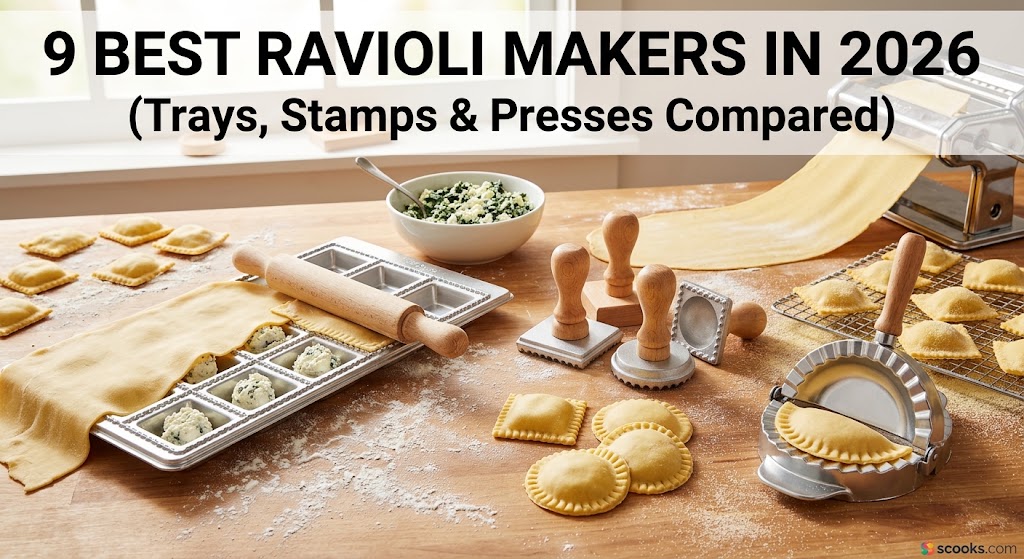
Every homemade ravioli that ever burst in the pot died of the same two wounds: trapped air, or a bad seal. The filling never fails; the envelope does. Which is why ravioli tools are worth owning at all — a press or stamp does not make ravioli prettier so much as it makes them sealed, pressing dough tight around the filling and cutting a clean crimped edge in one motion.
Some links in this post are affiliate links. If you buy through them we may earn a small commission at no extra cost to you — it never changes which products we recommend.
The formats split by batch size and temperament. Trays (a metal grid with a dimpling plate) make a dozen identical ravioli per pass and suit production cooking. Stamps cut one at a time from a filled sheet — slower, more flexible, more romantic. Presses handle single large ravioli and cross over into empanada and dumpling duty. Most serious pasta nights end up owning a tray and a stamp or two.
Upstream of all of them is the sheet: ravioli want pasta rolled thin enough to shadow your hand through, which is machine territory — our pasta maker guide covers that — and the finished pieces wait on semolina, not on top of each other. Nine tools worth buying below.
Our Top 9 Picks for the Best Ravioli Maker
Best Overall Tray: Bellemain Ravioli Mold & Press

The Bellemain tray is the classic production method done properly: lay a sheet over the metal grid, seat the dimpling plate to form even pockets, fill, cover with a second sheet, and roll a pin across — the grid’s edges seal and score a dozen ravioli in one pass.
The metal edges are the point: they cut cleanly where cheap plastic trays merely emboss, which is the difference between ravioli that separate at a touch and ravioli you tear apart raggedly. For filled-pasta nights measured in dozens, this is the tool.
Key Specifications
- 12-pocket metal tray with dimpling plate
- Rolling-pin sealing and scoring
- Even portioning per pass
- Classic tray format
Pros
- A dozen sealed ravioli per pass
- Metal edges cut, not just crease
- Uniform size cooks evenly
- Fast at production scale
Cons
- Fixed size and shape
- Needs well-rolled even sheets to shine
- Flour the grid or dough can grip
Best Stamp Set: TACGEA Ravioli Stamps with Fluted Wheel, Set of 4
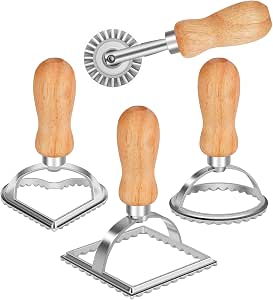
Stamps are the artisan path: dot filling across a sheet, lay the second sheet over, cup your hand around each mound to push the air out, and stamp — the fluted edge seals and crimps in one press. This set covers square and round in two sizes plus a fluted rolling wheel for hand-cut edges and pappardelle.
Slower than a tray, endlessly more flexible: any spacing, any filling volume, and the crimped edge that makes ravioli look bought from a good shop.
Key Specifications
- Four stamps: square and round, two sizes
- Fluted pastry wheel included
- Wooden handles
- Crimp-seal edges
Pros
- Beautiful crimped professional edges
- Any size and spacing you like
- Wheel handles edges and strip cutting
- Air-purge technique friendly
Cons
- One-at-a-time pace
- Sizes fixed per stamp
- Wood handles — hand wash
Best Complete Set: 11-Piece Ravioli Mold Kit with Cutters

The everything-drawer of filled pasta: press molds, multiple cutter shapes and sizes, and the accessories to cover ravioli tonight, pierogi Saturday, and empanadas whenever. For a household that fills dough in more than one culinary language, one kit replaces a shelf of single-purpose gadgets.
As with all bundles, two pieces will become daily drivers and the rest understudies — but the price of admission covers the discovery.
Key Specifications
- 11-piece mixed mold and cutter kit
- Multiple shapes and sizes
- Press and stamp formats together
- Multi-cuisine duty
Pros
- Covers ravioli, pierogi and empanadas
- Finds your preferred size by experiment
- Strong value per piece
- One box, whole category
Cons
- Storage sprawl
- Uneven quality across pieces
- Favourites emerge, spares linger
Best Press Molds: 8-Hole Square Ravioli Press

The press-mold format at family scale: eight square pockets that seal and portion under a rolling pin, in a design that moonlights unapologetically as an empanada and hand-pie press.
It is the lighter, cheaper cousin of the Bellemain approach — a fine second tray for doubling throughput on big nights, or a first tray for a kitchen still deciding how deep this hobby goes.
Key Specifications
- 8-pocket square press mold
- Rolling-pin operation
- Empanada crossover use
- Compact tray
Pros
- Affordable route into tray production
- Doubles for hand pies
- Light and easy to store
- Simple to learn
Cons
- Plastic edges seal softer than metal
- Eight pockets per pass, not twelve
Best Multi-Shape: 3-Shape Ravioli and Empanada Press Set

Three single-piece presses — round, square, half-moon — at a generous 2.6 inches, which is exactly the size range where ravioli grow into ravioloni and half-moons become mezzelune or small pierogi. One filling-spoonful per piece, fold, press, done.
The large-format single press is also the most forgiving teacher: big pieces tolerate imperfect technique while you learn how much filling an envelope really holds.
Key Specifications
- Three press shapes, 2.6-inch format
- Round, square and crescent
- Single large-piece workflow
- Fold-and-press operation
Pros
- Large forgiving format for learners
- Crescent doubles for pierogi
- One tool per shape, no assembly
- Quick weeknight batches
Cons
- One piece at a time
- Large ravioli need longer, gentler boiling
Best Heritage Brand: Fox Run Ravioli Maker

Fox Run has been selling this style of ravioli tray for generations, and its survival is the review: the format works, the build is honest, and replacement is easy if a piece ever wanders. Sheet, plate, fill, roll — the same production rhythm as our top pick from a heritage housewares name.
A safe default where the Bellemain is out of stock, and frequently the cheaper of the two.
Key Specifications
- Classic tray-and-plate ravioli maker
- Heritage housewares brand
- Rolling-pin sealing
- Standard dozen format
Pros
- Time-tested format and brand
- Often keenly priced
- Reliable sealing edges
- Easy to find and replace
Cons
- No frills whatsoever
- Same fixed-size limits as all trays
Best Wooden Tools: Sliner 7-Piece Pasta Set with Gnocchi Board

The wooden workshop set: ravioli press molds alongside a gnocchi board and companions — because the same evening that fills ravioli usually rolls gnocchi off a fork anyway. The ridged board’s grooves are what make gnocchi and garganelli hold sauce, and no metal tool replaces it.
For the cook building a traditional pasta corner rather than buying one gadget, this is the affordable foundation.
Key Specifications
- 7 wooden pasta tools
- Gnocchi board included
- Ravioli press molds
- Traditional materials
Pros
- Covers ravioli and gnocchi in one set
- Wooden tools age gracefully
- The sauce-gripping ridges matter
- Complete beginner workshop
Cons
- Wood: hand wash, dry fully
- Press edges softer than metal trays
Best Big-Batch Molds: Geetery 5-Piece Ravioli Mold Set with 12-Hole Trays

Multiple twelve-pocket trays in one set is the assembly-line answer: one tray being filled while another is being rolled and a third rests floured, which is how a hundred-ravioli freezer session actually flows. Two-inch squares are the standard freezer-friendly size.
Batch cooks and holiday-tradition families: this is your format. Freeze on semolina-dusted sheets, bag when solid, and boil from frozen all winter.
Key Specifications
- Five-piece set with 12-hole trays
- 2-inch square format
- Parallel-tray workflow
- Batch production oriented
Pros
- Assembly-line big batches
- Freezer-standard sizing
- Spare trays cover wear
- Strong per-tray value
Cons
- Plastic trays — gentler seals than metal
- Single-size squares only
Best Edge Wheel: Fluted Ravioli Stamp and Roller Wheel Set

The minimalist artisan pair: one good fluted stamp and one good fluted wheel, which between them cut, seal and crimp everything from classic squares to freehand agnolotti and hand-cut edges. Many long-time pasta cooks own exactly this and nothing else.
[YOUR EXPERIENCE — your first batch of filled pasta, any tradition: what filling, and did they survive the boil? The burst-ravioli confession is the most relatable sentence this page can carry. Delete this bracket when done.]
Key Specifications
- Fluted stamp plus roller wheel
- Wooden handles
- Freehand and fixed cutting
- Two-piece minimal kit
Pros
- The two tools that cover everything
- Wheel enables freehand shapes
- Small drawer footprint
- Traditional feel
Cons
- No production tray speed
- Wood care rules
The Ultimate Buying Guide for Ravioli Makers
Tray vs Stamp vs Press
- Trays make a dozen identical, well-sealed ravioli per pass — the production format for batch and freezer cooking. Metal-edged trays cut cleaner than plastic.
- Stamps work one piece at a time from a filled double sheet — slower, prettier, endlessly flexible on spacing and size, and the crimped edge is the professional look.
- Presses fold single large pieces — the forgiving format for beginners and the crossover tool for empanadas and pierogi.
The honest endgame for most pasta households: one tray for volume, one stamp for craft.
The Air Rule
Trapped air is the ravioli assassin: it expands in boiling water and bursts the seal from inside. Whatever tool you use, the motion that matters is cupping around each filling mound and pressing outward — chasing air to the edges — before the seal closes. Trays do some of this with their dimple plates; stamps rely on your hands; either way, the pressing-out is the actual skill of filled pasta.
Dough, Filling, Seal
- Sheets thin enough to read shadows through — thick doubled edges are why homemade ravioli eat doughy
- Filling drier than you think: wet ricotta is the second-commonest burst; drain it, and go easy on the spoon
- Seal on slightly tacky dough — if the sheet has dried, a water-brushed edge glues it; a beaten-egg brush is the belt-and-braces version
- Rest and dust: finished pieces wait on semolina in one layer, never stacked
Freezing Is the Real Superpower
Filled pasta is the best freezer food in the Italian repertoire: freeze pieces flat on a dusted sheet until solid, bag them, and boil from frozen (one extra minute) for months. This is why the batch formats earn their place — one Sunday session becomes eight weeknight dinners, which no fresh-only workflow matches.
Frequently Asked Questions About Ravioli Makers
Why do my ravioli burst when boiling?
Trapped air, overfilling, wet filling, or a dry-edged seal — in roughly that order of frequency. Press air out around each mound before sealing, fill less than feels generous, drain ricotta properly, and boil at a confident simmer rather than a rolling churn; violence in the pot finishes what a weak seal started.
Do I need a machine-rolled sheet, or can I roll by hand?
Hand-rolling to true ravioli thinness is a real skill with a long rolling pin — achievable, and how it was always done, but a pasta machine gets a beginner to even, shadow-thin sheets in one evening. The tools on this page all perform dramatically better on machine-even sheets.
What filling should a beginner start with?
Ricotta (well drained), parmesan, egg yolk, nutmeg, salt — the classic cheese filling is cheap, forgiving and diagnostic: if these burst, the technique needs work, not the recipe. Spinach-ricotta is step two; loose meat and squash fillings come after the sealing habit is solid.
Can ravioli tools make pierogi and empanadas?
The press and crescent formats, absolutely — the fold-and-crimp geometry is the same across cuisines; only the dough changes. Trays are pasta-specific mostly by size. If your kitchen cooks in several dumpling languages, buy presses first.
How do I stop dough sticking to the mold?
Flour the tool, not just the board — a dusting in the tray pockets or on the stamp face before each pass. Semolina beats plain flour for release. Sticky trouble that persists is the dough’s hydration talking; knead in a little more flour.
Final Thoughts
Buy the Bellemain tray if ravioli night means dozens, the TACGEA stamp set if it means craft, and the three-shape press if you are learning or your dumplings speak several languages. The gnocchi-board set builds the whole traditional corner for less than one restaurant plate of the real thing.
Thin sheets, dry filling, chase the air, dust with semolina, freeze the surplus. The tools are cheap; the technique is the treasure — and it is a weekend’s practice, not a lifetime’s.
As an Amazon Associate we earn from qualifying purchases. Availability is accurate as of the date of publishing. We do not list prices because they change too often to quote honestly.

Rimi Sultana is a home cook from Bangladesh who has cooked for her family every day for the past five years and writes about it at Smart Cooks. Perpetually testing whether internet-famous recipes actually work in a regular home kitchen. Say hello on Facebook or through the contact page.