Flour is a fresh product pretending to be a pantry staple. The moment wheat is milled, its oils meet air and the clock starts — which is why flour ground this morning smells faintly of hazelnuts and grass, and why whole-wheat flour from a supermarket shelf mostly smells of nothing or worse. Home milling is not nostalgia; it is the difference between cooking with a live ingredient and a stabilised one, and bakers who try it rarely walk it back.
Some links in this post are affiliate links. If you buy through them we may earn a small commission at no extra cost to you — it never changes which products we recommend.
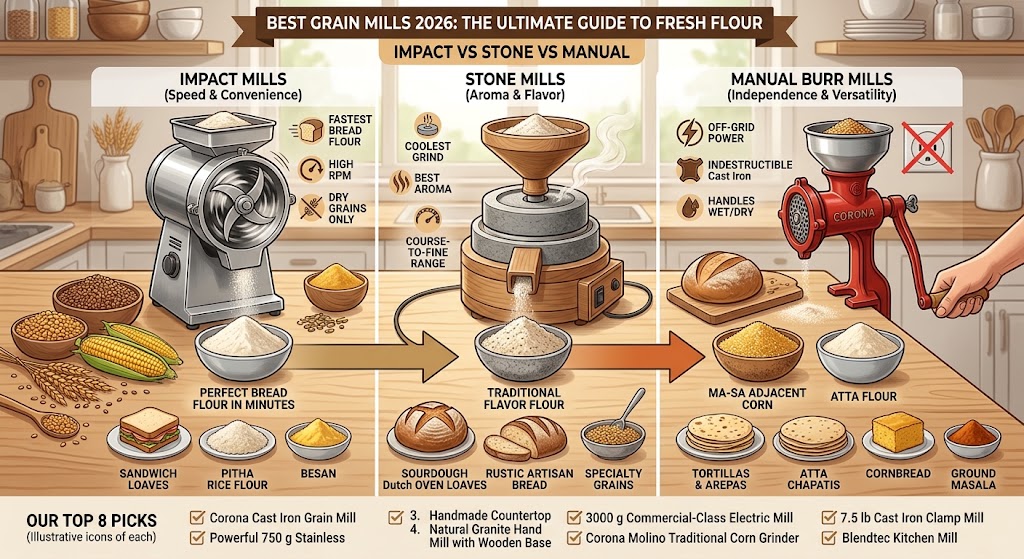
The machines split into three honest families. Impact mills (micronizers) hammer grain to flour fast and fine — the whir-and-done choice for bread bakers. Stone burr mills grind slower and cooler between stones, preserving more aroma and offering true coarse-to-fine range. Manual burr mills trade speed for independence and price — and double as corn, bean and masala grinders in a way electric flour-first machines do not.
Fresh flour feeds directly into everything this site bakes — the bread-dough stand mixers, the sourdough Dutch ovens, the sourdough kits. Eight mills worth owning below.
Our Top 8 Picks for the Best Grain Mill
Best Overall Manual: Corona Cast Iron Grain Mill with Hand Crank
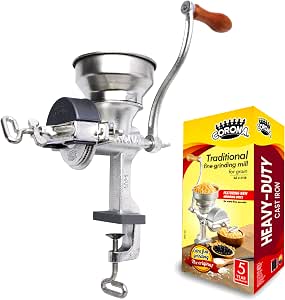
The Corona is the mill of record across half the world’s kitchens — a cast-iron burr grinder cranked by hand, clamped to a table, grinding corn for arepas and tortillas, wheat for atta, soaked chickpeas, spices, coffee in emergencies. It has been in continuous production for over a century because it does not break and cannot become obsolete.
It will not make pastry-fine flour in one pass — run coarse then regrind fine, sifting between — but for flatbread flours, masa-adjacent corn work and general grain independence, nothing at the price touches it.
Key Specifications
- Cast iron burr mill, hand crank
- Table-clamp mounting
- Corn, wheat, beans, spices
- Century-proven design
Pros
- Effectively indestructible
- No electricity — works anywhere
- Handles corn and pulses electrics refuse
- Cheapest serious mill
Cons
- Fine flour needs multiple passes
- Cranking is honest exercise
- Burrs need seasoning-in and occasional adjustment
Best Electric Impact: Powerful 750 g Stainless High-Speed Mill

The impact-chamber format: a sealed stainless cup whose blades spin at tens of thousands of RPM, reducing 750 grams of wheat, rice, dal or spices to fine powder in under a minute. For a household that grinds rice-and-dal flours, besan, or masalas in batch quantities, this is the workhorse format at the friendliest price.
Its physics run hot and loud in exchange for speed — grind in short pulses for heat-sensitive spices, and expect flour slightly less uniform than a true mill’s.
Key Specifications
- 750 g stainless grinding chamber
- High-speed impact blades
- Grains, dals, rice and spices
- Under-a-minute batches
Pros
- Very fast batch grinding
- Handles the whole South Asian flour list
- Easy chamber cleaning
- Budget-friendly
Cons
- Loud in operation
- Heat builds on long runs
- Texture less uniform than burr or stone
Best Stone Mill: Handmade Countertop Stone Grain Mill
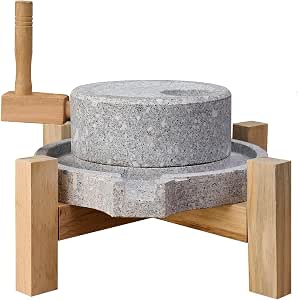
Stone milling is the original technology for the best reason: stones grind cool, and cool grinding preserves the volatile aromatics that make fresh flour taste like something. This handmade countertop disk mill is the traditional chakki brought to a modern counter — slow, fragrant, and adjustable from cracked to fine.
It is the mill for the baker chasing flavour rather than throughput, and the one whose flour smells most like a field.
Key Specifications
- Handmade stone disk mill
- Cool, slow grinding
- Adjustable coarseness
- Countertop format
Pros
- Coolest grind, best aroma retention
- True coarse-to-fine range
- Traditional chakki character
- Beautiful, honest machine
Cons
- Slowest throughput here
- Stones need occasional dressing
- Heavier and bulkier than steel mills
Best Manual Stone: Natural Granite Hand Mill with Wooden Base

The full ancestral article: a granite quern on a wooden base, turned by hand — the same machine that ground every chapati’s atta for a few thousand years before electricity. As a working mill it is real (soaked rice and urad for batter, wheat for small-batch atta, wet-dry versatility no electric matches); as an object it is the most beautiful thing in this guide.
Buy it for small sacred batches and the connection, not for weekly twenty-pound grinds.
Key Specifications
- Natural granite stones
- Wooden base, hand-turned
- Wet and dry grinding
- Traditional quern format
Pros
- Wet-grinds batters electrics cannot
- Zero electricity, zero noise beyond stone song
- Generational object
- Cool grind, full flavour
Cons
- Slow, meditative throughput
- Heavy to move and store
- Stone care learning curve
Best High Capacity: 3000 g Commercial-Class Electric Mill

Three kilograms per chamber-load at 36,000 RPM is bulk-buying-club territory: households that mill weekly bread flour for six, grind masalas by the jar not the spoon, or process a garden’s worth of dried corn and chilies each autumn. The swing-mill format eats everything dry.
Big impact mills reward respect: pulse rather than marathon, let the motor rest between loads, and never grind oily seeds to butter in them.
Key Specifications
- 3000 g chamber capacity
- 3600 W, 36,000 RPM class
- Stainless chamber and blades
- Bulk batch format
Pros
- Family-bakery batch sizes
- Powers through hard corn and spices
- Fast enough for weekly milling
- Strong value per gram of capacity
Cons
- Loud as power tools are loud
- Heat management needs pulsing
- Overkill for occasional bakers
Best for Corn and Masa: Corona Molino Traditional Corn Grinder

The molino configuration of the Corona, set up as Latin kitchens run it: nixtamalized corn in the hopper, masa-coarse meal out the burrs, tortillas and tamales downstream. If our comal and tamalera guides are your kitchen’s territory, this is the missing upstream machine.
Same immortal cast iron, same clamp, same century of spare parts.
Key Specifications
- Cast iron molino corn mill
- Masa-oriented burr setup
- Table clamp mount
- Manual crank
Pros
- The traditional masa path at home
- Handles wet nixtamal electrics hate
- Interchangeable Corona parts world
- Indestructible
Cons
- Masa fineness takes two passes
- Manual labour by design
- Needs a solid table edge
Best Heavy-Duty Manual: 7.5 lb Cast Iron Clamp Mill

A heavier-framed take on the manual burr mill: 7.5 pounds of cast iron whose mass is the feature — less flex under hard corn, steadier meshing on the clamp, less chatter at the fine end of the adjustment. The preparedness community buys these for the same reason working kitchens do: mass equals consistency.
Between this and the Corona, buy on price and parts availability; the format is shared.
Key Specifications
- 7.5 lb cast iron construction
- Hand crank with table clamp
- Adjustable burr fineness
- Grains, corn, beans
Pros
- Mass damps wobble on hard grinds
- Consistent fine-end adjustment
- No-grid resilience
- Fair price for the iron
Cons
- Heavy to mount and stow
- Same multi-pass fineness reality
- Generic parts ecosystem
Best Compact Electric: Blendtec Kitchen Mill

Blendtec’s Kitchen Mill is the established American impact micronizer: a compact housing that turns wheat berries into genuinely bread-fine flour in minutes, from a brand with decades of parts and service behind it. For the sourdough-and-sandwich-loaf household that wants fresh flour with appliance convenience, this is the category’s safe pair of hands.
[YOUR EXPERIENCE — whatever your kitchen grinds fresh — atta, rice flour for pitha, masala — one line on what fresh grinding changed about the dish is this page’s missing heartbeat. Delete this bracket when done.]
Key Specifications
- Compact electric micronizer
- Bread-fine flour in minutes
- Established brand and parts
- Simple controls
Pros
- Reliable fine bread flour fast
- Decades-proven design
- Compact storage
- Real warranty ecosystem
Cons
- Impact heat and noise apply
- Dry grains only
- No coarse-cracked settings to speak of
The Ultimate Buying Guide for Grain Mills
Impact vs Stone vs Manual Burr
- Impact (micronizer) mills hammer grain at extreme RPM: fastest to fine flour, loudest, warmest. The bread-baker’s default electric.
- Stone mills shear grain cool between dressed stones: best aroma, true texture range, slowest. The flavour-first choice.
- Manual burr mills (Corona and kin) crush between metal burrs by crank: cheapest, immortal, off-grid, and the only family that happily eats wet corn and soaked pulses. Fineness costs passes.
Why Fresh Flour Behaves Differently
Whole-grain flour carries the germ’s oils, which oxidise within days-to-weeks of milling — fresh flour is sweeter and more aromatic, and also more absorbent and more active in fermentation. Practically: expect doughs to want a little more water, sourdoughs to move faster, and whole-grain loaves to taste noticeably less bitter than shelf whole-wheat. Store grain, not flour: wheat berries keep for years cool and sealed; flour’s clock starts at the burrs. Mill what the week needs, refrigerate any surplus.
Matching Mill to Kitchen
- Weekly bread bakers: impact electric (Blendtec) or stone if flavour outranks speed
- South Asian flour cabinets (atta, rice flour, besan, masala): the 750 g impact chamber covers the breadth
- Masa and arepa kitchens: Corona molino — wet nixtamal is manual-burr territory
- Batter traditions and heirloom romance: the granite quern wet-grinds what nothing electric will
- Bulk households and harvest processing: the 3 kg class
What Not to Grind
Oily things butter up burrs and impact chambers alike: nuts, flax in quantity, coffee in your flour mill (flavour ghosts linger for weeks), and very oily seeds want a food processor or dedicated grinder instead. Sugar and moist grains gum impact mills; bone-dry is the rule. And popcorn is the hardest common corn — feed it to cast iron, not to budget electrics.
Frequently Asked Questions About Grain Mills
Is home-milled flour really cheaper?
Against supermarket all-purpose, roughly break-even; against good whole-grain and specialty flours, decisively cheaper — wheat berries in bulk cost a fraction of boutique flour, and rice, corn and dal flours follow the same math. The stronger argument is freshness and control; the savings are the bonus.
Can I bake normal bread with 100% fresh whole flour?
Yes, with two adjustments: more water (fresh whole flour drinks), and slightly gentler expectations of rise until you learn its rhythm — bran cuts gluten strands. Many bakers sift fresh flour once for sandwich loaves and bake the bran back into porridge loaves. Sourdough loves fresh flour without reservation.
How fine can a manual mill actually grind?
Chapati-and-cornbread fine in one pass, cake-fine only with a second pass and a sift. That is the honest manual-burr trade: independence and versatility for throughput. If single-pass pastry flour is the requirement, buy impact or stone electric.
Do grain mills grind spices and dal?
The impact chambers are outright spice-and-dal machines — that is half their household duty. Cast-iron burrs handle whole spices and pulses happily (flavour memories included — dedicate or clean well). Stone mills prefer staying with grain. For small daily masala work, the stone tools in our molcajete guide remain the right scale.
How do I store grain for milling?
Cool, dry, sealed and dark: wheat berries and whole corn keep for years in airtight buckets, decades with oxygen absorbers. The freezer is the insurance policy for germ-rich grains in hot climates. Whole grain is the shelf-stable form — the entire point of milling at home is converting it to fresh flour only at the last minute.
Final Thoughts
The Corona is the hundred-year answer and the right first mill for most of the world’s actual cooking; the 750 g impact chamber is the fastest route through a South Asian flour list; the stone mills are for bakers who chase aroma; and the Blendtec is fresh bread flour with an appliance’s manners.
Store berries, mill mornings, bake the difference — the Dutch oven and stand mixer guides are waiting downstream.
As an Amazon Associate we earn from qualifying purchases. Availability is accurate as of the date of publishing. We do not list prices because they change too often to quote honestly.

Rimi Sultana is a home cook from Bangladesh who has cooked for her family every day for the past five years and writes about it at Smart Cooks. Perpetually testing whether internet-famous recipes actually work in a regular home kitchen. Say hello on Facebook or through the contact page.