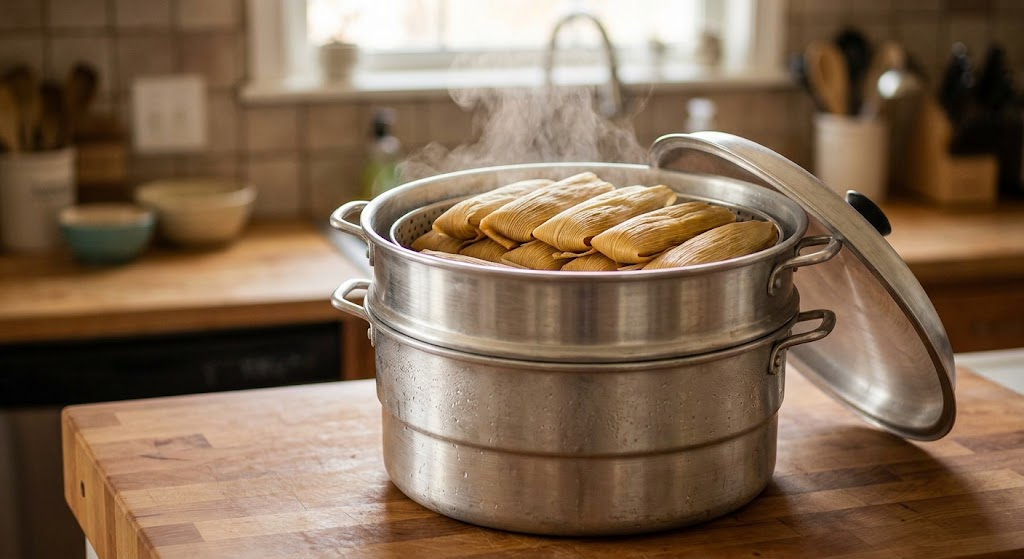
Tamales are never a solo project. Nobody makes six tamales — you make six dozen, with family, in an afternoon that is at least as much about the people as the food. Which is why the pot matters more than it would for almost any other dish: buy a tamalera that is too small and you are steaming in shifts until midnight; buy one too big for your burner and the water at the edge never properly boils.
Some links in this post are affiliate links. If you buy through them we may earn a small commission at no extra cost to you — it never changes which products we recommend.
A tamale steamer is a simple machine — a tall pot, a perforated rack that holds the tamales above a few inches of water, and a lid that keeps the steam in. The whole buying decision comes down to three things: size (measured honestly against how many tamales you really make), material (aluminium versus stainless), and one killer feature that separates the good ones from the ordinary ones — a way to add water without unstacking sixty tamales.
Below are seven worth buying across every batch size, from a weeknight dozen to a hundred-tamale Christmas. Pair whichever you choose with a molcajete for the salsa and our comal guide for the rest of the spread.
Our Top 7 Picks for the Best Tamale Steamer
Best Overall: IMUSA MEXICANA 20-Quart Aluminum Steamer with Glass Lid

Twenty quarts is the honest sweet spot for a family tamalada — roughly four to five dozen tamales standing upright, which is a real batch without being a restaurant batch. IMUSA is the Latin cookware brand you will find in any supermercado, and this is their standard vaporera: light aluminium body, steamer insert, and a glass lid.
The glass lid is worth more than it sounds. Every time you lift the lid to check, you dump the steam and add minutes to the cook; being able to see the boil without opening anything is the difference between tamales done in 75 minutes and tamales done whenever they feel like it. Aluminium also keeps the whole pot light enough to carry to the sink one-handed when it is time to drain.
Key Specifications
- 20-quart aluminium with steamer insert
- Glass lid to monitor without releasing steam
- Holds roughly 4 to 5 dozen tamales
- Light enough to lift and drain easily
Pros
- The right capacity for a family-sized tamalada
- Glass lid saves steam and cooking time
- Trusted Latin cookware brand
- Light for its size
Cons
- Aluminium will not work on induction
- No side spout for topping up water
- Thin base needs a reasonable burner
Best Small Batch: IMUSA MEXICANA-410 10-Quart Steamer with Glass Lid

Not every tamale day is a fiesta. If you mostly steam a dozen or two at a time — or you are reheating a gifted bag of frozen tamales, which is a seriously underrated use for a vaporera — the 10-quart is the version that actually fits in a cupboard and on a normal burner.
Same aluminium build and glass lid as its big sibling, scaled down. It also earns its keep between tamale days as a general steamer for vegetables, seafood and Chinese-style buns, which the giant sizes are too clumsy to do.
Key Specifications
- 10-quart aluminium with glass lid
- Steamer insert included
- Holds roughly 1.5 to 2 dozen tamales
- Fits standard burners and cupboards
Pros
- Right size for small households and reheating
- Stores like a normal pot
- Doubles as an everyday steamer
- Inexpensive
Cons
- Too small for a proper tamalada
- Aluminium, so no induction
- Water reservoir is shallow — watch the level
Best Stainless with Water Spout: ARC 20-Quart Stainless Tamale Steamer

Here is the problem the ARC solves, and once you have lived it you will pay for the fix: an hour into steaming, the water runs low. In a normal vaporera your options are lifting out sixty carefully stacked tamales to pour in more water, or pouring blindly down the side and soaking the bottom row of masa. The ARC has a spout on the side of the pot, below the rack — you top up the water through it without touching the tamales at all.
It is stainless rather than aluminium, which makes it heavier but also induction-compatible, sturdier, and immune to the pitting acidic water leaves in aluminium over years. Between tamale seasons it is a legitimate crab and seafood boil pot.
Key Specifications
- 20-quart stainless steel
- Side water-fill spout below the rack
- Induction compatible
- Doubles as a seafood boil pot
Pros
- Top up water without unstacking tamales
- Works on induction unlike aluminium vaporeras
- Heavier gauge and more durable
- Genuinely multi-purpose
Cons
- Heavier than aluminium at the same size
- Costs more than the classic vaporera
- Stainless shows hard-water spots
Best Large: ARC 32-Quart Stainless Tamale Steamer with Spout

For the full holiday production — eight to ten dozen tamales, multiple fillings, the batch that feeds the whole extended family and sends everyone home with a bag — you want the 32-quart. The same side-fill spout matters even more at this size, because a pot this full is genuinely impossible to top up any other way without casualties.
One honest warning that applies to every pot this big: measure your stove. A 32-quart pot needs a strong burner to keep a rolling boil going under all that mass, and on a small electric coil it will steam weakly and take forever. It is happiest on a big gas burner or an outdoor propane ring.
Key Specifications
- 32-quart stainless steel
- Side water-fill spout
- Holds roughly 8 to 10 dozen tamales
- Suited to large gas burners and outdoor rings
Pros
- Holiday-scale batches in one steaming
- Spout is essential at this capacity
- Stainless durability and induction compatibility
- Doubles for crawfish and seafood boils
Cons
- Needs a powerful burner to boil properly
- Heavy and bulky to store
- Overkill for anything under four dozen
Best Value Big Batch: Vasconia 26-Quart Aluminum Tamale Steamer

Vasconia is one of Mexico’s biggest cookware names, and this 26-quart aluminium vaporera is the traditional article at the in-between size — bigger than the family 20-quart, still manageable on a decent home burner in a way the 32-quart is not.
Aluminium keeps the weight down, which you will appreciate the moment you carry a finished pot to the counter. This is the pick if you want maximum tamales per peso and do not need induction or a spout.
Key Specifications
- 26-quart aluminium with rack and lid
- Traditional Mexican vaporera design
- Holds roughly 6 to 7 dozen tamales
- Established Mexican brand
Pros
- Big capacity at a friendly price
- Light for its size
- The traditional pot from a traditional brand
- Even steam distribution
Cons
- No side spout
- Aluminium — no induction, and it dulls with use
- Still needs a strong burner
Best Premium Touches: Concord Mi Abuela Stainless Steamer with Exterior Refill

Concord’s Mi Abuela series is the modernised vaporera: stainless body, an exterior water-refill port, and generally tighter fit and finish than the commodity pots. It is aimed at exactly the cook who makes tamales several times a year and has accumulated opinions about their pot.
Yes — and it is worse than it sounds. About ninety minutes into my first big batch I heard the sound every tamale-maker eventually learns to dread: the dry rattle of a pot that has boiled itself empty. I had to lift three layers of half-cooked tamales onto a tray, pour water down the side, and stack it all back while everything cooled off. The batch was edible, but the bottom row never got its texture right.
Two fixes, both of which I now do automatically. Drop a coin in the bottom of the pot — it rattles while there is water and goes silent the moment there is not, so you hear the problem before you smell it. And top up only with water that is already boiling; cold water into a hot steamer stops the cooking dead.
Key Specifications
- Stainless steel Mi Abuela series
- Exterior water refill port
- Fitted steamer rack and lid
- Multiple sizes available
Pros
- Refill port solves the mid-steam water problem
- Stainless build quality
- Nicer fit and finish than commodity pots
- Induction compatible
Cons
- Costs more than classic aluminium
- Heavier to handle
- Newer line with a shorter track record
Best Two-Pot Set: IMUSA Aluminum Steamer Dual Set, 28-Quart and 10-Quart

The honest truth about tamale pots is that no single size is right all year. The big pot is correct for December and absurd for a Tuesday; the small pot is correct for reheating and hopeless for a party. This IMUSA set solves it bluntly by giving you both — a 28-quart for the tamalada and a 10-quart for everything else.
The small one also nests inside the big one for storage, which is the only way a two-pot solution makes sense in a normal kitchen.
Key Specifications
- 28-quart and 10-quart aluminium steamers
- Both include inserts and lids
- Small pot nests inside the large
- Covers party and weeknight scales
Pros
- The right size available for every occasion
- Nests into a single storage footprint
- Cheaper than buying two pots separately
- Classic IMUSA vaporera design
Cons
- Aluminium only — no induction
- Two lids and two racks to keep track of
- 28-quart still needs a strong burner
The Ultimate Buying Guide for Tamale Steamers
Size: Count Your Tamales, Then Buy Honest
Tamales stand upright, open end up, packed loosely enough for steam to move between them. As rough working numbers:
- 10 to 12 quarts — one to two dozen; weeknights and reheating
- 20 quarts — four to five dozen; the family-tamalada sweet spot
- 24 to 26 quarts — six to seven dozen
- 32 quarts and up — eight to ten dozen; holidays, and honestly happiest over an outdoor burner
The classic mistake is buying for the biggest day of the year and then never using the pot otherwise, because a 32-quart monster is miserable to store and slow to boil. If you only buy one, buy the 20-quart. If you genuinely cook both scales, a two-pot set solves it properly.
Aluminium vs Stainless
Aluminium is the traditional vaporera: light, cheap, fast to heat. Its downsides are real but livable — it will not work on induction, it dulls and can pit over years of hard water, and thin bases can scorch on fierce burners.
Stainless costs more and weighs more, but it works on induction, shrugs off acid and hard water, and usually comes with the modern conveniences — spouts, better lids. If your stove is induction, stainless is not optional, it is the only choice.
The Water Spout Is the Feature That Matters
A full steaming runs one to two hours, and the couple of inches of water you started with often does not last. On a plain pot, topping up means either unstacking the tamales or pouring down the inside wall and hoping. A side spout or exterior refill port lets you add boiling water from a kettle without disturbing anything. If you regularly steam big batches, this one feature is worth choosing a pot over.
Using It Right: The Details That Decide the Batch
- Keep the water below the rack. Tamales touching water become soggy masa bricks. Two to three inches is plenty.
- Add boiling water, not cold, when topping up — cold water kills the steam for ten minutes.
- Stand tamales open end up, leaning against each other, loose enough for steam to circulate.
- Line the rack with corn husks and lay spares over the top — the traditional insulation that evens out the steam.
- A coin in the water is the old trick: while it rattles, the water is boiling. When it goes quiet, top up.
- Test at 60 to 75 minutes: a done tamale releases cleanly from its husk. If masa sticks, keep steaming.
Can You Use an Instant Pot?
For a dozen tamales, yes — a trivet, a cup of water, and pressure-steam works fine. The limit is capacity: even an 8-quart multicooker holds a fraction of what a real vaporera does, standing room only. For a tamalada it is not a substitute, and the batch is the point.
Frequently Asked Questions About Tamale Steamers
How much water goes in a tamale steamer?
Two to three inches in the bottom, always below the rack line. The tamales must never sit in water — they steam, they do not boil. Check the level every 30 to 40 minutes on a long batch and top up with boiling water from a kettle.
How long do tamales take to steam?
Roughly 60 to 90 minutes for a full pot at a steady boil, longer for very packed pots. They are done when the masa pulls cleanly away from the husk; if it sticks, give it another 15 minutes. Frozen cooked tamales reheat in about 20 to 30 minutes.
Can I use a regular stockpot with a steamer basket?
Yes — a tall stockpot with a rack or even a metal colander holding the tamales above the water does the job for small batches. What a real vaporera buys you is capacity, a rack sized so tamales stand properly, and in the better models a way to refill water. If you make tamales more than once a year, the dedicated pot earns its space.
Why did my tamales come out soggy?
Either they touched the water — too much water, or a collapsed stack — or condensation dripped from the lid onto open husks. Keep the water level below the rack, stand tamales upright rather than laying them flat, and lay a layer of spare husks or a clean cloth over the top of the stack to catch drips.
What else can I cook in a vaporera?
Everything a big steamer does: seafood boils, crab legs, corn, steamed vegetables in bulk, birria or barbacoa setups, and big-batch stock. The ARC-style stainless pots are explicitly marketed as dual tamale/seafood pots. An idle vaporera is just a very large pot — use it.
Final Thoughts
For most families the IMUSA 20-quart is the right pot — big enough for a real tamalada, small enough to live in a kitchen. If you steam serious batches or cook on induction, the ARC stainless pots with the side spout fix the one genuine pain of tamale day. And if your December batch and your March batch are different animals, the IMUSA dual set stops you compromising.
Whichever you choose: water below the rack, boiling top-ups only, husks over the top, and a coin in the pot. Serve with salsa from the molcajete and champurrado whisked with a molinillo, and you have the whole tamalada.
As an Amazon Associate we earn from qualifying purchases. Availability is accurate as of the date of publishing. We do not list prices because they change too often to quote honestly.

Rimi Sultana is a home cook from Bangladesh who has cooked for her family every day for the past five years and writes about it at Smart Cooks. Perpetually testing whether internet-famous recipes actually work in a regular home kitchen. Say hello on Facebook or through the contact page.