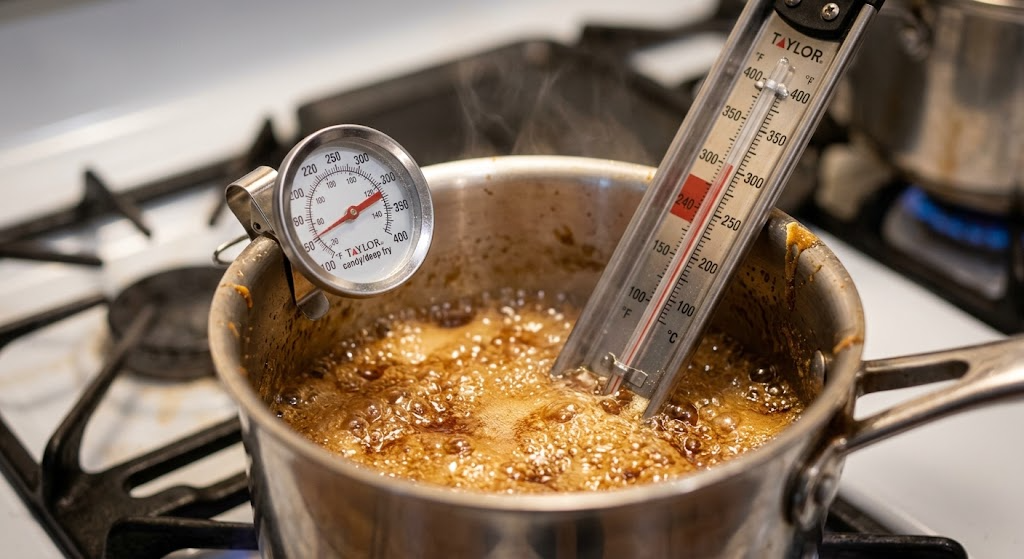
Candy making is one of the few areas of cooking where a few degrees genuinely make the difference between success and a pan of ruined, grainy or scorched sugar. The thermometer you use to track that matters as much as the recipe itself.
Some links in this post are affiliate links. If you buy through them we may earn a small commission at no extra cost to you — it never changes which products we recommend.
What Actually Matters
Digital vs. Analog
Digital thermometers read faster and more precisely, which matters a lot at the higher, fast-moving temperature stages of candy making like hard-crack stage. Analog dial thermometers are reliable too, but they can be slower to respond and harder to read precisely at a glance while sugar is climbing in temperature quickly.
Pot Clip
A secure clip that holds the thermometer in place against the side of the pot, with the tip suspended in the syrup but not touching the pot’s bottom, is essential — touching the bottom gives a falsely high reading from the direct heat source rather than the syrup’s actual temperature.
Probe Length and Range
A longer probe keeps your hand further from the boiling sugar, which matters both for safety and for accurate readings in a deeper pot. Check that the temperature range covers the specific stage you need — hard-crack stage runs around 300°F+, well above where some cheaper multipurpose thermometers top out.
From My Kitchen: The Falsely High Reading That Ruined a Batch
I once had a thermometer clip slip slightly during a caramel batch, letting the tip touch the bottom of the pot. It read the temperature as higher than the sugar actually was, since it was picking up direct heat from the pot itself rather than the syrup around it. I pulled the caramel off the heat exactly when the thermometer said to, but the syrup hadn’t actually reached that temperature yet, and the caramel set up soft and never firmed properly. Now I always double-check the clip is secure and the tip is fully suspended in the liquid, not resting against the pot, before I trust any reading during a candy batch.
Worth Considering
TempPro’s digital candy thermometer with pot clip gives fast, precise readings with a properly designed clip and long probe.
This candy and deep-fry thermometer with pot clip is a solid, more affordable option that covers the key temperature stages.
Why Sugar Work Is Less Forgiving Than Roasting
Sugar stages are separated by very small temperature windows. Soft ball is roughly 112–116°C, firm ball 118–120, hard crack 149–154. A thermometer reading three degrees high will take you from a fudge that sets to one that never firms, or from caramel to something burnt. Meat has an enormous margin for error by comparison; sugar has almost none, which is why accuracy is the specification that matters here above all others.
Speed matters nearly as much. Once sugar passes about 150°C it climbs very quickly, and a thermometer with a slow response gives you a reading from ten seconds ago — long enough to overshoot while you are still watching a number that looks safe. A digital probe that updates every second or two is genuinely safer than a traditional glass one for this reason alone.
Quick Comparison
| Digital with pot clip | Traditional glass or dial | |
|---|---|---|
| Response speed | 1–3 seconds | Slow, lags the actual temperature |
| Readability | Clear digits | Small markings, awkward angle |
| Accuracy over time | Stable, often calibratable | Dial types drift |
| Alarms | Usually included | None |
| Fragility | Electronics can fail | Glass can crack with thermal shock |
The Clip Is Not an Accessory
Where the probe sits changes the reading completely. A probe touching the base of the pan reads the pan, not the syrup, and pans run considerably hotter than their contents — that single mistake is behind most burnt caramel. A probe too high reads steam and tells you the sugar is cooler than it is. The tip needs to be submerged in the syrup without touching metal, and a proper clip is what holds it there while you have both hands busy.
It is worth calibrating before any batch that matters. Put the thermometer in boiling water: at sea level it should read 100°C, and a little lower at altitude. If it reads 97, every sugar stage in your recipe needs adjusting by three degrees, and knowing that in advance is the difference between fudge and syrup.
Two Thermometers Worth Considering
Best overall: TempPro Digital Candy Thermometer With Pot Clip
Fast digital reading with a clip that holds the probe at the right depth, which is the combination sugar work actually needs. An alarm you can set for the target temperature removes the need to watch continuously through the fast-moving final stages.
Pros
- Fast response through the critical stages
- Clip holds the probe clear of the pan base
- Settable alarm for target temperature
Cons
- Battery powered
- Electronics are less tolerant of being dropped
Best for frying too: Candy and Deep-Fry Thermometer With Pot Clip
Covers both sugar stages and oil temperature, which is the other job where a few degrees changes the result — oil below 175°C gives greasy food and above 195°C burns the outside before the inside cooks.
Pros
- Covers both sugar and frying ranges
- Sturdy clip for deep pans
- Clear stage markings for reference
Cons
- Slower to respond than a fast digital probe
- Larger to store
Frequently Asked Questions
Why does my candy thermometer read differently than my recipe expects?
The most common cause is the probe touching the bottom or side of the pot rather than being fully suspended in the syrup, which picks up direct heat and reads artificially high.
Do I need to calibrate a candy thermometer?
It’s worth checking occasionally — testing in boiling water, which should read very close to 212°F at sea level, is a simple way to confirm accuracy before a batch that depends on precise temperatures.
Is digital always better than analog for candy making?
Digital tends to be faster and easier to read precisely at a glance, which helps at fast-moving high temperatures, but a good analog dial thermometer with a proper pot clip can still work reliably if you’re used to reading it.
Can I use a meat thermometer for candy?
Only if its range goes high enough, and many do not — plenty of meat thermometers top out around 200°C, which covers sugar work, but instant-read models are often not designed to sit in a pan continuously. The practical problems are that they have no clip, so you are holding a probe in boiling sugar, and the probe length is often too short to reach into a deep syrup without your hand being over the pan. It works in an emergency; it is not the tool.
How do I test sugar stages without a thermometer?
The cold water test, which is what the stage names come from. Drop a small spoonful of syrup into a glass of very cold water and feel what forms: a soft, squashable ball is soft ball stage, a firmer ball that holds its shape is firm ball, and a thread that snaps cleanly rather than bending is hard crack. It is genuinely reliable, and worth knowing as a cross-check even when you own a thermometer.
Rimi Sultana is a home cook from Bangladesh who has cooked for her family every day for the past five years and writes about it at Smart Cooks. Perpetually testing whether internet-famous recipes actually work in a regular home kitchen. Say hello on Facebook or through the contact page.