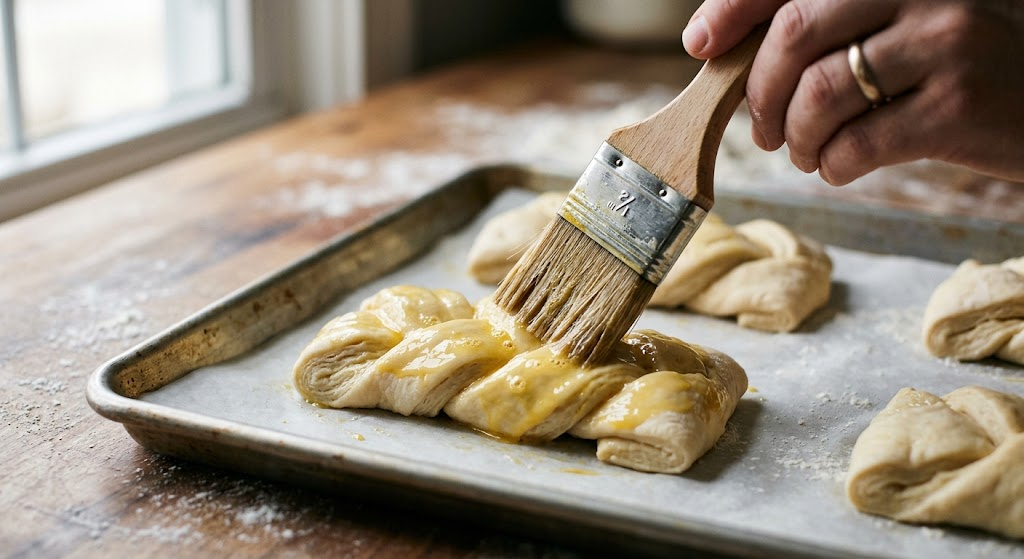
Finding actual bristles baked into a golden pie crust is one of those small kitchen disasters that’s entirely avoidable with the right brush. The material and construction matter more here than almost any other basic kitchen tool.
Some links in this post are affiliate links. If you buy through them we may earn a small commission at no extra cost to you — it never changes which products we recommend.
What Actually Matters
Silicone vs. Natural Bristle
Silicone bristles don’t shed, are heat resistant, and clean easily in a dishwasher — the shedding problem essentially doesn’t exist with a genuine silicone brush. Natural bristle brushes can apply an egg wash or butter slightly more delicately for some tasks, but they’re the ones responsible for the classic “bristle in the crust” problem, especially as they age.
Bristle Density and Bend
A silicone brush with densely packed, flexible bristles holds and spreads liquid more evenly than one with sparse, stiff bristles that just push liquid around rather than absorbing and releasing it smoothly.
Heat Resistance
If you ever use a brush near a grill or basting something directly over heat, check the specific temperature rating — not all silicone brushes are rated the same, and cheaper ones can start to soften or degrade at lower temperatures than advertised.
From My Kitchen: The Bristle I Found in a Finished Pie
Years ago I used a natural bristle brush that looked fine, brushed an egg wash over a pie crust, and found a loose bristle baked right into the crust when I cut into it after dinner. It wasn’t a cheap or particularly old brush — natural bristles just shed occasionally regardless, especially with repeated washing that loosens the glue holding them in place. I switched to silicone brushes after that and haven’t had the issue since, since there’s no glue or individual bristles to come loose in the first place.
Worth Considering
This heat-resistant silicone basting brush set handles both delicate pastry work and higher-heat grilling or basting.
OXO’s Good Grips silicone pastry brush is a well-regarded, smaller option suited to lighter, more precise egg wash or glaze work.
Why Natural Bristles Shed and Silicone Does Not
A natural-bristle brush is a bundle of boar hair glued into a metal ferrule. That glue is the weak point: hot fat softens it, repeated washing swells and dries the bristle bundle, and dishwasher heat does both at once. Over time the bond fails and bristles start coming out — usually into whatever you were basting, which is why people end up throwing these brushes away rather than replacing them on schedule.
Silicone brushes are moulded as a single piece, so there is nothing to come loose. They also do not absorb fat, which matters more than it sounds — a natural brush used for garlic butter holds that flavour and, worse, holds rancid oil deep in the bundle where washing does not reach. If you have ever picked up a pastry brush and caught a faintly stale smell, that is what it was.
Quick Comparison
| Natural bristle | Silicone | |
|---|---|---|
| Shedding | Yes, eventually | No |
| Liquid held | More — holds a proper load | Less, needs more dips |
| Thin even coat on pastry | Excellent | Adequate, can streak |
| Heat tolerance | Moderate, glue degrades | High, safe on a hot grill |
| Cleaning | Hand wash, dry hanging | Dishwasher safe |
| Rancidity risk | Real if not dried properly | None |
What Silicone Actually Gives Up
It is worth being honest that silicone is not strictly better. Natural bristles hold considerably more liquid and release it in a thin, even film, which is exactly what an egg wash on delicate pastry needs. Silicone bristles are thicker and further apart, so they can leave visible streaks and can drag on very soft dough. For a laminated pastry where the wash affects the final shine, a natural brush still does the better job.
Where silicone wins outright is heat and mess: basting on a grill, brushing butter onto hot corn, glazing something mid-bake, or anything with sugar in it that would otherwise set hard in a bristle bundle. Many kitchens end up with both — a cheap silicone brush for everything hot or sticky, and one good natural brush kept for pastry and dried properly after every use.
Two Brushes Worth Considering
Best for heat and basting: Heat-Resistant Silicone Basting Brush Set
The right tool for anything hot, sticky or sugary, where a bristle brush would either shed or set solid. Dishwasher safe, which removes the drying discipline natural brushes require.
Pros
- Nothing to shed into the food
- Handles grill and oven temperatures
- Dishwasher safe, no rancidity risk
Cons
- Holds less liquid than bristles
- Can streak on delicate pastry
Best all-round silicone: OXO Good Grips Silicone Pastry Brush
Finer, more densely set bristles than most silicone brushes, which narrows the gap with natural hair for pastry work while keeping all the durability advantages. A sensible single brush if you only want one.
Pros
- Finer bristles lay down a more even coat
- Comfortable handle, good control
- Easy to clean thoroughly
Cons
- Still not quite a natural brush for fine egg wash
- Larger head than some delicate work wants
Frequently Asked Questions
Are silicone brushes actually as good as natural bristle for pastry work?
For the vast majority of tasks, yes — modern silicone bristle designs apply liquid smoothly and evenly. Natural bristle still has a slight edge for extremely delicate, thin glazes, but it’s a marginal difference for most home baking.
Can I put a silicone pastry brush in the dishwasher?
Most can, which is one of their biggest practical advantages over natural bristle brushes that typically need hand washing and careful drying to avoid mildew or bristle damage.
Why does my silicone brush leave streaky butter or egg wash?
This is often a bristle density issue — sparse bristles push liquid around rather than holding and releasing it evenly. A denser-bristled brush usually solves streaky application.
How should I clean a pastry brush so it lasts?
Wash in hot soapy water immediately, working the suds through the bristles with your fingers rather than just rinsing the surface, then hang it bristles-down or stand it bristles-up so water drains out rather than sitting in the ferrule. Water trapped at the base of a natural brush is what loosens the glue and eventually causes both shedding and the stale smell. Silicone brushes can simply go in the dishwasher.
Which brush should I use for egg wash on pastry?
A natural bristle brush if you have one and the shine matters — on a pie lid, a tart or laminated pastry, it lays a thinner, more even film and does not leave streak marks in the finished bake. A fine-bristled silicone brush is a perfectly good substitute for everyday baking. The thing that matters more than either is not over-loading the brush: a wash applied too thickly pools in the corners and bakes to a dark, slightly rubbery patch.

Rimi Sultana is a home cook from Bangladesh who has cooked for her family every day for the past five years and writes about it at Smart Cooks. Perpetually testing whether internet-famous recipes actually work in a regular home kitchen. Say hello on Facebook or through the contact page.