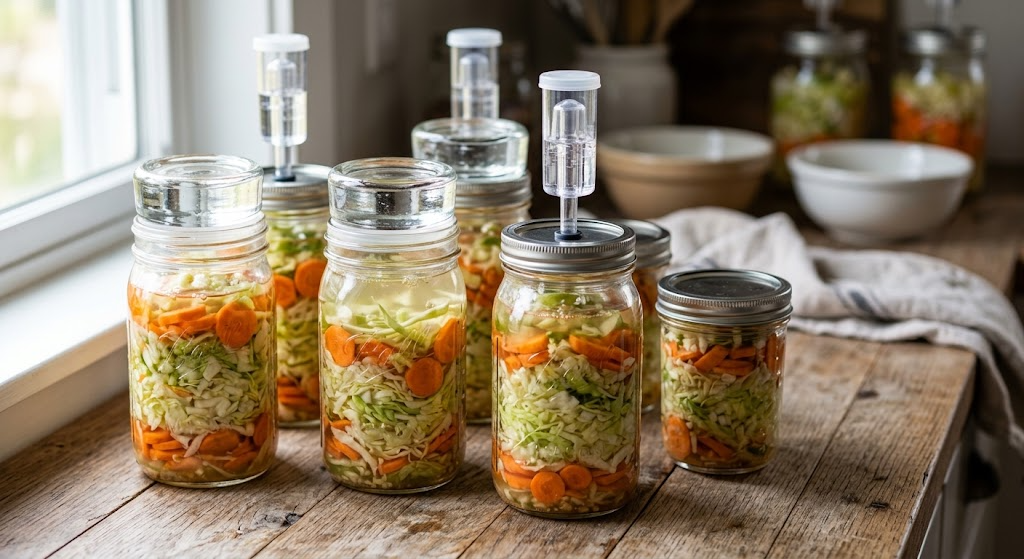
Fermenting vegetables is the cheapest, easiest preserving there is. No canner, no processing times, no altitude tables, no botulism arithmetic — you salt cabbage, keep it under the brine, and wait. The lactic acid bacteria do the rest, and they make the jar so acidic that nothing dangerous can live in it.
Some links in this post are affiliate links. If you buy through them we may earn a small commission at no extra cost to you — it never changes which products we recommend.
But there is one failure mode, and it accounts for nearly every batch of sauerkraut that goes fuzzy and gets thrown away: anything floating above the brine will grow mould. Everything you can buy for jar fermenting exists to solve that single problem — weights push the vegetables down, and airlock lids let carbon dioxide out without letting oxygen in.
You do not strictly need any of it. Generations fermented in open crocks with a plate and a rock. But the kit turns a slightly anxious process with a decent failure rate into something that just works, and it costs less than one ruined batch of cabbage. Below are seven sets and components worth buying. If you catch the habit, our guide to fermentation crocks covers the step up.
Our Top 7 Picks for Mason Jar Fermentation Kits
Best Overall: Masontops Complete Mason Jar Fermentation Kit

Masontops is the brand that made mason jar fermenting mainstream, and the complete kit is the sensible one-purchase answer. You get their silicone Pickle Pipe airlock lids, glass Pickle Pebble weights sized to sit inside a wide-mouth jar, and a wooden tamper for packing cabbage down hard enough to release its own brine.
The Pickle Pipe is the piece that earns the money. It is a one-piece silicone lid with a built-in nipple valve — carbon dioxide pushes out, nothing gets back in, and there is no water to top up and no plastic airlock to disassemble and clean. You screw it on and forget about it for two weeks.
The tamper matters more than it looks too. Getting cabbage genuinely submerged in its own liquid takes real force, and doing it with your fist is both ineffective and unpleasant.
Key Specifications
- Complete kit: airlock lids, glass weights and tamper
- Fits standard wide-mouth mason jars
- One-piece silicone valve lids, no water to maintain
- For sauerkraut, kimchi, pickles and fermented vegetables
Pros
- Everything needed in a single purchase
- Silicone airlocks need no topping up or cleaning out
- Glass weights sit properly below the jar shoulder
- The tamper genuinely improves results
Cons
- Wide-mouth jars only
- Jars are not included
- More expensive than buying weights alone
Best Airlock Lids: Masontops Pickle Pipes for Wide Mouth Mason Jars

If you already own weights, or you plan to use the boiled-cabbage-leaf trick instead, the Pickle Pipes alone are the highest-value thing in this category. They are moulded silicone with a slit valve at the top: fermentation gas pushes the slit open and escapes, and the slit closes behind it so no oxygen returns.
That matters because the alternative is either burping jars manually every day — which people forget, and forgotten jars build pressure — or a three-piece water airlock that needs the water level maintained and has crevices that grow things.
They wash in seconds, last years, and stack flat in a drawer.
Key Specifications
- Silicone one-piece airlock lids
- Fits wide-mouth mason jars
- Self-sealing slit valve
- Dishwasher safe, reusable indefinitely
Pros
- No daily burping and no water to top up
- Nothing to disassemble or scrub
- Very compact to store
- Cheapest reliable route to reliable fermenting
Cons
- Weights not included
- Wide-mouth only
- Silicone can pick up strong kimchi odours over time
Best Weights: Masontops Pickle Pebbles Glass Fermenting Weights

Glass weights are the honest solution to the submersion problem, and these are cut to sit below the shoulder of a wide-mouth mason jar so they hold vegetables under brine rather than perching on top of them.
Glass is the right material here specifically because it is inert: fermenting brine is acidic and salty, which is a hostile environment for metal, and stones or improvised weights can leach or harbour bacteria in their pores. It is also heavy enough to do the job without being so heavy it crushes delicate vegetables.
The trade against handled weights is that a flat pebble is harder to fish out of a full jar of brine. Some people prefer that — no handle means nothing sticking up above the liquid line.
Key Specifications
- Food-grade glass fermenting weights
- Sized for wide-mouth mason jars
- Sits below the jar shoulder
- Inert and non-porous
Pros
- Glass will not react with acidic brine
- Correct weight to submerge without crushing
- No handle protruding above the brine
- Effectively lasts forever
Cons
- Awkward to retrieve from a full jar without a handle
- Wide-mouth only
- Glass can chip if knocked against the jar
Best Kit With Jars Included: Elementi Mason Jar Fermentation Kit, 8 Pieces

Most fermentation kits assume you already own mason jars. If you do not, buying jars separately usually costs more than the kit did. This set includes the jars along with weights and lids, so it is genuinely everything needed to start a batch of sauerkraut the day it arrives.
Sensible as a gift for the same reason — nobody wants a present that requires a second shopping trip before it works.
My first jar went mouldy on top by day three and I threw the whole thing away, convinced I had done something wrong. I had — but not the thing I assumed. The cabbage had floated above the brine overnight because I had not weighted it, and anything sitting above the liquid is just vegetables in warm air. With a glass weight holding it under, the second jar was fine.
Here is the part that would have reassured me at the time: for the first two days almost nothing happens and you will be certain it has failed. Around day three it starts to smell sour and go slightly fizzy, and by day six mine tasted like actual sauerkraut. Sharp and sour is right. Like a bin is not — and you will not be in any doubt about which one you have.
Key Specifications
- 8-piece kit including wide-mouth mason jars
- Glass fermenting weights included
- Fermentation lids included
- Complete out of the box
Pros
- No separate jar purchase needed
- Genuinely complete for a first batch
- Makes a good gift
- Everything sized to match
Cons
- Costs more up front than components alone
- Jars may duplicate ones you own
- Fewer jars than a dedicated fermenter will want
Best Budget Kit: Wide Mouth Mason Jar Fermentation Kit for Sauerkraut and Pickling

The cheap route into jar fermenting, and for a first attempt it is a perfectly reasonable one. You get airlock lids and weights sized for wide-mouth jars — the two things that actually determine whether your kraut works.
What you give up against Masontops is longevity and consistency: budget silicone hardens sooner, valve slits can be cut unevenly, and weight thickness varies between pieces. If fermenting turns into a habit you will probably replace these within a year or two. If you are not sure yet whether you will like it, that is a rational way to find out.
Key Specifications
- Airlock lids and weights for wide-mouth jars
- Complete starter components
- For sauerkraut, kimchi and pickles
- Lowest-cost entry point
Pros
- Cheapest way to try fermenting properly
- Includes both lids and weights
- Fits standard wide-mouth jars
- Low risk if you are unsure
Cons
- Budget silicone hardens faster than Masontops
- Quality varies piece to piece
- Jars not included
Best Value Weights: 4-Pack Glass Fermentation Weights with Easy Grip Handle

The handled version of the glass weight, and if you have ever tried to get a flat pebble out of a full jar of brine with your fingers, you will understand immediately why the handle exists. A small knob on top lets you lift the weight out cleanly without tipping brine down your arm.
Four in a pack is the practical number, because fermenting is one of those habits where you go from one jar to four almost immediately.
The one consideration: the handle sits slightly above the weight, so leave a little extra headspace so the knob is not pressed against the lid.
Key Specifications
- Four glass fermentation weights per pack
- Easy-grip handle on top
- Fits wide-mouth mason jars
- Food-grade, non-porous glass
Pros
- Handle makes removal genuinely easier
- Four weights for less than most single-jar kits
- Inert glass, safe with acidic brine
- Simple to clean
Cons
- Handle needs a little extra jar headspace
- Lids not included
- Wide-mouth only
Best for Regular-Mouth Jars: Masontops Pickle Pipes for Small Mouth Mason Jars

Nearly every fermentation product on the market is made for wide-mouth jars, which is a problem if your cupboard is full of regular-mouth ones. These are the same silicone Pickle Pipe airlocks in the smaller diameter.
Worth being straight about the limitation, which is the jar rather than the lid: regular-mouth jars have a narrower opening and a pronounced shoulder, which makes packing vegetables in harder, makes getting them out harder, and means most fermentation weights will not fit through the neck at all. Use these for pickled beans, carrot sticks and small-batch pickles rather than a dense jar of kraut.
If you are buying jars anyway, buy wide-mouth.
Key Specifications
- Silicone airlock lids for regular-mouth mason jars
- Self-sealing slit valve
- Reusable and dishwasher safe
- Same design as the wide-mouth version
Pros
- One of very few options for regular-mouth jars
- No burping or water maintenance
- Uses jars you likely already own
- Compact and easy to clean
Cons
- Most fermentation weights will not fit through the neck
- Narrow opening makes packing and unpacking awkward
- Not ideal for dense ferments like sauerkraut
The Ultimate Buying Guide for Jar Fermentation Kits
The Only Rule That Matters: Keep It Under the Brine
Lactic acid bacteria work without oxygen. Mould and kahm yeast need it. So everything below the surface of the brine is protected and fermenting properly, and anything poking above it is exposed and will eventually grow something fuzzy.
That is the whole engineering problem. Weights solve it mechanically by holding vegetables down. Airlock lids solve the other half by letting the carbon dioxide the ferment produces escape without letting fresh oxygen back in. Get both right and jar fermenting is close to foolproof.
Airlock Lids: Silicone Valve vs Water Airlock
- Silicone valve lids (Pickle Pipes and similar) are a one-piece lid with a slit or nipple valve. Gas pushes out, the valve closes behind it. Nothing to maintain, nothing to disassemble, and they wash in seconds. This is what most people should buy.
- Three-piece water airlocks use a plastic lock filled with water — the traditional homebrew design. They work, and you can see bubbling activity, which is reassuring. But the water evaporates and needs topping up, and the crevices need proper cleaning.
- No lid at all, just a loose jar lid you burp daily, also works — until the day you forget.
Weights: Glass, and Handle or Not
Use glass. Brine is salty and acidic, which is hard on metal, and improvised weights — stones, ceramic shards, a smaller jar — can be porous, can leach, or can simply not fit. Glass is inert, heavy enough, and cleans completely.
- Handled weights are much easier to lift out of a full jar. Leave a little extra headspace for the knob.
- Flat pebble weights sit lower and leave more room, but are fiddly to retrieve with wet fingers.
A free alternative that genuinely works: fold a large outer cabbage leaf over the top of the shredded cabbage and tuck it down the sides, then weight it. It is what people did before anyone sold weights.
Wide Mouth vs Regular Mouth
Buy wide-mouth jars if you have the choice. Almost all fermentation weights and lids are made for them, packing vegetables in is far easier, and getting finished kraut out of a regular-mouth jar past the shoulder is genuinely annoying. Regular-mouth jars are fine for thin things — beans, carrot sticks, cucumbers — but poor for dense ferments.
Jar Size
- Quart (1 litre) — the standard, right for a first batch and for one cabbage split across two jars
- Half-gallon — a whole cabbage in one jar, fewer jars to manage, but heavy and harder to fit in a fridge
- Pint — good for testing a new recipe or for condiments like fermented hot sauce base
What You Also Need (And It Is Not Much)
- Non-iodised salt — sea salt, pickling salt or kosher salt. Iodine can inhibit the bacteria, and anti-caking agents cloud the brine.
- Filtered or dechlorinated water if your tap water is heavily chlorinated, since chlorine is designed to kill exactly the bacteria you want. Letting tap water stand overnight is usually enough.
- A tamper or a sturdy wooden spoon to pack cabbage hard enough to draw out its own liquid.
- A tray under the jars. Active ferments overflow. This is normal and it will happen on your counter.
How to Tell It Is Working (and When It Is Not)
- Bubbles, cloudy brine and a sour smell are all correct. Cloudiness is not spoilage.
- A white film on the surface is usually kahm yeast — harmless, if unappealing. Skim it off.
- Fuzzy growth in any colour — blue, green, black, pink — is mould. Discard the batch. Do not scrape it off and eat the rest.
- Slimy or rotten-smelling, rather than sour, means it went wrong. Throw it out.
- Trust your nose. A good ferment smells sharply sour and appetising. A bad one smells like something you do not want to eat.
Frequently Asked Questions About Fermentation Kits
Do I really need special lids and weights?
No, but they raise your success rate substantially. People fermented for thousands of years with a plate and a stone. What kits buy you is consistency: a weight that reliably keeps everything submerged and a valve that vents gas without admitting oxygen removes the two things that most commonly ruin a batch. Given a set costs less than a couple of failed cabbages, most people find it pays for itself immediately.
Is fermenting as risky as canning?
No, and it is worth being clear about why. Improperly canned low-acid food can grow botulism because it is sealed in an oxygen-free jar that has not been heated enough. A vegetable ferment rapidly becomes far too acidic for botulism to survive, and spoilage announces itself with visible mould and a bad smell rather than being invisible. Fermenting is a genuinely low-risk form of preserving. It is still worth discarding anything mouldy or foul-smelling instead of trying to rescue it.
Why did my sauerkraut go mouldy?
Almost always because something floated above the brine. Shreds poking through the surface are exposed to oxygen and will grow mould. Pack tighter, use a weight, and if there is not enough liquid, top up with a 2% brine — roughly one teaspoon of salt per cup of water — rather than plain water, which dilutes the whole jar.
Can I use regular mason jar lids instead of airlocks?
Yes, but you must burp them — loosen the lid daily to release built-up carbon dioxide, then retighten. It works fine as long as you actually remember. A forgotten jar builds pressure, and jars have been known to crack or push brine out around the seal. Airlock lids exist because people forget.
How long does vegetable fermentation take?
Anywhere from a few days to several weeks depending on temperature and how sour you want it. Warm rooms ferment fast, cool rooms slowly. Start tasting after about five days and move it to the fridge when it tastes right to you — cold storage slows fermentation almost to a stop and holds it there for months.
Can I put fermentation weights and lids in the dishwasher?
Glass weights and silicone lids are generally dishwasher safe. Silicone can absorb strong smells over time — kimchi in particular — so many people keep a dedicated set for pungent ferments. Three-piece plastic airlocks are better washed by hand so the small parts are not lost or warped.
Final Thoughts
For most people the Masontops complete kit is the right buy: valve lids, glass weights and a tamper in one purchase, all sized correctly for wide-mouth jars. If you already have jars and weights, the Pickle Pipes alone are the best value in this whole category. And if you are not yet sure fermenting is for you, the budget kit is a rational way to find out for the price of a cabbage or two.
Keep everything under the brine, use non-iodised salt, put a tray underneath, and taste as you go. If it becomes a habit, the next step is a proper crock — our guide to the best fermentation crocks covers that.
As an Amazon Associate we earn from qualifying purchases. Availability is accurate as of the date of publishing. We do not list prices because they change too often to quote honestly.

Rimi Sultana is a home cook from Bangladesh who has cooked for her family every day for the past five years and writes about it at Smart Cooks. Perpetually testing whether internet-famous recipes actually work in a regular home kitchen. Say hello on Facebook or through the contact page.