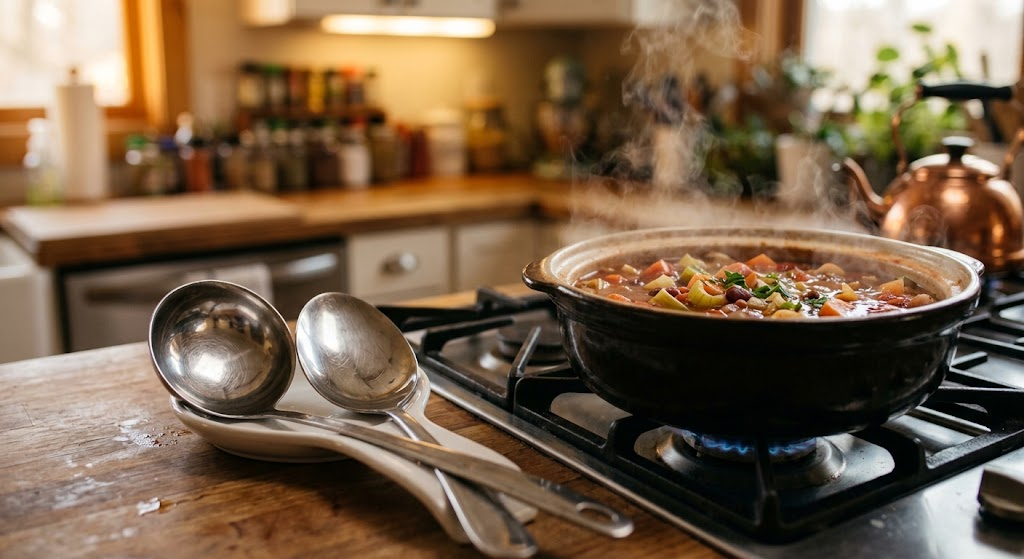
Reaching for whatever spoon is closest works fine for stirring, but serving and portioning sauce is a different job, and the tool you use actually changes how neatly it goes from pot to plate. Here’s when a ladle earns its place over a regular spoon.
Some links in this post are affiliate links. If you buy through them we may earn a small commission at no extra cost to you — it never changes which products we recommend.
What Actually Matters
Bowl Depth and Volume Control
A ladle’s deep bowl carries a consistent, measurable amount of liquid in one motion, which matters for anything you’re portioning evenly — soups, gravies, sauces over multiple plates. A flat spoon just doesn’t hold volume the same way, so portions end up uneven.
Pour Spout Design
Some ladles include a small spout or notch on the rim specifically for controlled pouring without dripping down the side. If you’re plating sauce with any precision (drizzling rather than dumping), this small detail matters more than it seems.
Handle Length for Pot Depth
A ladle with a handle too short for your stockpot means dipping your knuckles near hot liquid. Match handle length to the pots you actually use it in, especially for tall stockpots versus shallow saucepans.
From My Kitchen
I used a regular large spoon to portion gravy for a holiday dinner and ended up with visibly uneven plates — some guests got a generous pour, others barely a spoonful, because a flat spoon just doesn’t hold a repeatable amount. Switching to an actual ladle the following year made portioning almost automatic; I could tell by feel when I had a consistent scoop.
Worth Considering
For everyday soups and sauces, the OXO Good Grips Stainless Steel Soup Ladle has a genuinely useful pour spout that cuts down on drips. The Zulay Kitchen Premium Soup Ladle is a solid stainless option with a comfortable non-slip handle if you’re portioning for a while at once.
Depth, Lip and the Thing That Actually Causes Drips
A ladle is not just a deep spoon. The two features that separate it from a large serving spoon are a bowl deep enough to hold liquid without surface tension doing the work, and a pouring lip or spout that gives the stream somewhere to break away cleanly. Without that lip, liquid clings to the underside of the bowl and runs down the outside — which is the drip that lands on the rim of the plate, not a steadiness problem on your part.
The second thing that matters is where the handle meets the bowl. A sharp bend close to the bowl keeps your wrist at a comfortable angle when reaching into a deep pot; a gentle curve means you have to rotate your wrist awkwardly or tilt the ladle before it is out of the pot. This is the detail you notice on a stockpot and never notice on a shallow pan, which is why people who cook a lot of curry, dal or soup develop strong opinions about ladles.
Quick Comparison
| Ladle | Large serving spoon | |
|---|---|---|
| Thin liquid | Excellent, deep bowl holds volume | Poor, spills on the way out |
| Chunky stew | Good, but solids can slide out | Excellent, catches solids well |
| Clean pouring | Lip or spout breaks the stream | Drips down the underside |
| Reaching into a deep pot | Handle angled for it | Wrist ends up at a bad angle |
| Portioning consistently | Good — a known bowl volume | Inconsistent by nature |
A Note on Bowl Volume
Most home ladles hold somewhere between 4 and 8 ounces, and knowing yours turns the tool into a measuring device. If your ladle is a known 6 ounces, you can portion soup evenly across bowls without thinking, thin a sauce by a measured amount, or follow a recipe that calls for adding stock a ladleful at a time — risotto being the obvious case, where consistency between additions genuinely affects the result. Fill yours with water once, pour it into a measuring jug, and remember the number.
Two Ladles Worth Considering
Best all-round: OXO Good Grips Stainless Steel Soup Ladle
A well-shaped pouring edge and a handle angle that works in a deep pot, which is most of what a ladle needs to get right. The grip stays comfortable when your hands are wet, which matters more than it sounds like it should when you are moving a full ladle of hot soup.
Pros
- Clean pouring edge, minimal dripping
- Comfortable handle even with wet hands
- Solid stainless bowl, no flex
Cons
- Handle is not the shortest for small pots
- Grip material needs proper drying
Best value: Zulay Kitchen Premium Soup Ladle
A straightforward one-piece stainless ladle, which is the design least likely to develop a wobble or trap water where the handle meets the bowl. If you want something to hang on a rail and not think about for a decade, one-piece construction is the thing to look for.
Pros
- One-piece build, nothing to loosen or trap water
- Dishwasher safe and easy to hang
- Good weight for the price
Cons
- Metal handle gets warm if left resting in a pot
- Less cushioned in the hand than a gripped model
Frequently Asked Questions
What size ladle is best for most home cooking?
An 8-ounce ladle covers most everyday soup, sauce, and gravy portioning without being so large it’s awkward for smaller pots.
Is stainless steel better than plastic or silicone for a ladle?
For hot sauces and gravies, stainless steel handles heat better and won’t retain odors or stains the way some plastics do over time, which is why it’s the more common choice for serving tools that touch hot liquid directly.
What size ladle is right for a home kitchen?
A 6-ounce bowl is the most useful single size — about right for a serving of soup, small enough to work in a medium saucepan, large enough that you are not making six trips to fill a bowl. If you regularly cook large pots of dal or stock for a family, a second larger ladle around 8 ounces earns its place, but as a first and only ladle, 6 ounces is the safe choice.
Why does my ladle dribble down the side no matter how carefully I pour?
It is the shape of the rim, not your technique. A rim that curves outward gives the liquid a surface to cling to and follow downward; a rim that comes to a defined edge or a small spout lets the stream break away. If you are stuck with a dribbling ladle, pouring faster actually helps — surface tension loses to momentum — but the real fix is a ladle with a proper pouring lip.
Rimi Sultana is a home cook from Bangladesh who has cooked for her family every day for the past five years and writes about it at Smart Cooks. Perpetually testing whether internet-famous recipes actually work in a regular home kitchen. Say hello on Facebook or through the contact page.