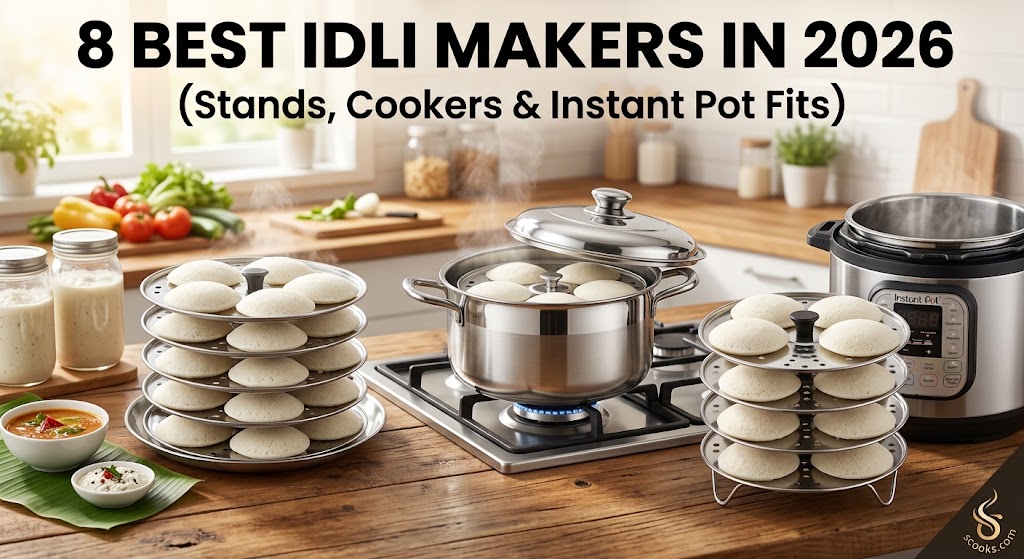
An idli is a steamed cloud — fermented rice-and-lentil batter turned into something so light it barely admits to being food. The batter does the hard work over a warm overnight ferment; the idli stand’s job is merely to not ruin it: hold the batter in shallow rounds, let steam reach every tier evenly, and release the finished idlis without a fight.
Some links in this post are affiliate links. If you buy through them we may earn a small commission at no extra cost to you — it never changes which products we recommend.
The format is standard everywhere — stacked stainless plates with shallow depressions, four idlis per plate, the stack sitting over an inch of boiling water in a covered pot. What varies is what you buy around that: a bare stand sized to a pressure cooker or Instant Pot you already own, or a complete idli cooker with its own pot and lid. Plate count decides batch size; build quality decides whether the depressions pit and stick after a year.
If your kitchen already ferments — and after our fermentation kit guide it might — idli batter is the most delicious ferment there is, and the stand is the cheapest equipment on this site. Here are eight worth buying.
Our Top 8 Picks for the Best Idli Maker
Best Overall Stand: Tabakh Stainless 5-Rack Idli Stand

Tabakh is the Indian-kitchenware name most US grocery stores stock, and this five-rack stand is the workhorse: twenty idlis per steam in solid stainless, with proper spacing between plates so the top tier cooks as evenly as the bottom — the failure point of cheap stands whose crowded tiers steam unevenly.
It drops into any pot deep enough to cover it — a big stockpot, a pressure cooker without its weight, an Instant Pot on steam. Twenty at a time matters because nobody eats three idlis.
Key Specifications
- Five stacked plates, 20 idlis per batch
- Solid stainless construction
- Proper inter-plate steam spacing
- Fits large pots and pressure cookers
Pros
- Twenty idlis per steam is real-family scale
- Even cooking to the top tier
- Established, replaceable brand
- Effectively immortal stainless
Cons
- Needs a pot tall enough to house it
- No pot or lid included
- Plates want oiling before each use
Best Complete Cooker: Tabakh Idli Cooker with Nonstick 4-Rack Stand

The all-in-one answer: Tabakh’s dedicated idli pot with a four-rack nonstick stand inside — sixteen idlis, correct water depth marked by the pot’s own geometry, lid designed to shed condensation to the walls instead of dripping onto the batter.
Nonstick depressions release idlis with a nudge instead of a knife, which matters most at breakfast speed. This is the buy for a household starting from no suitable pot.
Key Specifications
- Complete cooker pot plus 4-rack stand
- Nonstick idli depressions
- Makes 16 per batch
- Purpose-built lid and water depth
Pros
- Nothing else needed — pot included
- Nonstick release at breakfast pace
- Lid manages condensation properly
- Right water depth by design
Cons
- Nonstick plates are a consumable surface
- Single-purpose pot to store
- Sixteen is a smaller batch than the 5-rack
Best for Instant Pot: 4-Tier Stand for 5/6/8-Quart Multicookers

Sized specifically to drop inside 5, 6 and 8-quart multicookers, this four-tier stand turns the Instant Pot every American kitchen already owns into a perfectly good idli steamer: a cup of water, steam mode, vent open, twelve minutes.
For diaspora kitchens this is the lowest-friction route to homemade idlis — no new pot, no stovetop juggling, and the multicooker’s yogurt mode conveniently ferments the batter the night before.
Key Specifications
- Four tiers, 16 idlis
- Sized for 5/6/8-qt multicookers
- Stainless steel
- Central post handle for lifting
Pros
- Uses the Instant Pot you already own
- Yogurt mode ferments, steam mode cooks
- No dedicated pot to store
- Even steaming in the sealed pot
Cons
- Steam with vent open — pressure ruins texture
- Check your inner-pot diameter first
- Sixteen-idli ceiling
Best for Pressure Cookers: Hawkins 4-Plate Stand for 5 L+ Cookers

Hawkins makes the pressure cookers half of India cooks in, and this stand is engineered to their geometry — drop it into any 5-litre-plus cooker, steam without the whistle weight, and the fit is factory-matched instead of improvised.
If a Hawkins or similar cooker already lives on your stove, this is the cheapest possible idli setup: one stand, zero new vessels.
Key Specifications
- Stainless stand for 5 L+ pressure cookers
- Hawkins factory fit
- Steams without the weight
- Compact stack
Pros
- Perfect fit for the commonest cookers
- Cheapest full setup if you own the cooker
- Trusted brand stainless
- Small enough to store anywhere
Cons
- Twelve idlis is the smallest batch here
- Must remember: no whistle weight
- Wrong for very small cookers
Best Large Batch: 6-Plate Stainless Idli Stand

Six plates, twenty-four idlis, one steam — the stand for the household where idlis vanish as fast as they are plated, or for batch-cooking a week of breakfasts (idlis freeze and re-steam almost perfectly).
The tall stack demands a genuinely deep pot and slightly longer steaming, but the arithmetic of feeding six people once instead of twice settles the argument.
Key Specifications
- Six plates, 24 idlis per steam
- Stainless steel
- Tall-stack format
- Batch-cooking capacity
Pros
- Biggest single-steam yield here
- One steam feeds a full table
- Freezer-batch friendly
- Solid stainless build
Cons
- Needs a very deep pot
- Top tier takes a minute longer
- Overkill for two people
Best Premium Cooker: Judge by Prestige Idli Cooker with 4 Plates

Prestige is the other titan of Indian kitchens, and its Judge-line idli cooker is the refined version of the complete-kit idea: better-finished stainless, a lid that seats properly, plates whose depressions are polished smooth enough to release with minimal oil.
The buy for the kitchen that makes idlis weekly and wants the equipment to feel like it.
Key Specifications
- Complete cooker with 4 plates
- Judge by Prestige build quality
- Polished stainless depressions
- Fitted lid
Pros
- Noticeably better finishing than budget kits
- Smooth plates release cleanly
- Major-brand spares availability
- Complete out of the box
Cons
- Costs more than commodity cookers
- Sixteen-idli capacity
- Single-purpose vessel
Best Compact: Stainless Mini Idli Stand, 3 Plates

Mini idlis — bite-sized, extra-fluffy, beloved of children and of anyone who has met idli-sambar shots at a wedding breakfast — need their own smaller depressions, and this three-plate mini stand is the compact tool for them.
It is also simply the right size for one or two people in a small kitchen: fits a medium saucepan, stores in a drawer, steams a plateful in ten minutes.
Key Specifications
- Three plates of mini depressions
- Compact stainless stack
- Fits medium saucepans
- Mini-idli format
Pros
- Mini idlis for kids and sambar-dunking
- Smallest storage footprint
- Steams fast
- Cheap
Cons
- Minis dry faster if oversteamed
- Small batch for guests
- Standard-size idli fans need the big plates
Best Multi-Size Kit: 4-Plate Stand for Multicookers, Alternate Fit

A second multicooker-fit stand worth listing because dimensions are the whole game in this category — inner pots vary by brand, and between two near-identical stands the right buy is whichever matches your pot’s diameter and height with steam space to spare.
Four parts idli rice to one part urad dal, with a spoon of methi seeds soaked in alongside the dal — that ratio has not changed in my kitchen in years. The variable is never the proportion. It is the time.
In summer here the batter is risen and doubled in six or seven hours on the counter; in winter the same batter can take fourteen, and I put the container in the oven with only the light on. The sign is not the clock — it is that the batter has lifted, gone slightly airy on top, and smells faintly sour when you take the lid off. Over-fermented batter gives flat, sour idlis and cannot be rescued once it has gone past, so on a hot day I start checking at five hours rather than trusting a timing written for a cold kitchen.
Key Specifications
- Four tiers, 16 idlis
- Multicooker and pressure cooker fit
- Stainless steel
- Lifting post design
Pros
- Alternative dimensions for tricky pots
- Same one-cup-water steam method
- Sturdy simple build
- Fair price
Cons
- Measure before buying — fit is everything
- No pot included
- Generic branding
The Ultimate Buying Guide for Idli Makers
Stand Only or Complete Cooker?
A bare stand is the right buy if you own any pot deep enough to house it with an inch of boiling water below and steam room above — stockpot, pressure cooker (weight off), or multicooker. A complete idli cooker earns its shelf when no such pot exists, and its purpose-built lid genuinely manages condensation better. Diaspora shortcut: the Instant Pot ferments the batter on yogurt mode overnight and steams the idlis in the morning — one appliance, both jobs.
Batch Arithmetic
- 3-plate mini stands — couples, kids, sambar-shot minis
- 4 plates / 16 idlis — the standard family steam
- 5-6 plates / 20-24 — big households and freezer batches (idlis re-steam beautifully)
Nobody eats three idlis. Size up.
What Makes a Good Stand
- Solid stainless, no plating to pit
- Real spacing between tiers — crowded stacks steam the top tier last and worst
- Polished depressions — rough stamping is why idlis stick; a film of oil or ghee before ladling is still always worth it
- A lifting handle or post that clears the pot — fishing a hot stack out with tongs is the avoidable injury of this hobby
The Batter Is Nine-Tenths of the Idli
No stand rescues unfermented batter. The classic ratio is 4:1 idli rice to urad dal (plus a spoon of fenugreek), soaked separately, ground, and fermented 8 to 14 hours somewhere warm until visibly domed and bubbly — cold kitchens take longer, and an oven with the light on or a multicooker’s yogurt mode fixes winter. Steam 10 to 12 minutes; a toothpick should come out clean; rest two minutes before unmolding with a wet spoon. Flat, dense idlis are a fermentation complaint, not an equipment one.
Frequently Asked Questions About Idli Makers
Can I make idlis in an Instant Pot?
Yes, and it is arguably the easiest route: ferment the batter overnight on yogurt mode, then steam the filled stand over a cup of water on steam mode with the vent open, 12 minutes or so. The one rule is venting — idlis steamed under pressure come out dense and gummy.
Why do my idlis stick to the plates?
Unoiled or roughly-stamped depressions, or unmolding too fast. Film every depression with oil or ghee before ladling, rest the steamed stand two minutes, then release each idli with a wet spoon run around its edge. Nonstick plates forgive all of this at the cost of eventual coating wear.
Why are my idlis flat and dense instead of fluffy?
Fermentation, almost always: batter that never properly rose — too cold, too short, dead-slow grinding heat, or chlorinated water inhibiting the wild culture. The batter should visibly dome and smell pleasantly sour before steaming. Second causes: over-thick batter, or steaming under pressure.
Can I use the stand for anything besides idlis?
The depressions steam dhokla portions, muthia, momos and even eggs; the stand itself is a tiered steamer for anything small. And leftover idlis have a glorious second life — fried idli, idli upma — which is half the argument for the six-plate batch.
Do I need a wet grinder for the batter?
Traditional, yes; necessary, no. A strong blender grinds soaked rice and dal perfectly well in home quantities — work in batches, keep it from heating the batter, and add water sparingly. Wet grinders earn their space at family scale or daily-dosa frequency.
Final Thoughts
The Tabakh 5-rack stand plus a pot you already own is the best-value idli setup in America; the complete Tabakh or Prestige cookers are the answer when no pot fits; and the multicooker stands make the Instant Pot earn its counter space twice in one recipe.
Then it is all batter: soak, grind, ferment warm, steam gently. The stand only ever gets the credit.
As an Amazon Associate we earn from qualifying purchases. Availability is accurate as of the date of publishing. We do not list prices because they change too often to quote honestly.
Related: Top 10 instant pots for beginners and what makes them stand out

Rimi Sultana is a home cook from Bangladesh who has cooked for her family every day for the past five years and writes about it at Smart Cooks. Perpetually testing whether internet-famous recipes actually work in a regular home kitchen. Say hello on Facebook or through the contact page.