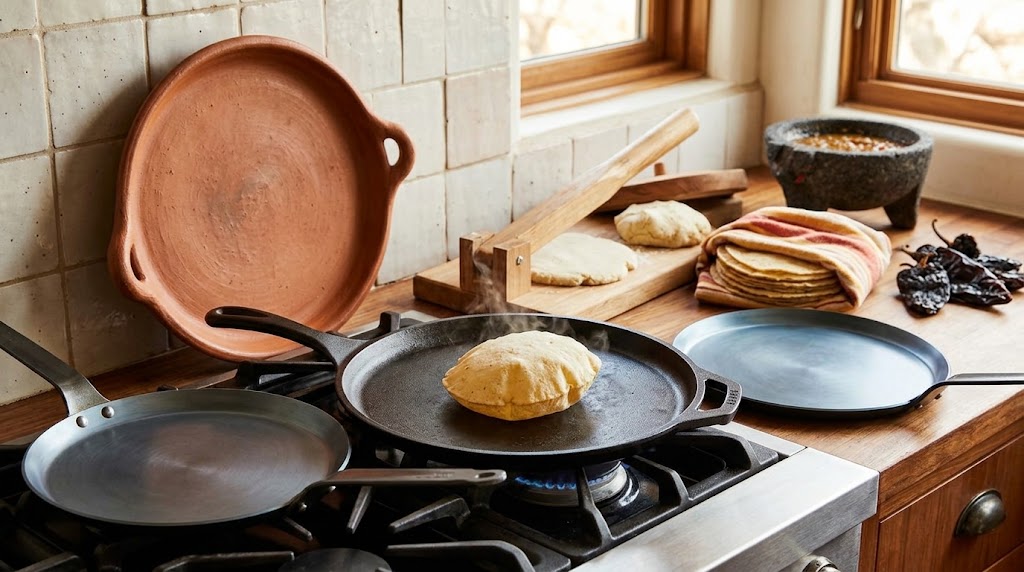
There is a moment, about forty seconds into cooking a corn tortilla, when it inflates like a small balloon. That puff is the whole point. It means the surface was hot enough and even enough to flash the moisture inside into steam, and it is what separates a tortilla that tastes like a tortilla from one that tastes like warm cardboard.
Some links in this post are affiliate links. If you buy through them we may earn a small commission at no extra cost to you — it never changes which products we recommend.
You cannot get that puff on a lukewarm nonstick pan. You need a comal — a flat, unlined, heavy-enough griddle that holds its heat when a cold, damp disc of masa lands on it. That is genuinely all a comal is, which is exactly why it is easy to buy the wrong one: the differences that matter are not the ones printed on the box.
We compared cast iron and carbon steel comals across the sizes that actually fit a home stove, and we flag one thing most roundups quietly skip — a large share of the “carbon steel comals” sold online are nonstick-coated, which is not the traditional article and behaves differently. If you are pressing your own tortillas, pair this with our guide to the best tortilla presses. Once you have a stack going, they are the right vehicle for picadillo or beef enchiladas.
Our Top 7 Picks for the Best Comal
Best Overall: Victoria 10.5-Inch Cast Iron Comal Griddle

The Victoria 10.5-inch is the comal most home cooks should buy, and the reason is the handle. It is long, cast as one piece with the pan, and angled upward — which sounds trivial until you are reaching over a hot burner to slide the comal off the flame with one hand while flipping with the other. Victoria has been casting iron in Colombia since 1939, and this pan is pre-seasoned with flaxseed oil rather than a generic vegetable oil, so it arrives with a harder, less tacky starting surface than most budget cast iron.
The cooking surface is flat and smooth, without the pebbled texture cheap cast iron often has, and 10.5 inches comfortably fits two 6-inch corn tortillas at once or one large flour tortilla. It is heavy enough that dropping a cold tortilla on it barely moves the surface temperature, which is the entire job description.
Key Specifications
- 10.5-inch pre-seasoned cast iron
- Seasoned with flaxseed oil, made in Colombia
- Long, angled, one-piece cast handle
- Oven, grill, campfire and induction safe
Pros
- Excellent heat retention — the tortilla puffs reliably
- Long angled handle is genuinely easier to work than short lugs
- Flaxseed seasoning is harder and less sticky out of the box
- Doubles as a crepe, dosa and quesadilla pan
Cons
- Heavy — not something you will move around casually
- The handle gets hot; you will want a cloth or silicone sleeve
- Needs a proper preheat, roughly five to eight minutes
Best Budget: IMUSA 9.5-Inch Cast Iron Pre-Seasoned Comal
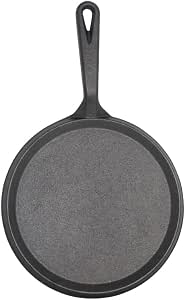
IMUSA is the brand you will find in the Latin foods aisle of most American supermarkets, and their 9.5-inch cast iron comal is the low-risk way to find out whether you will actually use one. It is a genuine unlined cast iron griddle at a fraction of the premium brands’ price, with short side handles instead of a long one.
The trade-off is honest: the casting is a little rougher and the factory seasoning is thinner than Victoria’s, so plan on two or three rounds of oiling and heating before it stops grabbing at things. Do that, and it cooks tortillas exactly as well as pans costing several times more. At 9.5 inches it is also the easiest of these to store.
Key Specifications
- 9.5-inch pre-seasoned cast iron
- Short side handles, compact footprint
- Heavy-duty flat griddle surface
- Trusted Latin American cookware brand
Pros
- The cheapest honest entry into real cast iron comals
- Small enough to store in a crowded cabinet
- Side handles keep the whole pan over the burner
- Works on gas, electric and induction
Cons
- Factory seasoning is thin and needs building up
- Short handles mean two mitts to move it
- 9.5 inches is tight for large flour tortillas
Best Widely Available: Lodge 10.5-Inch Round Seasoned Cast Iron Griddle

Lodge does not market this as a comal, but that is exactly what it is: a flat, unlined, 10.5-inch cast iron round with two small loop handles. It is the safest buy on this list in the boring sense — Lodge has been casting iron in Tennessee since 1896, quality control is consistent, and if something goes wrong you can find a replacement in almost any hardware store.
The two loop handles are the real design difference. They keep the whole pan on the burner with nothing sticking out to catch a sleeve, but you cannot nudge it one-handed the way you can the Victoria. Lodge also lists this as PFAS-free, which matters if you have been steering away from coated pans generally.
Key Specifications
- 10.5-inch pre-seasoned cast iron, made in USA
- Two integrated loop handles
- PFAS-free, no synthetic coating
- Stovetop, oven, grill and campfire safe
Pros
- Extremely consistent quality control
- Easy to find and easy to replace
- Loop handles keep the footprint compact
- No coating to wear off or worry about
Cons
- Loop handles are small and get very hot
- Slightly heavier than it needs to be for the size
- Factory seasoning is functional rather than luxurious
Best Large Budget: IMUSA 13.5-Inch Carbon Steel Round Comal

This is the comal that looks most like the ones on a Mexican street cart: a big, thin, black steel disc with two riveted metal handles. Carbon steel behaves differently from cast iron in a way that matters here — it is much lighter and it heats and cools far faster. On a home stove that means cold to tortilla-ready in a couple of minutes rather than eight, and you can actually adjust the heat mid-batch instead of waiting for a heavy pan to catch up.
At 13.5 inches it is also the only one here that lets you run an assembly line: press, cook, flip, and stack three or four tortillas at a time. That is the difference between making tortillas for one person and making them for dinner.
One honest caveat, and it is the reason this is not our overall pick: IMUSA lists this comal as nonstick-coated rather than bare steel. A coating is convenient at first, but it caps how hot you can safely run the pan, it will not build a seasoning layer the way bare carbon steel does, and it eventually wears. If you want a comal you will hand down to somebody, buy bare steel or cast iron. If you want a big, cheap, light comal for taco nights now, this is a sensible buy with its limits understood.
Key Specifications
- 13.5-inch round carbon steel
- Nonstick-coated finish, not bare steel
- Chrome riveted metal handles
- Lightweight, fast-heating, best on gas
Pros
- Big enough to cook several tortillas at once
- Heats and responds far faster than cast iron
- Much lighter to lift, wash and store
- The traditional street-cart format and size
Cons
- Coated rather than bare — will not season, and will wear
- Metal handles get dangerously hot, fast
- Thin steel can warp over a very hot burner
Best Premium: de Buyer Blue Carbon Steel Crepe & Tortilla Pan, 9.5-Inch

If you want carbon steel done properly, this is it. de Buyer has been making steel pans in the French Alps since 1830, and the “blue” in the name refers to a heat treatment that gives the raw steel a head start on rust resistance — not a coating. There is nothing on this surface to wear off. You season it, and it gets better every year.
The trade for that quality is size: at 9.5 inches with a 7.75-inch cooking surface, this is a one-tortilla-at-a-time pan. It is also the most responsive comal here, going from screaming hot to gentle in seconds, which is genuinely useful when you are toasting dried chiles and garlic and do not want to scorch them.
Buy this if you cook tortillas often and care about the tool. If you are mostly reheating store-bought tortillas for the family, the Victoria is the better-value answer.
Key Specifications
- 9.5-inch diameter, 7.75-inch cooking surface
- Blue heat-treated carbon steel, no coating
- Made in France by de Buyer
- Riveted steel handle, oven safe
Pros
- Genuinely lifetime-quality bare carbon steel
- The most responsive pan on this list
- No coating to fail or flake
- Superb for toasting chiles, garlic and spices
Cons
- Small — one tortilla at a time
- Arrives with a protective wax you must scrub off first
- The most expensive option here
- Rusts quickly if stored damp
Best With Accessories: Cuisinel 10.5-Inch Cast Iron Round Griddle

The Cuisinel is a straightforward 10.5-inch pre-seasoned cast iron round, and what earns it a place here is the included silicone handle cover. That sounds like a throwaway extra until you have grabbed a bare cast iron handle once. It is the same class of pan as the Victoria and Lodge — flat, unlined, heavy — with the one accessory you would otherwise buy separately.
It is also explicitly rated for induction, oven, grill, campfire and smoker, so if your comal is going to double as your camping griddle, this is a sensible pick.
During my stovetop testing, the silicone sleeve gripped the handle firmly without twisting or sliding when I tilted the heavy pan, though I quickly learned to pull it back an inch from the base to prevent a high gas flame from scorching the rubber edges.
Key Specifications
- 10.5-inch pre-seasoned cast iron
- Includes removable silicone handle cover
- Induction, oven, grill, campfire and smoker safe
- Long handle design
Pros
- Handle cover included rather than sold separately
- Same heat retention as more expensive cast iron
- Rated for outdoor and camp cooking
- Good value for a complete setup
Cons
- Silicone covers have a temperature ceiling — remove before the oven
- Seasoning quality varies more than Lodge or Victoria
- Heavier than carbon steel of the same width
Best Large Cast Iron: Victoria 12-Inch Cast Iron Comal

The 12-inch Victoria is the answer if you want cast iron heat retention at a size that can actually feed a family. Same flaxseed seasoning and same Colombian casting as our overall pick, but with a smart handle arrangement: one long handle for sliding it around, plus a loop handle on the opposite side so you can lift the extra weight with two hands safely.
Be realistic about your stove before buying. Twelve inches of cast iron over a standard 6-inch home burner develops a hot bullseye in the middle and cooler edges, and you will end up rotating tortillas to compensate. Over a large gas burner it is superb. Over a small one, the 10.5-inch is the better pan.
Key Specifications
- 12-inch pre-seasoned cast iron
- Long handle plus opposing loop handle
- Flaxseed oil seasoning, made in Colombia
- Oven, grill, campfire and induction safe
Pros
- Fits several tortillas or one large pizza base
- Two-handle design makes the weight manageable
- Same build quality as our top pick
- Excellent heat retention across a wide surface
Cons
- Needs a large burner or it heats unevenly
- Heavy — genuinely a two-handed pan
- Awkward to store and to wash in a small sink
The Ultimate Buying Guide for Comals
Cast Iron vs Carbon Steel vs Clay
These materials are not interchangeable, and the marketing rarely explains why.
Cast iron is thick and holds a lot of heat. When you drop a cold, wet tortilla on it, the surface temperature barely dips, so the tortilla hits full heat instantly and puffs. That is its advantage. Its disadvantage is the same property in reverse: it takes five to eight minutes to preheat and does not respond quickly when you turn the burner down. For most home cooks making a dozen tortillas, that is the right trade.
Carbon steel is thinner and lighter. It heats in a couple of minutes and responds to the burner almost immediately, which makes it better for long sessions where you are constantly adjusting. It also weighs a fraction of cast iron. The trade-off is that thin carbon steel can warp, and it lacks the thermal mass to recover as fast between tortillas. This is what most taquerías use — because they never let it cool down.
Clay (comal de barro) is the oldest form and gives a distinctly toasty flavour metal does not. It is also fragile, needs curing, cannot take thermal shock, will not work on induction, and carries the same lead-glaze questions as any traditional low-fired pottery. If you go this route, buy from a seller who documents lead-free glazing.
Our broader take on the two metals is in carbon steel pan vs cast iron for everyday cooking, and most of it applies here.
The Nonstick Trap: Read the Listing Carefully
This is the single most useful thing in this guide, and almost nobody says it. A large share of the budget “carbon steel comals” sold online are nonstick-coated, not bare steel — the IMUSA above is one of them, and we have flagged it there rather than pretending otherwise.
A coating is not automatically bad, but it changes the tool fundamentally. Coated pans have a temperature ceiling, they never develop the seasoning layer that makes an old comal work better than a new one, and the coating eventually wears through. A traditional comal is bare metal, full stop. If the listing says nonstick and you wanted the traditional article, that is the wrong pan — regardless of what the title says about carbon steel.
Size: Match It to Your Burner, Not Your Ambition
The most common mistake is buying a comal wider than the burner underneath it. A 14-inch comal on a standard 6-inch home burner develops a hot bullseye in the middle and cool edges, which means uneven tortillas and constant rotating.
- 9.5 to 10.5 inches is the right answer for almost every home stove — one large flour tortilla, or two small corn tortillas
- 12 to 14 inches only makes sense over a large gas burner, a two-burner setup, or an outdoor ring
Handles Matter More Than You Would Think
Comal handles come in three shapes and the difference is real. A long single handle (Victoria, Cuisinel) lets you slide the pan off heat one-handed while your other hand works the tortilla — the most useful design for a home cook. Loop or lug handles (Lodge, IMUSA 9.5) keep everything compact and over the burner, but need two mitts. Riveted metal handles on carbon steel comals conduct heat fast and get genuinely dangerous; keep a folded towel within reach.
Seasoning and Care
An unlined comal is not a nonstick pan and should not be treated like one.
- Season before first use even if it says pre-seasoned: wipe on a very thin film of neutral oil, heat until it just stops smoking, cool, repeat two or three times. Thin coats — thick coats go sticky.
- Skip the soap on a built-up seasoning layer. Hot water and a stiff brush or a chainmail scrubber is all it needs.
- Dry it on the burner, not on a towel. Thirty seconds of heat drives off the water that would otherwise start rust overnight.
- Cook tortillas dry. No oil. Oil on a comal makes tortillas leathery and prevents the puff.
Does It Work on Induction?
Cast iron and bare carbon steel both work on induction. Clay and aluminium comals do not. If you have an induction hob, stick to the metal options above.
Frequently Asked Questions About Comals
What is the difference between a comal and a regular griddle?
Functionally very little, which is why the Lodge griddle earns a place on this list. A comal is the Mexican name for a flat, unlined, uncoated griddle traditionally used for toasting tortillas, chiles and spices. The distinction that matters is what it is not: no nonstick coating and no raised ridges. A ridged grill pan is not a comal, and a coated nonstick pan will not get hot enough to puff a tortilla without damaging the coating.
Do I need to oil a comal to cook tortillas?
No, and you should not. Corn and flour tortillas are cooked completely dry on a comal. Adding oil makes them greasy and floppy instead of pliable and blistered, and it interferes with the steam puff. Oil is for seasoning the pan, not for cooking on it.
Why will my tortillas not puff up?
Three usual culprits. The comal is not hot enough — it should make a drop of water dance and evaporate within a couple of seconds. The masa is too dry — properly hydrated dough feels like soft play-dough, not crumbly. Or you are flipping too often; the classic method is a short first side, a longer second side, then back to the first side, which is when the puff happens.
Can I use a comal for anything besides tortillas?
Constantly. A comal is the traditional tool for dry-toasting dried chiles, garlic, tomatillos and whole spices before grinding them — which is exactly the step before you reach for a molcajete. It also makes excellent quesadillas, arepas, dosas, crepes, pancakes and naan.
Is a clay comal better than cast iron?
Better at one thing, worse at most others. Clay gives a subtle earthy, toasted flavour that metal does not, and purists prefer it for that reason alone. But it is fragile, cracks under thermal shock, will not work on induction, needs curing before first use, and raises lead-glaze questions that metal simply does not. For everyday use, cast iron or bare carbon steel is the practical choice.
How do I stop my carbon steel comal from warping?
Do not preheat it empty over a screaming-hot burner, and never run it under cold water while hot. Both create the uneven expansion that causes warping. Bring it up over medium heat and let it cool before washing. A thicker comal resists this far better than a thin one.
Final Thoughts
For most home cooks, the Victoria 10.5-inch cast iron comal is the one to buy: the right size for a home burner, heavy enough to puff a tortilla properly, and with the only handle design here you can work one-handed. On a budget, the IMUSA 9.5-inch does the same job for less once you have built the seasoning up. And if you want a pan you will still be using in thirty years, the de Buyer is bare steel done properly.
Whichever you pick, season it, cook dry, and dry it on the heat. Then put it to work alongside our tortilla press guide and a molcajete full of salsa.
As an Amazon Associate we earn from qualifying purchases. Availability is accurate as of the date of publishing. We do not list prices because they change too often to quote honestly.
Related: Top 7 carbon steel pans for high heat searing with honest insights

Rimi Sultana is a home cook from Bangladesh who has cooked for her family every day for the past five years and writes about it at Smart Cooks. Perpetually testing whether internet-famous recipes actually work in a regular home kitchen. Say hello on Facebook or through the contact page.