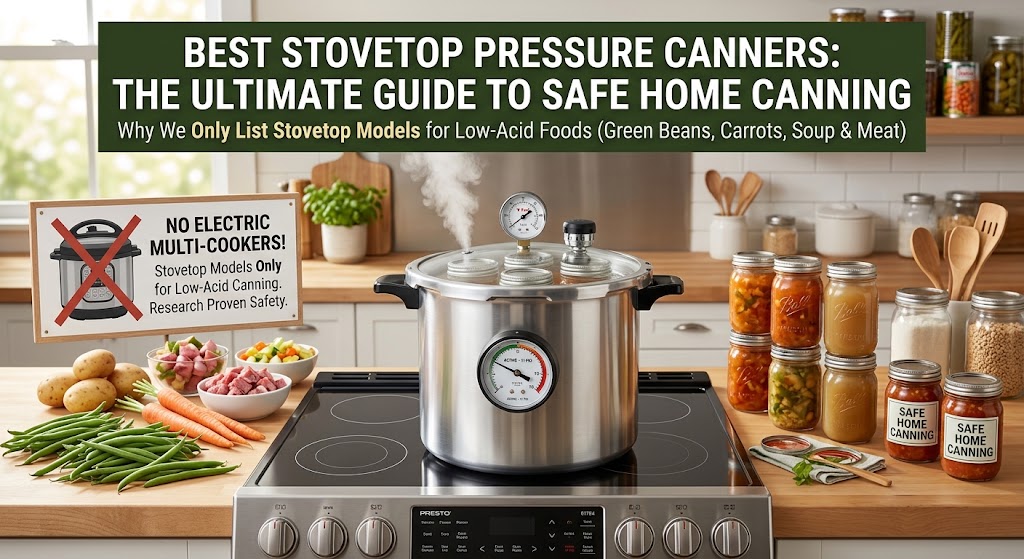
A pressure canner is the only way to safely put up green beans, carrots, soup, stock or meat at home. Boiling water tops out at 212°F and botulism spores survive that indefinitely; a pressure canner reaches about 240°F, which destroys them. There is no substitute, no clever workaround, and no family recipe that makes water-bathing vegetables safe.
Some links in this post are affiliate links. If you buy through them we may earn a small commission at no extra cost to you — it never changes which products we recommend.
Which makes it uncomfortable that the most commonly recommended “pressure canners” on the internet right now are electric countertop appliances that no extension service in the United States endorses for low-acid canning. We are not including a single one on this list, and the buying guide below explains exactly why, with the research linked. Every canner here is a stovetop model.
If you are only doing jam, pickles and acidified tomatoes, you do not need any of this — see our guide to the best water bath canners instead. If you want to put up vegetables and meat, read on.
Our Top 7 Picks for the Best Pressure Canner
Best Overall: Presto 01781 23-Quart Pressure Canner and Cooker

The Presto 01781 is the canner most American home canners actually own, and it is the right default. Twenty-three quarts holds seven quart jars or up to twenty pints depending on how you stack, which matches the batch sizes every tested recipe is written around. The aluminium body heats quickly and evenly, and replacement parts — gaskets, overpressure plugs, gauges — are available everywhere and cheap.
It uses a dial gauge, which is the important thing to understand before buying. A dial gauge lets you read exact pressure, which is genuinely useful at altitude where you need precise adjustments. The trade is that dial gauges must be tested for accuracy every year, usually free through your county extension office. NCHFP advises replacing any gauge reading more than two pounds off.
Buy this unless something specific about your stove or your altitude pushes you elsewhere.
Key Specifications
- 23-quart aluminium, holds seven quart jars
- Dial gauge with overpressure plug and lock
- Includes canning and cooking racks
- Replacement parts widely available
Pros
- The standard canner nearly every recipe assumes
- Dial gauge allows precise altitude adjustment
- Parts and gaskets easy to source for decades
- Heats fast and evenly
Cons
- Dial gauge needs annual accuracy testing
- Aluminium — not for glass or induction cooktops
- Heavy and bulky to store
Best for Glass and Induction Cooktops: Presto 01784 23-Quart Induction Compatible Pressure Canner

Standard aluminium canners will not work on induction and are widely discouraged on glass smooth tops, where a heavy wide-based pot can crack the surface. The 01784 is Presto’s answer: a stainless body with a magnetic, encapsulated base, in the same 23-quart size and with the same familiar dial gauge and parts.
If you have induction or a ceramic top, this is effectively the only mainstream stovetop canner designed for you, and that makes the price premium beside the point. Confirm your stove’s maximum recommended pot diameter and weight in its manual before ordering — some smooth tops have limits a full canner exceeds.
Key Specifications
- 23-quart stainless steel with encapsulated base
- Induction compatible, magnetic base
- Dial gauge, same parts family as the 01781
- Holds seven quart jars
Pros
- The practical choice for induction and glass tops
- Stainless will not pit or discolour like aluminium
- Same proven Presto mechanism and parts
- Full standard batch capacity
Cons
- Significantly more expensive than the aluminium version
- Very heavy when loaded
- Dial gauge still needs annual testing
- Check your cooktop’s weight limit first
Best Weighted Gauge: T-fal 22-Quart Aluminum Pressure Canner with 3 PSI Settings

A weighted gauge is a small metal weight that jiggles or rocks on the vent when the canner reaches pressure. It needs no annual testing, cannot drift out of calibration, and tells you audibly that pressure is holding — you can hear it from the next room. For anyone who finds the dial-gauge testing requirement annoying or unreliable to arrange, that is a real advantage.
This T-fal offers three settings at 5, 10 and 15 PSI, which is what you want; single-setting weights are far less flexible. The limitation, per NCHFP, is that weighted gauges cannot be finely adjusted for altitude — above 1,000 feet you simply step up to the next higher weight rather than dialling in an exact number.
Key Specifications
- 22-quart aluminium pressure canner
- Weighted gauge with 5, 10 and 15 PSI settings
- Includes racks and canning accessories
- Holds a standard seven-quart batch
Pros
- No annual gauge testing ever required
- Audible confirmation that pressure is holding
- Cannot drift out of calibration
- Three pressure settings rather than one
Cons
- Cannot fine-tune pressure for specific altitudes
- Aluminium — not for induction or glass tops
- The rocking weight is noisy for hours
Best Compact: Presto 01755 16-Quart Aluminum Pressure Canner and Cooker

Sixteen quarts is the smallest size that is still a genuine canner rather than a pressure saucepan — it takes seven pint jars, or quart jars in a single layer. If you are canning for one or two people, or your kitchen storage genuinely cannot absorb a 23-quart pot, this is the sensible compromise.
Worth being clear on what you give up: you cannot double-stack pints the way you can in the 23-quart, so your batches are smaller and you will run the canner more often. NCHFP specifically warns against small-capacity pressure canners and pressure saucepans; this 16-quart is above that line, but it is the floor rather than a comfortable margin.
Key Specifications
- 16-quart aluminium pressure canner
- Dial gauge with overpressure plug
- Takes seven pint jars
- Same Presto parts availability
Pros
- Fits kitchens where a 23-quart will not
- Lighter to lift and easier to store
- Full Presto reliability and parts support
- Boils up faster than the larger canners
Cons
- Smaller batches mean more rounds
- No double-stacking pints
- Dial gauge needs annual testing
- Not for induction or glass tops
Best Value Weighted Gauge: MIRRO 22-Quart Aluminum Pressure Canner with 3 Regulators

MIRRO has been making pressure canners for a very long time, and this 22-quart is the budget route to a weighted gauge with all three pressure settings. Mechanically it is simple in the way that matters: fewer things to calibrate, fewer things to drift, a weight that either rocks or does not.
The finish and fittings are less refined than Presto’s and the lid can be stiff until it wears in. If you want a no-testing weighted canner and do not want to pay T-fal money, this does the job.
Key Specifications
- 22-quart aluminium pressure canner
- Three separate regulators: 5, 10 and 15 PSI
- Long-established canner brand
- Standard seven-quart-jar capacity
Pros
- Weighted gauge means no annual testing
- All three pressure settings included
- Among the cheapest true canners here
- Simple mechanism with little to go wrong
Cons
- Build finish is basic
- Lid can be stiff to seat until worn in
- Aluminium — not for induction or glass
- Loose regulators are easy to misplace
Best for Nervous Beginners: Denali THE TANKER 23-Quart Pressure Canner

Pressure canners frighten a lot of people, and mostly the fear is about not knowing whether the thing is behaving correctly. Denali built this one around that anxiety — it is marketed as beginner-friendly, it is induction compatible, and it ships with more hand-holding than the older industrial-looking canners.
For what it is worth, modern pressure canners are extremely safe. Every canner on this list has an overpressure plug and a lid lock that physically prevents opening under pressure. The stories people remember are from mid-century canners without those features.
I remember hovering anxiously over my stove the first time I processed a batch of homemade stew, half-expecting the heavy pot to blow a hole in the ceiling. The biggest surprise wasn’t the intense hiss of venting steam, but how quickly my genuine panic faded into boredom once the pressure regulator started its steady, predictable rocking, leaving me with nothing to do but watch the clock.
Key Specifications
- 23-quart capacity
- Induction compatible
- Marketed and documented for beginners
- Includes racks and canning accessories
Pros
- Genuinely approachable for a first canner
- Works on induction unlike most aluminium canners
- Full standard batch capacity
- Clear documentation
Cons
- Newer brand with a shorter track record
- Parts availability less certain than Presto
- Heavy when fully loaded
Best Budget: Barton 23-Quart Pressure Canner with Gauge

The cheapest way onto this list while still being a real 23-quart stovetop canner with a gauge and safety valve rather than a pressure saucepan pretending to be one.
Two caveats worth taking seriously at this price. First, verify the gauge against a tested one before your first low-acid batch — budget dial gauges are the most likely to be off. Second, check that replacement gaskets are available before you commit, because a canner you cannot re-gasket in five years is not actually cheap.
Key Specifications
- 23-quart aluminium pressure canner
- Dial gauge with safety valve
- Includes rack
- Standard seven-quart-jar capacity
Pros
- Lowest cost of any true canner here
- Full standard capacity
- Doubles as a large pressure cooker
- Simple, conventional design
Cons
- Gauge accuracy should be verified before first use
- Parts availability less certain than Presto
- Aluminium — not for induction or glass
- Fit and finish reflect the price
Why There Are No Electric Pressure Canners on This List
This is the most important section here, and it is the reason this guide looks different from most of the results you will find for this search.
Electric countertop “pressure canners” sell extremely well and are recommended constantly by affiliate sites. But the extension services that actually run the research do not endorse them for low-acid canning, and they are not being subtle about it.
Utah State University Extension tested multiple brands of electric programmable pressure cookers and found food was frequently under-processed — failing to reach a safe temperature for long enough to destroy botulism spores — and, worse, that the results were inconsistent: the same food in the same appliance could be adequately processed one run and unsafe the next. Their conclusion is that these units of any brand should not be used for low-acid canning, and that it still needs to be done in a stovetop pressure canner. You can read the research at USU Extension.
Penn State Extension takes the same position for a related reason: there has been no USDA or university research validating these appliances for pressure canning low-acid foods, and electric units heat and cool far faster than a heavy stovetop canner, which changes the thermal behaviour that every tested processing time is built on.
Two honest clarifications, because this gets muddled. First, this is about low-acid canning — vegetables, meat, soup. Electric appliances tested specifically for high-acid foods, like the Ball countertop water bath canner, are a different product answering a different question. Second, none of this means electric multicookers are unsafe as cookers. An Instant Pot is a fine pressure cooker. It is not a canner, and its “canning” button does not make it one.
If that changes — if USDA or a university validates a specific electric unit for low-acid foods — we will update this page. Until then, recommending one for green beans would be putting affiliate revenue ahead of a reader’s safety.
The Ultimate Buying Guide for Pressure Canners
Pressure Canner vs Pressure Cooker
They are not the same tool and the words are used carelessly. A pressure cooker is built to cook food fast. A pressure canner is built to hold a verified pressure steadily for a long processing time, is large enough to hold jars with proper air circulation, and has a gauge you can trust or verify. NCHFP does not recommend small pressure saucepans for canning, because they heat and cool too quickly for tested times to apply.
A pressure canner will happily work as a pressure cooker. The reverse is not true.
Dial Gauge vs Weighted Gauge
This is the real decision when choosing between the canners above.
- Dial gauge shows exact pressure on a face, which lets you adjust precisely for your altitude. It must be tested for accuracy annually — most county extension offices do this free — and NCHFP says to replace any gauge reading more than two pounds off.
- Weighted gauge is a metal weight that rocks or jiggles on the vent. It never needs testing and cannot drift, and it tells you audibly that pressure is holding. But it cannot be adjusted finely: above 1,000 feet you step up to the next weight rather than dialling an exact figure.
If you live near sea level and dislike the idea of annual testing, weighted is the easier life. If you live at altitude, a dial gauge gives you the precision that tested recipes assume.
Size: Bigger Than You Think, Within Reason
- 23 quarts is the standard and what most recipes assume — seven quart jars, or pints double-stacked
- 16 quarts is the practical minimum — seven pints, quarts in a single layer only
- Below 16 quarts is not recommended for canning by NCHFP
Aluminium vs Stainless, and Your Cooktop
Most pressure canners are aluminium because it is light and conducts heat well. Aluminium is not magnetic, so it will not work on induction at all, and its wide heavy base is discouraged on glass and ceramic smooth tops. If you have either, you need a stainless canner with an encapsulated magnetic base — and you should check your stove manual for maximum pot diameter and weight, because a loaded 23-quart canner is heavy enough that some manufacturers advise against it entirely.
Parts Wear Out, So Buy Into a Parts Supply
The sealing gasket is a rubber ring that hardens and shrinks over a few years, and the overpressure plug perishes too. Both are consumable. Presto’s advantage over cheaper canners is not really the pot — it is that you can buy a gasket for a decades-old model at any hardware store. Before buying an unfamiliar brand, search for its replacement gasket and confirm it exists.
Before Every Season
- Test a dial gauge for accuracy through your extension office
- Inspect the gasket for hardness, cracks or shrinkage and replace if in doubt
- Check the vent pipe is clear — hold it up to the light and look through it
- Check the overpressure plug is soft and intact
- Never force the lid. If it will not open, pressure has not fully released
Frequently Asked Questions About Pressure Canners
Can I use an Instant Pot to can green beans?
No. Extension research has found electric programmable pressure cookers under-process low-acid food and do so inconsistently, and no USDA or university research validates any electric unit for low-acid canning. A canning button on the control panel is a marketing feature, not a safety validation. Low-acid foods need a stovetop pressure canner.
Is pressure canning dangerous?
Modern pressure canners are very safe. Every model on this list has an overpressure plug that releases before dangerous pressure builds, and a lid lock that physically prevents opening while pressurised. The frightening stories people remember come from mid-century canners without those safeguards. The real risk in pressure canning is not the pot exploding — it is under-processing food and getting botulism, which is why gauge accuracy and tested recipes matter so much.
Do I need to test my dial gauge every year?
Yes, if your canner has a dial gauge. Most county extension offices test them free or for a small fee. NCHFP advises replacing gauges that read more than two pounds off. Weighted-gauge canners never need this, which is their main practical advantage.
What is the difference between 10 PSI and 15 PSI?
The pressure determines the temperature inside the canner, and the temperature is what makes the food safe. Tested recipes specify a pressure for a reason — higher is not better, and lower is dangerous. On a weighted gauge above 1,000 feet you step up to the next weight; on a dial gauge you follow the altitude table exactly.
Can I stack jars in a pressure canner?
Pints can usually be double-stacked in a 23-quart canner, offset so steam can circulate, with a rack between layers. Quarts generally cannot. Follow your canner manual, and never pack jars so tightly that steam cannot move freely between them.
How long does a pressure canner last?
The pot itself can last decades — people are still using canners inherited from parents. The consumables do not: gaskets, overpressure plugs and dial gauges all wear and need replacing. Buy a brand whose parts you can still find in ten years.
Final Thoughts
For most people the Presto 01781 is the canner to buy: standard size, endlessly available parts, and the model most tested recipes were written around. If you cook on glass or induction, the Presto 01784 is effectively your only mainstream option and worth the premium. And if annual gauge testing sounds like something you will never actually get around to, buy a weighted-gauge canner like the T-fal and remove the problem entirely.
Whatever you choose, buy stovetop, use tested recipes with their altitude adjustments, and check your gauge and gasket before each season. If you are only doing jam and pickles, you do not need any of this — our water bath canner guide covers that.
Sources on canning safety
- National Center for Home Food Preservation — Recommended Canners
- Utah State University Extension — Why Electric Pressure Cookers Are Not Pressure Canners
- Penn State Extension — Canning in Electric Multi-Cookers
This article is general information about canning equipment, not a substitute for tested procedures. Always follow current recipes and processing times from NCHFP, your state extension service, or a USDA-based canning guide. Improperly canned low-acid food can cause botulism, which can be fatal.
As an Amazon Associate we earn from qualifying purchases. Availability is accurate as of the date of publishing. We do not list prices because they change too often to quote honestly.

Rimi Sultana is a home cook from Bangladesh who has cooked for her family every day for the past five years and writes about it at Smart Cooks. Perpetually testing whether internet-famous recipes actually work in a regular home kitchen. Say hello on Facebook or through the contact page.