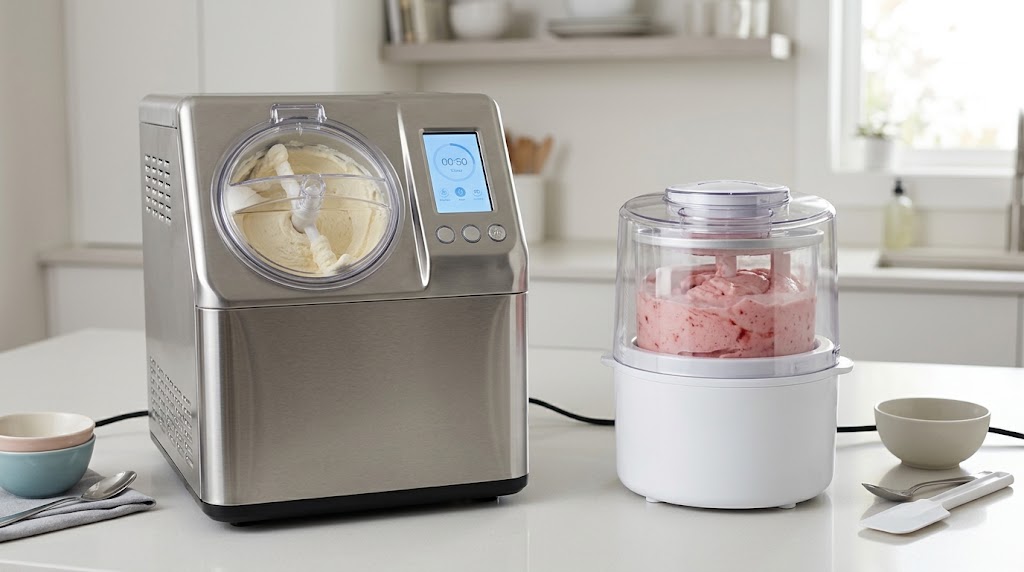
This is the single biggest decision in buying an ice cream maker, and it’s easy to miss because both types get sold under the same generic “ice cream maker” label. The mechanism is completely different, and it changes how the machine fits into your actual routine, not just how it performs.
Some links in this post are affiliate links. If you buy through them we may earn a small commission at no extra cost to you — it never changes which products we recommend.
How Each One Actually Works
Freezer-Bowl Machines
These have a double-walled canister filled with a coolant gel. You freeze the empty bowl in your regular freezer for at least 24 hours, then fit it onto the machine’s base and pour in your ice cream base. The pre-frozen bowl provides all the cooling power for the roughly 20–25 minute churn. Once it’s used, the bowl needs to go back in the freezer for another full day before it’s cold enough to use again.
Compressor Machines
These have a built-in refrigeration compressor, the same basic technology as a mini fridge, that actively cools the churning chamber in real time. There’s no pre-freeze step — you pour in the base and start churning immediately, and you can make another batch right after, since the machine cools itself back down between uses.
Where Each One Wins
- Freezer-bowl wins on price — these typically cost a fraction of a comparable compressor model.
- Freezer-bowl wins on weight and footprint — they’re generally lighter and smaller to store.
- Compressor wins on spontaneity — no planning required, ready whenever the craving hits.
- Compressor wins on repeat batches — genuinely useful if you’re making ice cream for a party or testing multiple flavors in one day.
- Both produce the same quality churned ice cream — the mechanism affects convenience, not the final texture or taste.
From My Kitchen: Why I Still Haven’t Upgraded to a Compressor Model
I’ve thought about buying a compressor machine more than once, usually right after being annoyed that my freezer-bowl wasn’t ready when I wanted it to be. But when I actually tracked how often that happened over a couple of months, it was maybe twice — most of the time I already know a day or two ahead that I want to make ice cream, which is plenty of lead time for a freezer-bowl. The honest answer for me was that I was buying convenience I mostly wouldn’t use. If you tend to plan meals and desserts a day or more ahead anyway, that’s worth being honest with yourself about before spending three or four times as much on a compressor model.
A Few Worth Considering
Cuisinart’s FastFreeze freezer-bowl model is a solid, affordable entry point if you’re going the pre-freeze route.
Whynter’s upright compressor machine is worth the extra cost if same-day, no-planning ice cream is genuinely something you’ll use regularly.
The Freezer Maths Nobody Does Before Buying
A freezer-bowl machine does not just need a bowl frozen — it needs that bowl to live in your freezer more or less permanently, because a bowl put away in a cupboard is a machine you cannot use on impulse. A standard bowl occupies roughly the space of a large loaf of bread, and it needs to sit where air circulates rather than wedged between packets. In a full family freezer that is a real cost, and it is the practical reason many freezer-bowl machines end up unused.
A compressor machine inverts the problem. It takes no freezer space at all but occupies serious counter or cupboard space, typically weighing 15 to 25 kilograms — heavy enough that most people leave it out rather than lifting it in and out. So the question is not really which machine is better; it is which space you have spare.
Quick Comparison
| Freezer-bowl machine | Compressor machine | |
|---|---|---|
| Space cost | Freezer shelf, permanently | Counter or cupboard, heavy |
| Consecutive batches | One, then refreeze 24 hours | Continuous |
| Noise while running | Low hum | Compressor plus churn, louder |
| Time from decision to ice cream | 24 hours if the bowl is not frozen | About 40 minutes |
| Typical lifespan concerns | Bowl coolant can fail after years | Compressor is a repairable appliance |
What Changes Across Consecutive Batches
This is where the two diverge most sharply and where reviews are least helpful. A freezer bowl is at its coldest in the first ten minutes and warms steadily through the churn — which is fine for one batch, since the ice cream is done by the time the bowl has given up its cold. Attempt a second batch immediately and it will not freeze at all; you will get cold soup. There is no workaround short of owning a second bowl.
A compressor holds its temperature indefinitely, so the third batch is as good as the first. For anyone making several flavours for a gathering, or testing recipe variations, this is the whole reason to own one. It also means you can churn on a hot day without the bowl losing its edge, which is precisely when you most want ice cream and precisely when a freezer bowl performs worst.
Two Machines Worth Considering
Best freezer-bowl machine: Cuisinart FastFreeze
The sensible version of the freezer-bowl approach: quick churn, simple operation and a price that makes sense for a machine used a handful of times a month. Keep the bowl in the freezer permanently and it is ready whenever you are.
Pros
- Inexpensive for very good results
- Light and easy to store
- Quiet while churning
Cons
- Bowl occupies freezer space permanently
- One batch per 24-hour freeze cycle
Best compressor machine: Whynter Upright Compressor Machine
Self-freezing, so there is no planning and no freezer shelf given up. The upright form factor takes less counter footprint than horizontal compressor machines, which is worth something in a normal kitchen.
Pros
- No pre-freezing, churn whenever you like
- Batch after batch without waiting
- Frees the freezer space a bowl would take
Cons
- Heavy and expensive
- Noticeably louder while running
Frequently Asked Questions
Can I speed up freezing a freezer-bowl?
Not really — the coolant gel needs sustained sub-freezing temperature over time to fully solidify all the way through. A standard freezer set cold enough and given the full recommended time is the only reliable method.
Are compressor machines louder?
Yes, generally — the compressor itself makes an audible hum while running, similar to a small refrigerator, whereas freezer-bowl machines only have the motor turning the paddle.
Which one is easier to clean?
They’re comparable, since in both cases only the bowl and paddle touch the ice cream base. Compressor machines have a few more internal components, but the parts you actually wash are similar.
Can I buy a spare bowl instead of a compressor machine?
For many models, yes, and it is a genuinely good middle path. Two bowls means two batches in an evening for a fraction of a compressor’s price. The catch is the same freezer space problem doubled — you now need room for two bowls to sit frozen permanently. If freezer space is what you have and money is what you do not, this is the sensible answer.
How do I know if my freezer bowl is properly frozen?
Shake it near your ear. If you hear any liquid moving, the coolant has not fully frozen and the batch will fail. A properly frozen bowl is silent and evenly cold across its whole outer surface, including the top rim. If a bowl that has been in for 24 hours still sloshes, your freezer is probably running warmer than −18°C, which is worth checking with a thermometer for the sake of everything else in there too.

Rimi Sultana is a home cook from Bangladesh who has cooked for her family every day for the past five years and writes about it at Smart Cooks. Perpetually testing whether internet-famous recipes actually work in a regular home kitchen. Say hello on Facebook or through the contact page.