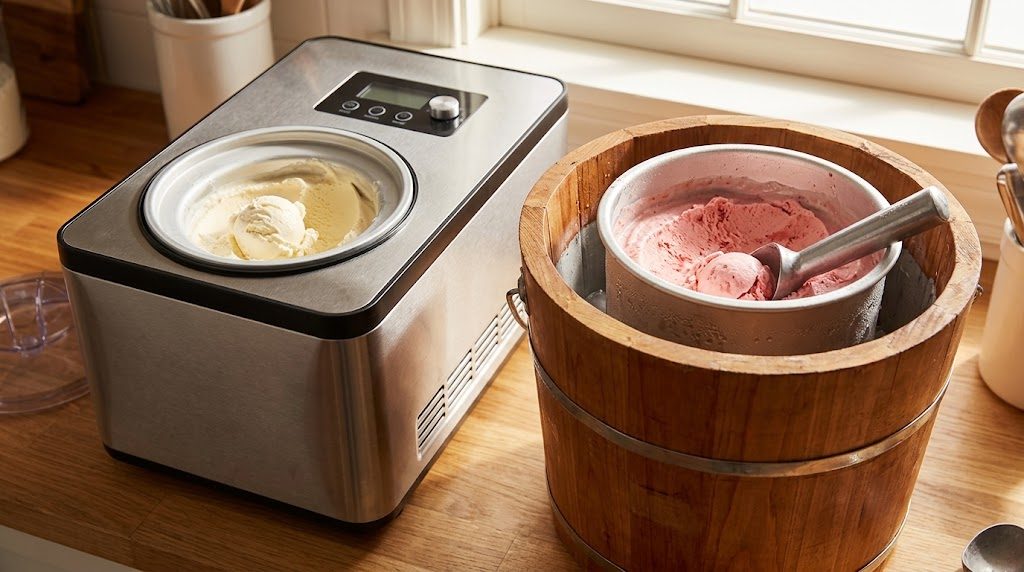
Gelato and ice cream look similar in the tub, but the machines that make them at home are not interchangeable in the way most kitchen shoppers assume. If you’ve been eyeing a ‘gelato maker’ online and wondering whether it’s just marketing language for an ice cream maker, the honest answer is: partly, but the differences matter once you actually start churning.
Some links in this post are affiliate links. If you buy through them we may earn a small commission at no extra cost to you — it never changes which products we recommend.
What Actually Matters
Churning Speed and Air Incorporation
The single biggest technical difference is how much air gets whipped into the base as it freezes. Ice cream makers churn faster and incorporate more air (called ‘overrun’), which is why American-style ice cream is light and fluffy. Gelato machines churn slower and denser, which is what gives real gelato its characteristically dense, almost chewy texture rather than a fluffy one.
Serving Temperature
Gelato is also served several degrees warmer than ice cream, which is part of why it tastes so intensely flavored straight out of the machine. A true gelato-style base with a slower churn and less fat content will taste flat if you freeze it as hard as a standard ice cream, so machines built for gelato are tuned for a softer target consistency.
Fat Content of the Base
Traditional gelato recipes use less cream and more milk than American ice cream bases, so the machine isn’t doing all the work — the recipe itself is part of what makes gelato taste different, even in a machine marketed for both.
From My Kitchen
I ran the same pistachio base through a compressor ice cream maker set to a normal cycle and then again on a slower, gelato-style setting, and the texture difference genuinely surprised me — the slower batch came out denser and scoopable almost immediately, while the standard batch needed a firm-up period in the freezer before it held a scoop shape. It wasn’t subtle once I tasted them side by side.
Worth Considering
If you want true gelato texture at home, a dedicated compressor machine like the Cuisinart Ice Cream Maker and Gelato Machine gives you both settings without needing to pre-freeze a bowl. For anyone chasing genuinely professional gelato results and willing to spend more, the Lello Musso Lussino is the machine most serious home gelato makers eventually land on.
Three Real Differences, and None of Them Are the Machine
Gelato differs from ice cream in three measurable ways. It contains less fat — typically 4 to 8 percent against 14 to 18 percent for American-style ice cream — because it uses proportionally more milk and less cream. It is churned more slowly, so far less air is beaten in: gelato runs around 20 to 30 percent overrun where ice cream often doubles in volume. And it is served warmer, around −12°C rather than −18°C.
Those three things explain why gelato tastes more intense despite having less fat. Fat coats the tongue and mutes flavour; less fat means the flavour reads more directly. Less air means more actual gelato per spoonful. And the warmer serving temperature means your palate is not numbed by cold. It is a genuinely different dessert, and only one of those three differences has anything to do with the machine.
Quick Comparison
| Gelato | American-style ice cream | |
|---|---|---|
| Fat content | 4–8% | 14–18% |
| Overrun (air beaten in) | 20–30% | 50–100% |
| Serving temperature | About −12°C | About −18°C |
| Texture | Dense, silky, slightly elastic | Lighter, fluffier |
| Flavour intensity | More direct | Rounder, muted by fat |
Can One Machine Do Both?
Mostly, yes. A machine with a slower churn setting genuinely helps, because beating in less air is the one difference a machine controls. But you can get a long way with a standard ice cream maker by changing the recipe — shift the ratio toward milk and away from cream, use egg yolks or a little milk powder for body since you have removed the fat that would have provided it, and stop the churn a little earlier than you would for ice cream.
Then serve it warmer. Move the container from the freezer to the fridge for fifteen to twenty minutes before serving, or simply let it sit out for five. This costs nothing and is the difference most people notice immediately — homemade gelato served at freezer temperature tastes like dense, slightly disappointing ice cream, and the same batch at −12°C tastes like gelato.
Two Machines Worth Considering
Best for both styles: Cuisinart Ice Cream Maker and Gelato Machine
Has a dedicated gelato setting that churns more slowly, which handles the one variable a recipe cannot. Sensible if you want to make both styles without owning two machines or relying entirely on recipe adjustments.
Pros
- Separate gelato and ice cream churn settings
- Handles both styles competently
- Reasonably priced for the flexibility
Cons
- Frozen bowl needs pre-freezing
- Not the equal of a dedicated compressor machine
The serious option: Lello Musso Lussino
A compressor machine built for dense, low-overrun churning, which is exactly what gelato asks for. This is a genuine step into professional territory in both results and price, and only worth it if you make gelato often enough to justify it.
Pros
- Compressor, so no pre-freezing or planning
- Produces genuinely dense, professional texture
- Built to run batch after batch
Cons
- Very expensive
- Heavy and takes serious counter space
Frequently Asked Questions
Can I make gelato in a regular ice cream maker?
You can get close by using a gelato-style base recipe (less cream, more milk) and slowing down or shortening the churn time if your machine allows it, but you won’t get the true dense texture without a machine designed to churn slower.
Why does gelato melt faster than ice cream?
Gelato has less air and less fat, so it has less structure to resist melting and softens faster at room temperature — which is also part of why it tastes so vivid when eaten quickly.
Why does my homemade gelato come out icy?
Because you removed the fat but did not replace what it was doing. Fat interferes with ice crystal growth, so a low-fat base with nothing else holding it together freezes into crystals you can feel. Traditional gelato bases solve this with egg yolks, and many also use a spoonful of milk powder, which adds milk solids without adding water. Do not cut the sugar either — sugar lowers the freezing point and is part of the structure, not just the sweetness.
Does serving temperature really make that much difference?
It is the most underestimated variable in the whole comparison. Cold suppresses flavour perception, which is why very cold ice cream tastes less intensely of its flavour than the base did before freezing. Gelato served at around −12°C is warm enough that your palate registers the flavour fully and the texture is soft and dense rather than hard. Twenty minutes in the fridge before serving transforms a batch that seemed disappointing.

Rimi Sultana is a home cook from Bangladesh who has cooked for her family every day for the past five years and writes about it at Smart Cooks. Perpetually testing whether internet-famous recipes actually work in a regular home kitchen. Say hello on Facebook or through the contact page.