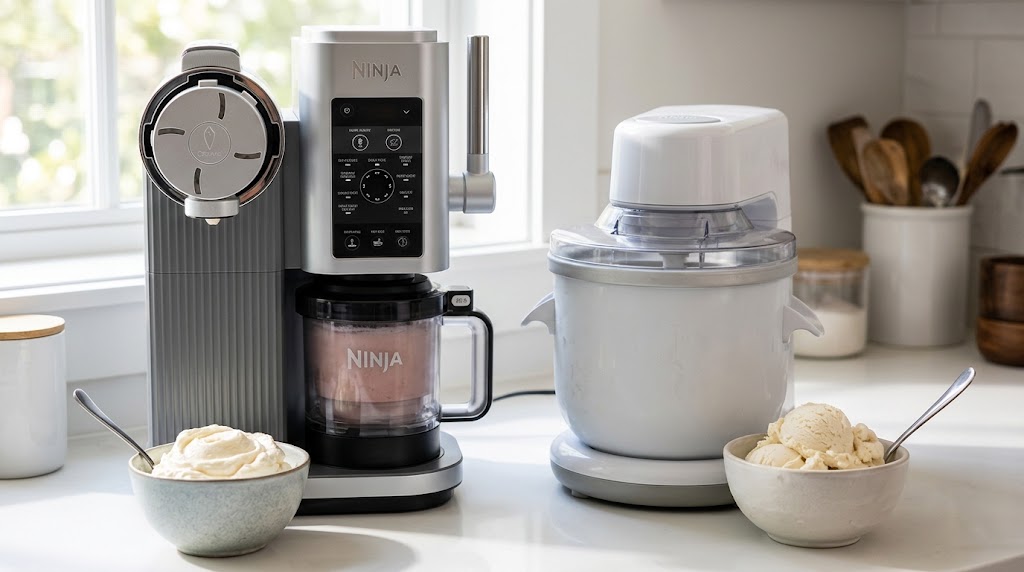
The Ninja Creami gets marketed alongside regular ice cream makers, but it’s solving a different problem with a genuinely different process. Understanding that difference matters more than any spec comparison, because it determines whether it’s actually the right tool for what you want to make.
Some links in this post are affiliate links. If you buy through them we may earn a small commission at no extra cost to you — it never changes which products we recommend.
How They’re Actually Different
A traditional machine churns a liquid ice cream base while simultaneously freezing it, so air gets incorporated as it thickens — that’s what gives churned ice cream its light, scoopable texture. The Creami does the opposite order: you freeze your base completely solid first (usually overnight, in the machine’s own pint containers), then the machine’s blade shaves and re-spins that frozen block into a creamy texture in about two minutes.
Where the Creami Wins
- Genuinely fast once the base is frozen — about 2 minutes versus 20–25 for a churn cycle.
- Built around single-serving pint containers, which is convenient if you don’t want a full quart-sized batch every time.
- Handles high-protein, low-sugar bases (popular for fitness-focused recipes) more forgivingly than a traditional churn, which can struggle to properly freeze bases with unusual ratios.
- No moving liquid base to worry about spilling or splashing during the process.
Where Traditional Machines Win
- No mandatory overnight freeze — with a compressor model, you can go from base to finished ice cream in under half an hour.
- Classic churned texture that many people consider the reference standard, especially for mix-heavy flavors like cookie dough or swirl-style ice creams.
- Generally cheaper at the entry level, especially freezer-bowl models.
From My Kitchen: What Surprised Me About the Creami
The first time I used one, I under-froze the base — I’d only left it in the freezer about 16 hours instead of a full 24, thinking it looked solid enough. The machine’s blade genuinely struggled, and the result came out crumbly and icy rather than smooth, more like shaved ice than ice cream. I ran the respin function a second time and it recovered mostly fine, but it taught me that “looks frozen” and “frozen solid all the way through” aren’t the same thing, especially with a full pint container. Now I freeze for the full recommended time without exception, even when I’m impatient.
Worth Considering
The Ninja Creami 7-in-1 is the one to try if single servings, fast turnaround once frozen, and flexibility with unusual bases (protein, low-sugar) matter to you.
Cuisinart’s traditional automatic machine is the better fit if you want classic churned texture without an overnight freezing commitment.
Two Machines Solving Genuinely Different Problems
A traditional ice cream maker churns a liquid base while it freezes. The paddle keeps the mixture moving so ice crystals stay small, and it beats in air as it goes — that air, the overrun, is what gives churned ice cream its light scoopable texture. The result comes out of the machine soft and needs a few hours in the freezer to firm up.
The Ninja Creami does the opposite. You freeze a pint solid for 24 hours, then a blade descends and shaves the frozen block at high speed, pulverising the ice crystals into something creamy. There is no churning and very little air. What you get is denser than churned ice cream, and the texture comes from mechanical destruction of the crystals rather than from preventing them forming in the first place.
Quick Comparison
| Ninja Creami | Traditional churn machine | |
|---|---|---|
| Preparation | Freeze the pint 24 hours | Freeze the bowl 24 hours |
| Portions | One pint at a time | A full batch, 1–1.5 L |
| Texture | Dense, smooth, low air | Lighter, more air, classic scoop |
| Low-sugar and protein bases | Excellent | Often icy |
| Noise | Loud for about 2 minutes | Low hum for 20–30 minutes |
| Flavours at once | Several pints, one machine | One batch per frozen bowl |
Where Each One Genuinely Wins
The Creami’s real advantage is bases that traditional churning handles badly. Protein powder mixes, low-sugar bases, fruit-only pints and anything without much fat come out icy in a churn machine because there is nothing to interfere with crystal growth. The Creami does not care — it simply pulverises whatever crystals formed. For anyone eating low-sugar or high-protein, this is a genuine capability difference rather than a convenience one.
The traditional machine wins on classic texture and batch economics. A custard-based vanilla churned properly has a lightness that a spun pint does not, and you get a litre and a half at once rather than a pint. It is also far quieter, which matters more than you would think when the alternative runs like a drill for two minutes in an evening kitchen.
Two Machines Worth Considering
Best for portions and unusual bases: Ninja Creami 7-in-1
The right choice if you want single portions, several flavours in the freezer at once, or bases that would go icy in a churn machine. Freeze a few pints on Sunday and spin one whenever you want it.
Pros
- Handles protein, low-sugar and fruit-only bases well
- Single-portion pints, several flavours at once
- Re-spin function fixes a crumbly first pass
Cons
- Loud while it runs
- Pints must be frozen a full 24 hours
Best for classic ice cream: Cuisinart Traditional Automatic Machine
Churned texture, a proper batch size, and a quiet run. Still the better machine if what you want is a classic custard ice cream to serve from a tub rather than individual portions.
Pros
- Classic light churned texture
- Makes a full batch at once
- Quiet compared with a Creami
Cons
- Bowl needs 24 hours in the freezer
- Low-sugar and fat-free bases turn icy
Frequently Asked Questions
Can the Creami make regular churned-style ice cream?
Not exactly — the texture is smooth and creamy but structurally different from air-churned ice cream, since it’s created by shaving frozen solid rather than freezing while aerating. Most people find it very good, just not identical.
Do I need special pint containers for the Creami?
Yes, it only works with its own branded pint containers, since the machine’s blade mechanism is designed around their exact shape and size.
Is the Creami worth it if I already own a regular ice cream maker?
It depends on what you’re missing — if fast single servings or protein-forward recipes appeal to you, it fills a real gap. If you’re happy with your current machine’s texture and timeline, it’s a nice-to-have rather than a replacement.
Why does my Creami pint come out crumbly?
That is the normal first pass on a lean base, and the fix is built in — add a tablespoon or two of milk and use the re-spin function. Lower-fat and lower-sugar pints almost always need one re-spin, sometimes two. The other cause is a pint that was not frozen flat: if the surface froze at an angle, the blade meets it unevenly and shaves inconsistently. Freeze pints on a level shelf.
Which is better if I am cutting sugar?
The Creami, clearly. Sugar does structural work in ice cream — it lowers the freezing point and keeps the mixture soft — so removing it from a churned base produces something hard and icy no matter how well the machine works. Because the Creami creates its texture by pulverising crystals after freezing, it sidesteps that problem entirely. This is the single strongest argument for it over a traditional machine.

Rimi Sultana is a home cook from Bangladesh who has cooked for her family every day for the past five years and writes about it at Smart Cooks. Perpetually testing whether internet-famous recipes actually work in a regular home kitchen. Say hello on Facebook or through the contact page.