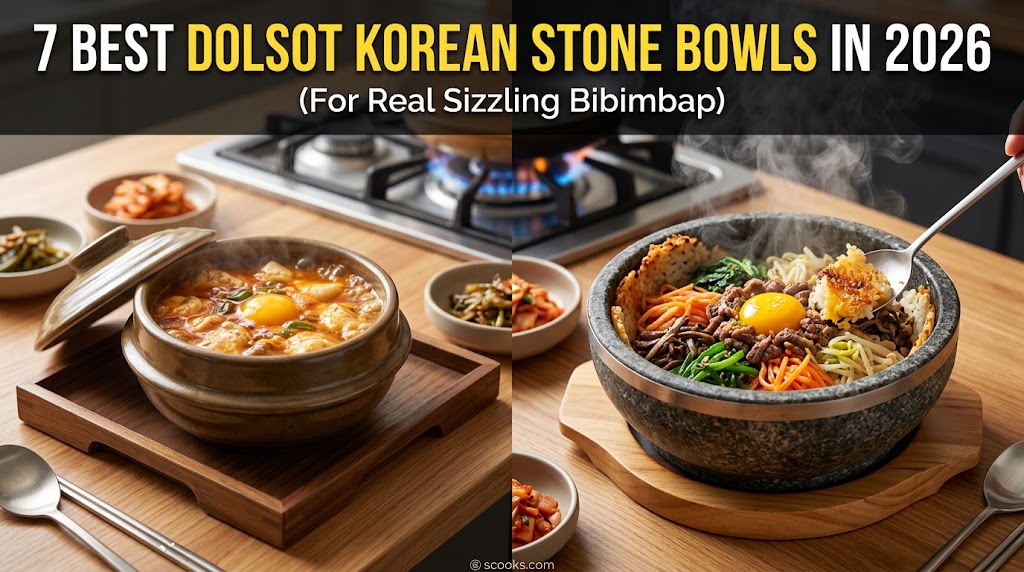
The whole point of dolsot bibimbap is the sound. A properly preheated Korean stone bowl hits the table still crackling, the rice against its walls frying into nurungji — that golden, toasted crust you scrape loose at the end, which regulars will tell you is the best three bites of the meal. A cold bowl of bibimbap is a salad; a dolsot makes it an event.
Some links in this post are affiliate links. If you buy through them we may earn a small commission at no extra cost to you — it never changes which products we recommend.
The engineering is thermal mass, the same principle as our donabe and cazuela guides: heavy stone or ceramic, preheated empty until screaming hot, holds enough heat to keep frying the rice for ten full minutes off the flame. That mass is also why these bowls double as ttukbaegi — the bubbling stew pots that keep soondubu jjigae boiling at the table.
Buying one means choosing between genuine carved granite (heavier, hotter, longer preheat) and glazed ceramic/earthenware (lighter, faster, gentler), and never forgetting the tray — a 200°C bowl needs somewhere to land. Here are seven worth owning.
Our Top 7 Picks for the Best Dolsot
Best Overall: Crazy Korean Cooking Stone Bowl with Lid and Tray

Crazy Korean Cooking is the brand that took Korean cookware seriously for the Western market, and their dolsot set is the standard: a properly heavy bowl, a fitted lid, and the wooden base tray that makes serving a screaming-hot vessel actually practical. Buy the set, not the bare bowl — the tray is not an accessory, it is the delivery system.
Preheat it empty on medium for five to eight minutes, film the inside with sesame oil, pack in warm rice, and listen: the crackle starting is the nurungji forming.
Key Specifications
- Dolsot with lid and wooden tray
- Serious thermal mass for table-sizzling
- Bibimbap and jjigae capable
- Established Korean cookware brand
Pros
- Complete set including the essential tray
- Holds sizzling heat through the meal
- Makes proper nurungji crust
- Consistent, documented quality
Cons
- Heavy — treat it like the stone it is
- Needs gradual preheating
- Hand wash, no soap soaking
Best Value Set: Dolsot with Wood Tray, 27 oz Granite-Style Bowl

The affordable route to the full experience: a 27-ounce stone bowl with its wooden tray, sized for one generous personal bibimbap — which is the authentic format; dolsot bibimbap is a per-person dish, not a shared one.
Twenty-seven ounces sounds small until you remember it arrives dense with rice, vegetables, meat and an egg still cooking against the walls. For a first bowl, this is the honest starting point.
Key Specifications
- 27 oz stone bowl with wood tray
- Personal-serving bibimbap size
- Bowl and tray matched set
- Entry price point
Pros
- Cheapest complete bowl-plus-tray set
- Correct single-serving format
- Good first dolsot
- Tray included, not extra
Cons
- One bowl — a family needs several
- Lighter mass cools sooner than premium stone
- Preheat gently; budget stone dislikes shock
Best Large: Premium Stone Bowl with Lid and Tray, 37 oz

The 37-ounce class is the big-appetite and stew-first size: enough volume for a full soondubu jjigae that keeps bubbling at the table, or a bibimbap for someone who considers the standard bowl a warm-up. The lid matters more at this size — it is what lets the bowl work as a genuine ttukbaegi, trapping the boil for the walk from stove to table.
If soups and stews are half your Korean cooking, size up and take the lid.
Key Specifications
- 37 oz stone bowl
- Fitted lid plus base tray
- Bibimbap and jjigae dual use
- Large single-serving format
Pros
- Volume for stews as well as rice
- Lid keeps jjigae at a table boil
- Complete three-piece set
- Big-appetite bibimbap approved
Cons
- Longer preheat for the bigger mass
- Heavier to carry loaded
- One-bowl households only need one — families budget more
Best Ceramic Set: Korean Stone Bowl with Tray, 37 oz Ceramic

Glazed ceramic dolsots trade a little of granite’s brute heat retention for real conveniences: lighter in the hand, faster to preheat, easier to clean because the glaze releases rice that raw stone grips. For a weeknight bibimbap habit rather than a weekend ceremony, that trade is usually right.
The crust still forms — slightly gentler, slightly more forgiving, and much kinder to the person doing dishes.
Key Specifications
- 37 oz glazed ceramic bowl with tray
- Lighter than carved granite
- Faster preheat
- Traditional Korean form
Pros
- Half the weight of stone at this size
- Glaze cleans far more easily
- Quicker weeknight preheat
- Still crusts the rice properly
Cons
- Cools sooner than true granite
- Glaze can craze after years of high heat
- Gentler nurungji than raw stone
Best Two-Bowl Set: Korean Stone Pot Ttukbaegi Pair, 38 oz

Bibimbap for one is authentic; dinner is usually for two. This two-pot set solves the arithmetic in one purchase, with matched ttukbaegi-style vessels that run bibimbap one night and twin soondubu the next.
Two bowls preheating side by side on two burners is also simply the correct workflow — a single bowl means someone eats while someone waits.
Key Specifications
- Two 38 oz stone-pot vessels
- Ttukbaegi stew-and-rice format
- Matched pair for couples
- Bibimbap and jjigae capable
Pros
- Solves the two-person dinner problem
- Cheaper than two singles
- Matched preheat behaviour
- Stew-friendly depth
Cons
- Check whether trays are included
- Two heavy pots to store
- Pair quality varies more than single premium bowls
Best With Lids: Dolsot Ttukbaegi Cookware Set, 38.7 oz

The lidded large-format ttukbaegi is the stew specialist of this list: nearly 39 ounces with a proper fitted lid, which is what lets kimchi jjigae arrive at the table still at a rolling bubble and stay hot to the last spoonful.
It does bibimbap too — everything this shape touches crusts — but if your Korean cooking leans soup-first, this is your bowl.
Key Specifications
- 38.7 oz with fitted lid
- Deep ttukbaegi stew geometry
- Table-boiling thermal mass
- Dual bibimbap and jjigae use
Pros
- Lid holds the boil from stove to table
- Deep enough for a full stew serving
- Big-format nurungji at the bottom
- Versatile daily shape
Cons
- Depth makes rice-scraping more work
- Long preheat
- Heavy when full of stew
Best Natural Stone: Carved Natural Stone Bowl, 32 oz

The purist’s bowl: carved from actual stone, unglazed, the way dolsots existed before ceramics borrowed the name. Raw stone runs hottest, crusts hardest, and seasons slowly over years like cast iron — the tenth bibimbap releases better than the first.
It demands the most in return: thorough drying, no soap baths, no thermal shortcuts. The reward is the loudest sizzle and the deepest crust on this page.
The nurungji at the bottom, and yes — my younger cousin now asks for that bowl specifically so he gets it. That crust is the entire reason to own a dolsot rather than a nice ceramic bowl.
Two things I got wrong the first time. I did not oil the bowl before the rice went in, so what I scraped up was burnt rather than crisp. And I brought it to the table too early — it needs to be genuinely, almost alarmingly hot, still audibly sizzling when it is set down, not merely steaming. Sesame oil around the sides, rice in, then leave it completely alone for two or three minutes before anyone mixes it.
Key Specifications
- 32 oz carved natural stone
- Unglazed traditional surface
- Seasons with use
- Maximum heat retention
Pros
- The hottest, crustiest, loudest option
- Improves with seasoning over years
- The genuinely traditional article
- No glaze to ever craze
Cons
- Most demanding care of the group
- Unglazed stone grips rice until seasoned
- Confirm a tray — it needs one
The Ultimate Buying Guide for Dolsots
Granite vs Ceramic
Carved stone (granite) holds the most heat, makes the hardest crust, and seasons like cast iron — at the cost of weight, longer preheats, and stricter care (no soap soaks, thorough drying, no thermal shock). Glazed ceramic and earthenware heats faster, weighs half as much, and wipes clean, with a gentler crust and slightly shorter sizzle. First bowl for a weeknight habit: ceramic. The full restaurant ritual: stone.
The Preheat Is the Recipe
- Start empty on medium-low, climbing to medium — five to eight minutes for ceramic, up to ten for stone. Never max flame on a cold bowl.
- Oil the walls with sesame oil just before the rice goes in — this is what makes the crust release instead of weld.
- Rice first, warm and packed against the walls; toppings arranged over; egg last, cracked on at the table so it cooks in residual heat.
- Let it sit two to three minutes at the table before mixing — that silence is the crust forming.
- Scrape at the end. The nurungji is the dessert of the dish; a splash of hot water or barley tea over the last crust makes the traditional finishing broth.
The Tray Is Not Optional
A working dolsot lands on the table at roughly 200°C. The wooden or heatproof tray is what stands between that and your table’s finish — and its handles are how the bowl travels. If a listing sells the bowl bare, add a tray to the order the same day.
Care Rules (Stone Especially)
- No thermal shock: no cold water into a hot bowl, no hot bowl onto cold stone counters — the same physics as every clay pot we cover.
- Unglazed stone: hot water and a brush, minimal soap — porous stone drinks detergent.
- Dry completely before storing; trapped damp is how stone smells musty and ceramic crazes.
- First-use seasoning for raw stone: several rounds of oiling and gentle heating, or the traditional rice-porridge simmer.
Frequently Asked Questions About Dolsots
How do I get the crispy rice (nurungji) at the bottom?
Heat, oil, and patience: a properly preheated bowl, a film of sesame oil, warm rice pressed against the walls, and two to three untouched minutes at the table before mixing. If there is no crackle when the rice goes in, the bowl was not hot enough — that sound is the recipe working.
Can I use a dolsot on an electric or induction stove?
Electric coil and (carefully, with gentle preheating) glass smooth-tops, yes. Induction, no — stone and ceramic are not magnetic; you would need an induction interface disc, at which point a gas burner or coil is simpler. Ovens are fine for most bowls; check the maker’s rating.
Why did my rice weld itself to the bowl?
Missing oil, cold rice, or an unseasoned new stone bowl — usually all three. Oil the hot walls, use warm rice, and accept that raw stone releases better with every use. A stuck aftermath cleans with a hot-water soak (after the bowl has cooled gradually) and a bamboo brush, never steel wool on glaze.
What else can I cook in it?
Everything ttukbaegi: soondubu jjigae, kimchi jjigae, doenjang jjigae, steamed eggs (gyeranjjim), even individual braises. The bowl’s whole talent is arriving at the table still cooking — any dish that benefits from that is fair game.
Is a dolsot the same as a ttukbaegi?
Cousins: dolsot properly means carved stone, ttukbaegi the glazed earthenware stew pot; in practice shops label both freely. Function overlaps almost completely — stone runs hotter and crustier, earthenware is lighter and stew-friendlier. Buy by material and size, not by label.
Final Thoughts
Get the Crazy Korean Cooking set if you want the proven article with its tray and lid in one box; the ceramic 37 oz if weeknight ease matters more than maximum sizzle; and the two-bowl set the moment a second person joins dinner. Purists already know the raw stone bowl has their name on it.
Preheat patiently, oil the walls, wait out the crackle, and fight politely over the crust. That is the entire tradition, and it is worth the counter space.
As an Amazon Associate we earn from qualifying purchases. Availability is accurate as of the date of publishing. We do not list prices because they change too often to quote honestly.
Rimi Sultana is a home cook from Bangladesh who has cooked for her family every day for the past five years and writes about it at Smart Cooks. Perpetually testing whether internet-famous recipes actually work in a regular home kitchen. Say hello on Facebook or through the contact page.