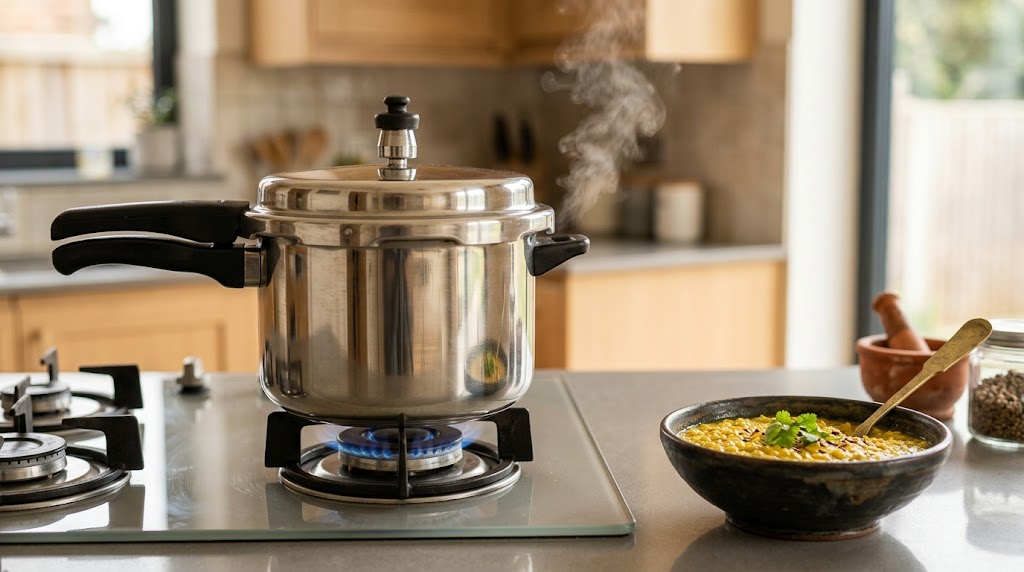
An Indian pressure cooker is not a smaller Instant Pot. It is a stovetop pot with a gasket, a weight and a safety valve, it cooks dal in eight minutes instead of fifty, and in most South Asian kitchens it runs more often than the oven does.
Some links in this post are affiliate links. If you buy through them we may earn a small commission at no extra cost to you — it never changes which products we recommend.
The decision nobody explains properly is inner lid versus outer lid, and it changes how the cooker behaves more than brand or price does. Get that right and the rest is sizing.
Inner Lid vs Outer Lid — The Difference That Matters
An inner lid cooker (Hawkins is the best-known) has a lid that goes in through the mouth of the pot and seals upward against the rim from the inside. Pressure pushes the lid harder against the seal, so the seal gets tighter as pressure rises.
An outer lid cooker (Prestige built its reputation here) has a lid that sits over the mouth and clamps down from outside, the way most Western pressure cookers do.
- Inner lid: narrower mouth, tighter seal, generally faster to pressure, and the lid cannot be opened while pressure remains — it physically will not fit through the opening. That is a real safety feature, not marketing.
- Outer lid: wider mouth, so it is easier to load whole vegetables, easier to clean, and easier to see into. Slightly slower to reach pressure and marginally more prone to gasket leaks as the gasket ages.
- In practice: inner lid suits dal, rice, meat — anything you tip in and forget. Outer lid suits cooking where you want access: browning first, adding things in stages, or lifting out whole potatoes.
Material is the second choice. Aluminium heats fastest and costs least but reacts with acidic food. Stainless steel is neutral, durable and slower to heat. Hard-anodized aluminium sits between the two — non-reactive surface, aluminium heat response.
Our Top 7 Picks for the Best Indian Pressure Cooker
Best Overall: Hawkins Contura 5 Litre Stainless Steel Inner Lid

The Contura shape — curved sides, narrower base, wider belly, like a handi — exists for a practical reason: it lets you stir and sauté in the cooker before you close it, which a straight-sided pot makes awkward. For dal that starts with a tempering, or a meat curry that wants browning first, that curve saves you a pan.
Stainless steel means you can cook tomato, tamarind and yoghurt-based gravies without the metallic edge that aluminium eventually gives them. It is heavier and slower to heat than aluminium, which is the price of that neutrality.
Five litres is the standard family size: dal for four with room to spare, or a full chicken curry. Hawkins gaskets and safety valves are sold everywhere, which matters more than people realise — a cooker you cannot buy parts for is a cooker with an expiry date.
Pros
- Handi shape genuinely helps with tempering and stirring
- Stainless steel is safe with acidic gravies
- Inner lid cannot be opened under pressure
- Spare gaskets and valves are easy to find
Cons
- Heavier and slower to heat than aluminium
- Narrow mouth makes cleaning fiddlier
- Costs more than the aluminium equivalent
Best Hard-Anodized: Hawkins Contura Black 5 Litre

This is the same Contura shape in hard-anodized aluminium instead of stainless, and for a lot of kitchens it is the better buy. Hard anodizing gives you a non-reactive surface over an aluminium body, so you get aluminium’s quick, even heat without the reactivity.
It comes up to pressure noticeably faster than the stainless version and it is lighter to lift when full, which is not a trivial consideration with five litres of dal in it.
The catch is care. Hard-anodized surfaces are not dishwasher-safe and they dull and mark if you scour them. Wash by hand with a soft sponge and it will look fine for years; put it through a dishwasher a few times and it will not.
Pros
- Faster to pressure than stainless
- Lighter than stainless at the same capacity
- Non-reactive surface, safe for tomato and tamarind
- Even heat with no hot spots
Cons
- Hand wash only — dishwashers ruin the finish
- Surface marks and dulls with abrasive scrubbing
- Not induction compatible unless the variant specifies it
Best Outer Lid: Prestige Deluxe Alpha Svachh Stainless Steel

If you want the wide mouth — and for anyone who cooks whole vegetables, or wants to see what is happening, or simply hates cleaning around a narrow rim — this is the one to get.
The Svachh feature is a deep lid designed to catch the starchy water that otherwise spits out of the vent and runs down the side of the pot onto your hob. Anyone who has cooked rice or dal in a pressure cooker knows exactly the mess being solved here, and it works.
The base is a bonded induction-compatible plate, so it runs on any hob. As an outer lid design it takes slightly longer to come to pressure than a Hawkins, and the gasket does more work, so plan on replacing it a little more often.
Pros
- Wide mouth is much easier to load and clean
- Deep lid genuinely reduces spillage onto the hob
- Induction compatible
- Stainless steel, safe with all ingredients
Cons
- Slower to pressure than an inner lid cooker
- Gasket wears faster and needs more frequent replacement
- Outer lids can be opened under residual pressure if you are careless
Best Small: Hawkins Contura 3.5 Litre Stainless Steel

Three and a half litres is the size for one or two people, and it is the size most first-time buyers should look at rather than defaulting to five.
An oversized cooker is not harmless. Pressure cookers have a minimum fill level and a maximum, and cooking a small amount of dal in a five-litre pot means it sits below the useful range — more water than the dish wants, and a longer time to pressure for no benefit.
Same Contura shape, same stainless build, same parts availability as the five-litre. If your household is small, this is the sensible default.
Pros
- Right size for one or two people
- Comes to pressure faster than larger models
- Easy to lift and store
- Same build and parts support as the 5 L
Cons
- Too small for family batch cooking
- Still costs most of what the 5 L does
- Narrow mouth, as with all inner-lid cookers
Best Budget Aluminium: Hawkins Classic 3 Litre Wide

Aluminium is what most Indian kitchens actually ran on for decades, and there is nothing wrong with it as long as you know its one limitation.
It heats faster than any stainless cooker, it is light, and it costs substantially less. The wide variant gives you a bit more mouth than the standard Classic, which helps with loading.
The limitation: aluminium reacts with acidic food. Tomato-heavy gravies, tamarind, and anything left sitting in the pot after cooking can pick up a faint metallic taste and discolour the surface. For dal, rice, potatoes and steaming, none of that applies and this is excellent value. For sour curries, spend more and get stainless.
Pros
- Fastest to pressure in this list
- Genuinely inexpensive
- Light to handle
- Hawkins safety design and parts availability
Cons
- Reacts with tomato, tamarind and other acidic ingredients
- Do not store cooked food in it
- Not induction compatible
- Discolours over time
Best Compact Stainless: Hawkins SSC20 Stainless Steel, 2 Litre

Two litres is a single-person cooker, or a second cooker for the household that wants to cook rice and dal simultaneously rather than sequentially. That second use is more common than the first.
It is stainless, so it handles anything, and at this size it comes to pressure in a couple of minutes. It also fits on a small hob without crowding the neighbouring burner, which matters in apartment kitchens.
Do not buy this as your only cooker unless you genuinely cook for one. The minimum fill rules cut both ways — a 2 L cooker caps you at a fairly small batch.
Pros
- Very fast to pressure
- Ideal as a second cooker for parallel cooking
- Stainless, so no ingredient restrictions
- Compact on small hobs
Cons
- Too small to be a household’s only cooker
- Cost per litre is high
- Small mouth is fiddly to clean
Best Wide-Mouth Small: Prestige 3 L Alpha Deluxe Induction Base

The outer-lid advantage in a small size. Three litres with a wide mouth is a genuinely practical combination: enough for two or three people, and open enough that you can brown onions properly in the base before closing it.
The bonded induction base works on every hob type and adds enough thickness to stop dal catching on the bottom, which thin-based cookers do.
If you found the narrow Hawkins mouth annoying in a previous cooker, this is the direct answer at a small capacity.
Pros
- Wide mouth in a small cooker — unusual and useful
- Thick bonded base resists scorching
- Induction compatible
- Easy to clean
Cons
- Slower to pressure than inner-lid equivalents
- Gasket needs more regular replacement
- Lid is bulkier to store
Pressure Cooker Safety, Honestly
Modern cookers from established brands are safe appliances, and the accidents that do happen are almost always maintenance failures rather than design failures. Four things account for most of them:
- Replace the gasket. Rubber hardens and shrinks. Once a year with regular use, or as soon as steam starts escaping around the rim. A leaking gasket does not just slow cooking — it means pressure is not being regulated where it should be.
- Keep the vent clear. The weight sits on a vent pipe that food can block. Check it is clear before every use and clean it properly, not just rinse it.
- Never force a lid. If it does not open easily, there is still pressure inside. Cool it under running water on the outside of the pot, or wait. This is the single most important rule.
- Respect the fill lines. Two-thirds full maximum for most food, half for things that foam like dal and rice. Overfilling is what blocks vents.
Buy the safety valve and gasket for your specific model at the same time as the cooker if you can. They are inexpensive, and having them on hand is what makes replacing them on schedule realistic rather than a job you postpone.
From My Kitchen
I ignored the gasket for far too long. My cooker had started taking longer to whistle and I assumed the burner or the dal was to blame — more soaking, higher flame, none of which helped. When I finally looked at the gasket properly it had gone stiff and slightly glazed, and it had clearly been that way for months. A new one cost a few dollars and the cooker went back to whistling in the time it always had. If your cooker is slowing down, check the rubber before you change anything else.
The other thing I would tell anyone buying their first cooker: count the whistles for your own hob, not for the recipe. Recipes say three whistles for chana, and on my stove three whistles gives me chana that still has a bite. Whistle count depends on your burner output, the cooker size and how much is in it, so it is a rough unit at best. Two whistles then a natural release has become my default for dal, and I open, check, and put it back on if it needs more — which is always safer than overshooting.
One habit worth building early: get into the routine of checking that the vent pipe is clear as you pick the lid up, every single time, before it goes on the pot. It takes two seconds and it is the check that actually prevents the failure people are afraid of.
FAQ
Inner lid or outer lid — which is safer?
Inner lid designs have a structural advantage: the lid physically cannot pass through the mouth of the pot while pressure holds it against the rim, so it cannot be opened early. Outer lid cookers rely on you following the rules. Both are safe when maintained; the inner lid removes one way for a person to make a mistake.
What size pressure cooker do I need?
Roughly 1.5 to 2 litres per person for regular use. Two people are well served by 3 to 3.5 litres, a family of four by 5 litres. Buying too big is a real mistake, not a safe hedge — small quantities in a large cooker need more water and take longer.
Can I use an Indian pressure cooker on an induction hob?
Only if it has a bonded induction base or is made of magnetic stainless steel — the listing will say. Plain aluminium and most hard-anodized cookers will not work on induction at all.
How often should I replace the gasket?
About once a year with regular use, and immediately if you see steam escaping from the rim, if the cooker is taking longer than usual to reach pressure, or if the rubber feels stiff rather than pliable. Use the gasket made for your model — a generic one that nearly fits is not a saving.
Is a stovetop pressure cooker better than an electric one?
For South Asian cooking, stovetop cookers reach higher pressure and cook faster, and they let you control the flame directly for tempering. Electric multi-cookers are more convenient and can be left unattended. Many households keep both, and the stovetop one gets used for daily dal.

Rimi Sultana is a home cook from Bangladesh who has cooked for her family every day for the past five years and writes about it at Smart Cooks. Perpetually testing whether internet-famous recipes actually work in a regular home kitchen. Say hello on Facebook or through the contact page.