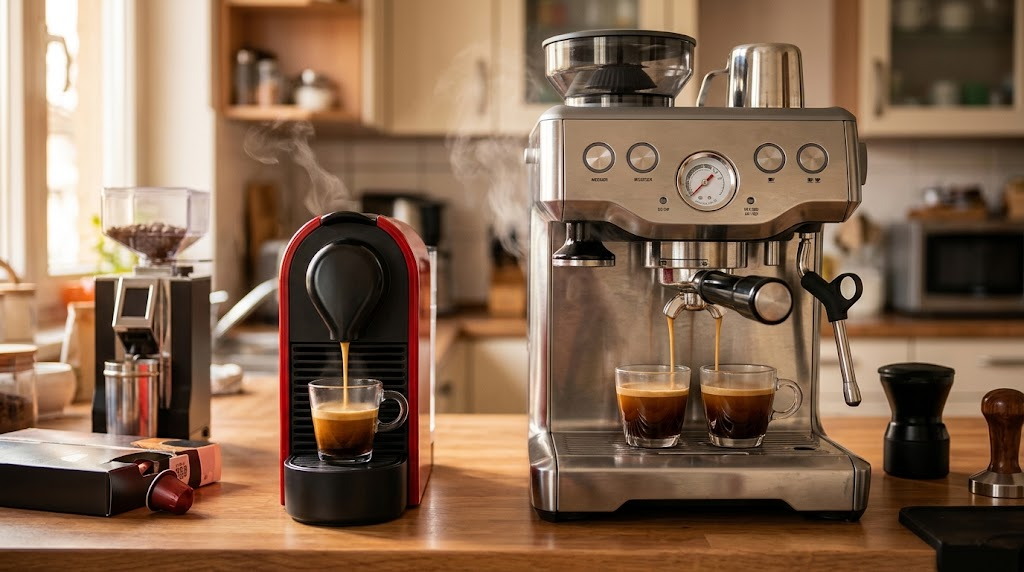
Espresso machines span an enormous price range, arguably wider than almost any other kitchen appliance, and the gap isn’t purely marketing — but it also doesn’t scale linearly with how good your actual cup of espresso will be.
Some links in this post are affiliate links. If you buy through them we may earn a small commission at no extra cost to you — it never changes which products we recommend.
What Budget Machines (Including Pod Machines) Get Right
Capsule-based machines in particular deliver remarkably consistent results with almost no technique required — the extraction variables are essentially locked in by the pod itself. For someone who wants reliable espresso without learning tamping pressure or grind dialing, this consistency is a real advantage, not just a compromise.
What Premium Machines Actually Add
- Finer control over extraction variables — pressure, temperature stability, pre-infusion — that let a skilled user get closer to café-quality results.
- Built-in grinders integrated with the machine, removing a variable that otherwise has to be managed separately and precisely.
- More consistent temperature control shot to shot, which matters more than people expect for extraction quality.
- Steam wands and milk frothing systems that are genuinely more capable for latte art or textured microfoam.
Where the Extra Cost Isn’t Worth It
If you’re not planning to learn proper tamping, dial in grind size precisely, and steam milk by hand, a lot of a premium machine’s capability goes unused. The gap between a well-used budget machine and a poorly-used premium one can favor the budget machine in practice.
From My Kitchen: The Skill Gap I Didn’t Account For
I bought a mid-range machine expecting an automatic upgrade over the pod machine I’d been using, and my first several shots were genuinely worse — under-extracted, sour, and inconsistent — because I hadn’t yet learned to dial in grind size or tamp with consistent pressure. It took real practice over a couple of weeks before my shots consistently outperformed what the pod machine had been producing effortlessly. If you’re buying a manual or semi-automatic machine expecting immediate café-quality results without a learning curve, that expectation is worth adjusting before you buy.
Worth Considering
Nespresso’s Vertuo Next is a strong pod-based option if consistency without a learning curve matters most to you.
De’Longhi’s Classic Signature espresso machine is a solid mid-range step into semi-automatic espresso making with real control over the process.
What the Price Actually Buys: Pressure, Temperature and Control
At the budget end you are mostly buying a capsule system: the machine handles pressure and dose automatically because the capsule is engineered to a fixed recipe. It is consistent by design, and it removes every variable — which is both the appeal and the ceiling. You cannot improve a capsule shot, because nothing is under your control.
A traditional machine puts three things back in your hands: the dose, the grind and the tamp. What separates a cheap traditional machine from an expensive one is temperature stability and pressure control — a thermoblock heats fast but swings several degrees between shots, while a machine with a proper boiler holds within a degree or two. That stability is what makes shot-to-shot repeatability possible, and it is where most of the price difference sits.
Quick Comparison
| Capsule machine | Entry traditional machine | Premium traditional | |
|---|---|---|---|
| Consistency | Very high, fixed recipe | Depends on your technique | High once dialled in |
| Control over the shot | None | Full but fiddly | Full and repeatable |
| Temperature stability | Managed internally | Swings between shots | Holds within a degree or two |
| Grinder needed | No | Yes, espresso-capable | Yes, espresso-capable |
| Cost per cup | Higher, capsules | Low, beans | Low, beans |
| Milk texturing | Basic frother | Steam wand, variable power | Powerful steam wand |
The Cost Nobody Includes in the Comparison
A traditional espresso machine needs a burr grinder capable of espresso-fine, repeatable adjustment, and that grinder often costs as much as an entry-level machine. Buying a good machine with no grinder produces worse coffee than a capsule system, because espresso amplifies grind inconsistency more than any other brewing method. If your budget covers only one, the honest advice is to buy a cheaper machine and a better grinder.
The running costs run the other way. Capsules typically work out several times the per-cup cost of beans, so a capsule machine that is cheap to buy is expensive to live with if you drink two a day. Over three or four years that difference can exceed the price of the machine itself, which is worth calculating before deciding which is the budget option.
Two Machines Worth Considering
Best for convenience: Nespresso Vertuo Next
If you want a consistent cup with no technique, no grinder and no learning curve, this is the honest answer. Accept that the ceiling is fixed and that the ongoing cost is in the capsules rather than the machine.
Pros
- Consistent results with zero technique
- No grinder required
- Fast from cold to cup
Cons
- Higher cost per cup over time
- No control or room to improve
Best to grow into: De’Longhi Classic Signature Espresso Machine
A traditional portafilter machine that gives you dose, grind and tamp to work with, plus a steam wand for milk. Budget for a capable burr grinder alongside it, because the machine can only be as good as what you put in the basket.
Pros
- Real control over the shot
- Steam wand for proper milk texturing
- Much lower cost per cup with beans
Cons
- Needs an espresso-capable grinder
- Takes practice before shots are consistent
Frequently Asked Questions
Is a pod machine really worse than a manual one?
Not necessarily worse, just different — pod machines trade some flavor complexity and customization for consistency and simplicity, which is a completely reasonable trade-off depending on what you value.
How long does it take to get good at using a manual espresso machine?
Most people see meaningful improvement within a few weeks of regular practice, dialing in grind size and tamping technique, though genuinely fine-tuned results can take longer to develop consistently.
Do premium machines really make a taste difference for casual drinkers?
The difference is most noticeable to people who already have a developed palate for espresso specifically. Casual drinkers, especially those who add milk or sugar, often notice a smaller difference than the price gap might suggest.
Will a more expensive machine make better coffee on its own?
Not on its own, no. Above a basic threshold, the biggest variables are the grinder, the freshness of the beans and your technique — in that order. A premium machine with stale supermarket beans and a blade grinder will make disappointing espresso. The money a premium machine buys you is repeatability and better milk steaming, which matter enormously once everything else is right and very little before then.
How long do capsule machines actually last?
Typically several years of daily use, though the failure modes are usually the pump or the capsule mechanism rather than anything serviceable. Descaling on schedule genuinely extends that, particularly in a hard water area, because scale in the heating circuit is what kills them. Traditional machines are more repairable by nature — seals, gaskets and even pumps are replaceable parts on most models.

Rimi Sultana is a home cook from Bangladesh who has cooked for her family every day for the past five years and writes about it at Smart Cooks. Perpetually testing whether internet-famous recipes actually work in a regular home kitchen. Say hello on Facebook or through the contact page.