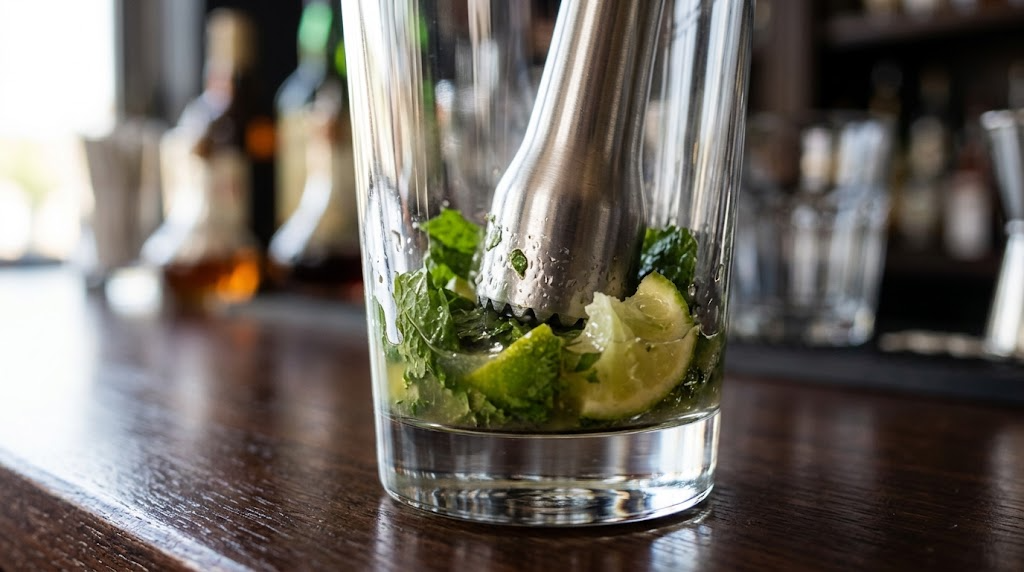
A muddler seems like the simplest bar tool you can own — a stick that mashes mint and sugar. So why do some cost $8 and others $25? The difference isn’t marketing. It’s what happens to the herbs and fruit you’re actually muddling, and whether the tool survives more than a few Mojito nights.
Some links in this post are affiliate links. If you buy through them we may earn a small commission at no extra cost to you — it never changes which products we recommend.
What Actually Matters in a Muddler
Three things separate a good muddler from a frustrating one: the head material, the length, and the weight.
Head material: stainless steel vs. wood vs. nylon-tipped
A solid stainless steel head (sometimes with a textured or toothed end) crushes mint leaves and releases citrus oils from lime and lemon peel efficiently, and it never absorbs odors or stains from berries. Wood muddlers look nicer on a home bar but can splinter over time, especially if they’re run through a dishwasher, and unfinished wood can hold onto garlic or ginger smells if you ever use it for savory cocktails. A nylon or hard-plastic textured tip, often paired with a steel or wood handle, is a middle ground — gentle enough not to shred herbs into bitter fragments, but firm enough to actually extract flavor.
Length and weight
A muddler that’s too short forces you to work with your knuckles jammed against the rim of a mixing glass or shaker tin, which is both awkward and a good way to bruise your hand. Something in the 8 to 10 inch range clears most glassware comfortably. Weight matters more than people expect — a heavier muddler does the crushing work for you with less wrist effort, which matters if you’re making more than one drink at a time.
From My Kitchen
I didn’t own a dedicated muddler for years — I used the handle end of a wooden spoon, which works fine for a single Mojito but is genuinely bad at pressing citrus wedges without the peel sliding away instead of releasing oil. The first time I used an actual muddler with a flat, slightly textured steel head, the difference in how much lime oil came through in a Caipirinha was obvious in one try. It’s a small tool, but it’s one of those cases where the purpose-built version earns its keep.
Worth Considering
The Ortarco 10-inch stainless steel muddler is a solid all-metal option — long enough for tall mixing glasses, with a textured crushing end that handles mint and citrus without turning herbs to mush. If you’d rather have a hybrid grip, the OXO steel muddler with a nylon head pairs a comfortable handle with a tip gentle enough for delicate herbs.
Why Teeth Are a Problem, Not a Feature
Many muddlers have an aggressively toothed head, and for herbs it is the wrong design. Teeth tear mint leaves rather than pressing them, and torn mint releases chlorophyll along with the oils — chlorophyll is what makes a badly made mojito taste grassy and faintly bitter. What you actually want from mint is the oil on the surface of the leaf, which comes out under gentle pressure without any shredding at all.
Teeth do have a use: breaking down firm fruit and grinding sugar cubes with bitters. If most of your drinks are herb-based, a flat or lightly textured head is the better buy. If you make a lot of caipirinhas and old-fashioneds, some texture helps. A nylon head with light texturing is the practical compromise, which is why it has become the standard behind most bars.
Quick Comparison
| Nylon head on steel | Unfinished wood | Lacquered wood | Toothed steel | |
|---|---|---|---|---|
| Mint and soft herbs | Very good | Very good | Good | Poor — shreds |
| Citrus wedges and sugar | Good | Good | Good | Excellent |
| Flavour carryover | None | Absorbs over time | None until it chips | None |
| Durability | Excellent | Good with care | Lacquer chips into drinks | Excellent |
| Cleaning | Dishwasher safe | Hand wash, dry upright | Hand wash | Teeth trap pulp |
Length and the Technique That Actually Works
An 8 to 10 inch muddler suits standard highball and rocks glasses, with enough shaft left above the rim to grip comfortably. Too short and your knuckles are inside the glass; too long and you lose control of the pressure. Weight helps — a muddler with some mass lets the tool do the pressing rather than your forearm, which is exactly the control you want with delicate herbs.
The technique for mint is press and twist gently, three or four times, and then stop. You are looking to bruise the leaves so they release oil, not to break them apart — leaves should still be recognisable leaves at the end. For citrus and sugar it is the opposite: press firmly and grind, because you are physically breaking the fruit cells and dissolving the sugar into the released juice.
Two Muddlers Worth Considering
Best all-round: Ortarco 10-inch Stainless Steel Muddler
Good length for standard glassware with enough weight that gentle pressure does the work. Stainless throughout means nothing to absorb flavours or chip into a drink, and it cleans without thought.
Pros
- Good length and weight for control
- Nothing to absorb flavour or chip
- Simple to clean thoroughly
Cons
- Check the head texture suits your drinks
- Metal can feel cold and slippery when wet
Best for herbs: OXO Steel Muddler With Nylon Head
The nylon head is gentle enough to bruise mint without shredding it, while still having enough texture to break down a citrus wedge. This is the sensible default if mojitos, juleps and smashes are what you actually make.
Pros
- Nylon head bruises herbs without tearing
- Comfortable grip, controlled pressure
- Dishwasher safe
Cons
- Less effective on very firm fruit
- Nylon head will discolour over years
Frequently Asked Questions
Can I just use the back of a wooden spoon?
For an occasional mint mojito, sure. For citrus-heavy cocktails or if you’re making drinks regularly, a dedicated muddler with a flatter, wider head extracts noticeably more juice and oil with less effort.
Should I muddle mint aggressively?
No — mint should be pressed gently just to release its oils, not pulverized. Over-muddling mint releases chlorophyll and turns the drink bitter and grassy. Citrus and sugar, on the other hand, can take a firmer hand.
Why does my mojito taste bitter or grassy?
You are over-muddling the mint. Torn leaves release chlorophyll and the bitter compounds in the stems, and once they are in the drink there is no fixing it. Press gently three or four times with a twist and stop while the leaves are still intact. It is also worth using leaves only — stems carry far more of the bitterness — and giving them a light clap between your palms first, which releases the aromatic oils before they even reach the glass.
Can I just use the end of a wooden spoon?
For citrus and sugar, yes, and it works perfectly well. For herbs it is worse than a proper muddler, because the small flat end concentrates pressure on a few leaves and tears them rather than pressing the whole bunch evenly. A better improvisation for herbs is the flat base of a small jar or a pestle, which spreads the pressure the way a muddler head does.
Related: Top 5 cooling racks for cookies: what separates the good from the forgettable

Rimi Sultana is a home cook from Bangladesh who has cooked for her family every day for the past five years and writes about it at Smart Cooks. Perpetually testing whether internet-famous recipes actually work in a regular home kitchen. Say hello on Facebook or through the contact page.