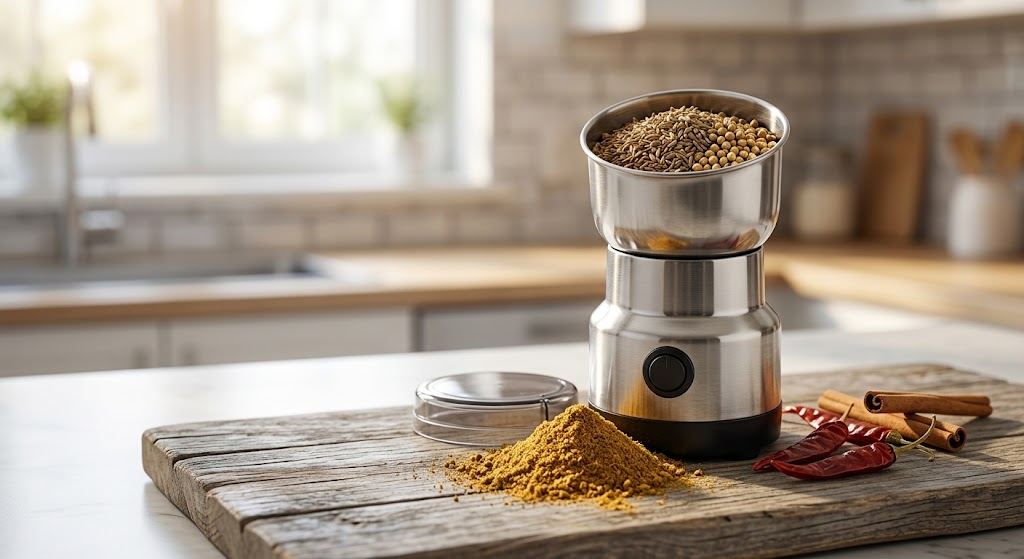
Ground spice starts losing what makes it worth having within weeks. That is the entire case for grinding your own, and anyone who has opened a jar of cumin ground that morning next to a supermarket packet has already had the argument settled for them.
Some links in this post are affiliate links. If you buy through them we may earn a small commission at no extra cost to you — it never changes which products we recommend.
The equipment question is smaller than it looks. For whole spices you want a blade grinder, not a burr grinder. Burr grinders are built to crush hard, dry, uniformly-sized coffee beans between two plates; feed them cardamom pods, cinnamon bark or anything oily and they clog. Blade grinders chop, which is exactly right for the mixed shapes and sizes of a masala.
The other rule, learned the hard way by nearly everyone: do not share a bowl between coffee and spices. Cumin oil embeds itself in the plastic and steel and it does not come out. Buy a grinder with removable bowls, or buy a second grinder.
If you are setting up a South Asian kitchen, this pairs with our masala dabba guide — grind fresh, then stage what you use daily in the dabba.
Our Top 7 Picks for the Best Spice Grinder
Best Overall: Secura Electric Coffee and Spice Grinder, 2 Removable Bowls

Two removable stainless bowls is the feature that matters, and it is why this is the pick for most kitchens. One bowl lives as the spice bowl, the other stays clean for coffee or for anything delicate, and the cross-contamination problem simply stops existing.
Removable bowls also solve the cleaning problem that makes fixed-bowl grinders unpleasant to own. A fixed grinder has to be wiped out around a spinning blade with the motor housing right there; a removable bowl goes to the sink.
Stainless steel bowls rather than plastic matters more for spices than for coffee. Turmeric stains plastic permanently and cumin oil soaks into it. Steel wipes clean.
Pros
- Two bowls means true separation between spice and coffee
- Removable bowls are genuinely easy to clean
- Stainless steel resists turmeric staining and oil absorption
- Handles hard spices like cinnamon and cloves
Cons
- Bulkier to store than a single-bowl grinder
- No grind-size control — you judge by time
- Loud, as all blade grinders are
Best Value: SHARDOR Electric Coffee Bean and Spice Grinder

A single removable stainless bowl, a simple press-down lid switch, and not much else. For a kitchen where the grinder is a spice grinder and nothing else, that is the whole requirement met.
The removable bowl is the reason to pick this over cheaper fixed-bowl models at a similar price. You can wash it properly, and you can buy a second bowl separately if you later want to keep coffee out of it.
It is a small-batch machine. Grinding a large quantity of garam masala means working in two or three loads, with a rest between them so the motor does not heat the spices.
Pros
- Removable stainless bowl at a low price
- Simple, robust press-to-run operation
- Small footprint
- Good on cumin, coriander, fennel and peppercorn
Cons
- One bowl only unless you buy a second
- Small capacity — batches, not bulk
- Motor wants a rest between loads
Best Simple One-Touch: BLACK+DECKER One-Touch Coffee & Spice Grinder

The virtue here is that it is boring and it is from a brand that will still be around to honour a warranty. Press the lid, it grinds; release, it stops. There is nothing to configure and nothing to go wrong.
The bowl is fixed rather than removable, which is the significant compromise. Cleaning means careful wiping around the blade, and it means committing this machine to spices permanently — which, if it is your spice grinder, is a decision rather than a limitation.
For anyone who wants one appliance to grind masala and does not want to think about it further, this does the job at a fair price.
Pros
- Dead simple to use
- Established brand with real warranty support
- Sturdy stainless blades
- Inexpensive
Cons
- Fixed bowl — harder to clean and impossible to share safely
- Commit it to spices permanently
- No grind control
Best for Control: SHARDOR Blade Grinder with Timed Grind Control

A timer knob sounds like a small thing until you have ground the same masala twice and got two different results. Blade grinders have no grind-size setting, so duration is your only control — and doing that by feel means inconsistency.
Setting a dial and getting the same coarseness every time is genuinely useful for anyone who grinds the same blends regularly. A coarse chaat masala and a fine idli podi are different times, and the knob makes that repeatable.
The all-stainless housing also handles turmeric better than plastic-bodied grinders, which yellow permanently.
Pros
- Timer makes results repeatable batch to batch
- All-stainless construction resists staining
- Auto-stop means you can walk away
- Good build quality for the price
Cons
- More expensive than a plain press-to-run grinder
- Still a blade grinder — the timer controls duration, not particle size
- One bowl
Best Multi-Blade: FAOFER Electric Spice, Coffee and Nut Grinder

A three-blade head moves more of the load through the cutting path per rotation, which helps with the awkward stuff — bay leaf, dried chilli, star anise, anything flat or fibrous that a two-blade grinder just pushes around the bowl.
It also handles nuts, which matters if you make Mughlai gravies that call for ground almond or cashew paste. Most small blade grinders struggle with oily nuts and turn them to paste unevenly.
The included filter is more useful than it sounds: sieving out the coarse fragments and regrinding them is how you get a genuinely fine masala from a blade grinder.
Pros
- Three blades handle flat and fibrous spices better
- Copes with nuts as well as spices
- Filter included for sieving and regrinding
- Removable, washable parts
Cons
- A newer brand with less track record
- More parts to clean and store
- Still small-batch
Best Hands-Free: Secura Brands Electric Coffee and Spice Grinder

Most blade grinders require you to hold the lid down for the entire grind. That is fine for ten seconds of coffee and tiresome when you are working through a batch of garam masala in stages.
A hands-free model with a proper switch lets you start it and turn to something else, and the anti-splash lid keeps fine powder from puffing out when you open it — which anyone who has opened a grinder full of freshly ground chilli has strong feelings about.
Sensible pick if you grind in quantity rather than a spoonful at a time.
Pros
- No holding the lid down through long grinds
- Anti-splash lid contains fine powder
- Same Secura build quality as the two-bowl model
- Comfortable for larger batches
Cons
- Single bowl
- Bigger footprint
- Costs more than basic press-to-run models
Best Compact: Small 200W Stainless Steel Spice Grinder

For a small kitchen, or as a dedicated second grinder that only ever sees chilli or only ever sees garam masala, a compact high-speed unit is the practical answer.
High RPM does most of the work in a small bowl — the spices spend more time in the blade path because there is less bowl for them to fly around in. For small quantities that often produces a finer result than a larger machine half-filled.
Do not expect it to grind a month of masala at once. It is a spoonful-to-a-few-tablespoons machine, which for freshly ground spice is arguably the right quantity anyway.
Pros
- Takes up very little counter or cupboard space
- High speed gives a fine grind on small quantities
- Cheap enough to own two for separate spices
- Stainless bowl
Cons
- Genuinely small capacity
- Motor heats quickly — needs rests
- Basic build compared to name brands
How to Grind Spices Properly
- Dry-roast first. Warm the whole spices in a dry pan until they smell fragrant, then cool them completely before grinding. Roasting deepens flavour; grinding them warm makes them clump and smear.
- Cool fully before grinding. This is the step people skip. Warm spices release oil, and oil turns powder into paste on the blade.
- Pulse, do not hold. Short bursts with pauses keep the motor and the spices cool. Continuous grinding heats the powder and dulls the aroma you just went to the trouble of creating.
- Sieve and regrind. Pass the powder through a fine sieve, tip the coarse remnants back in, and go again. Two rounds gets you noticeably finer than one long grind.
- Clean with rice. Grind a tablespoon of raw rice to lift residual oil and smell out of the bowl, tip it out, then wipe. This works far better than washing alone.
- Grind small, grind often. The whole point is freshness. A jar of home-ground masala sitting for six months is just expensive supermarket powder.
From My Kitchen
I ruined a grinder with turmeric before I understood what was happening. Not damaged mechanically — it worked fine — but the plastic bowl went permanently yellow and, more to the point, everything ground in it afterwards carried a faint turmeric note. Coffee in it was undrinkable. If you are going to grind turmeric or chilli, use a steel bowl, and accept that the bowl now belongs to those spices.
The rice trick is the one I wish someone had told me in the first month. A tablespoon of raw rice, ground to powder and tipped out, pulls the oil residue and most of the smell out of a bowl in about fifteen seconds. It is the difference between a grinder that permanently smells of whatever you last made and one you can switch between blends with.
And on roasting: I used to grind spices while they were still warm from the pan because I was in a hurry, and I could never work out why my garam masala was slightly gummy and clumped in the jar. It was moisture and released oil, nothing else. Spread them on a plate, let them come fully back to room temperature, and the same spices grind to a loose dry powder.
FAQ
Can I use a coffee grinder for spices?
Mechanically yes — a blade coffee grinder is a spice grinder. The problem is flavour transfer, which goes both ways and is close to permanent in a plastic bowl. Either dedicate the grinder to spices or buy a model with removable bowls and keep one for each.
Burr grinder or blade grinder for spices?
Blade. Burr grinders are engineered for uniform hard beans and will jam or grind unevenly on mixed spices, cardamom pods, cinnamon bark and anything oily. Blade grinders chop, which suits the varied shapes of a masala.
How do I get a really fine powder from a blade grinder?
Roast, cool completely, grind in short pulses, then sieve and regrind the coarse remainder. Two passes with sieving beats one long grind, which mostly just heats the powder.
Why does my ground spice clump in the jar?
Moisture, usually from grinding while still warm, or from storing before the powder has cooled. Let both the whole spices and the finished powder reach room temperature before the jar goes shut.
Should I just use my mixer grinder’s small jar instead?
A mixie chutney jar works well and many kitchens use nothing else. A dedicated spice grinder is smaller to pull out for a single spoonful, quieter, and easier to keep separate from garlic and onion smells — which is the real argument for owning one.

Rimi Sultana is a home cook from Bangladesh who has cooked for her family every day for the past five years and writes about it at Smart Cooks. Perpetually testing whether internet-famous recipes actually work in a regular home kitchen. Say hello on Facebook or through the contact page.