As an Amazon Associate, Smart Cooks earns from qualifying purchases. Product prices and availability are shown on Amazon and may change.
Every kitchen gadget cycle has a moment where the thing everyone bought two years ago quietly stops being the thing people actually reach for. Right now that’s happening to the air fryer. It’s not disappearing — most of us still own one — but the appliance getting the enthusiastic reviews in 2026 is the sous vide precision cooker, and the reason has less to do with hype than with a fairly boring, practical complaint: air fryers are great at crisping and inconsistent at everything else, and a lot of home cooks are tired of babysitting a basket to keep chicken breast from turning into shoe leather.
Some links in this post are affiliate links. If you buy through them we may earn a small commission at no extra cost to you — it never changes which products we recommend.
What Actually Matters
Temperature Precision vs. Guesswork
An air fryer is a small, fast convection oven. You set a temperature and a time, but the actual air temperature inside swings several degrees around that setting, and how close your food gets to “done” depends on basket size, how crowded it is, and how often you shake it. A sous vide immersion circulator works completely differently: it holds a water bath at your exact target temperature, often within a fraction of a degree, and your food cooks in a sealed bag inside that bath until it reaches that temperature throughout — not a moment hotter. That’s the whole trick. You can’t overcook a steak sous-vide the way you can in an air fryer, because the water physically cannot get hotter than the number you set.
What Each Tool Actually Does Well
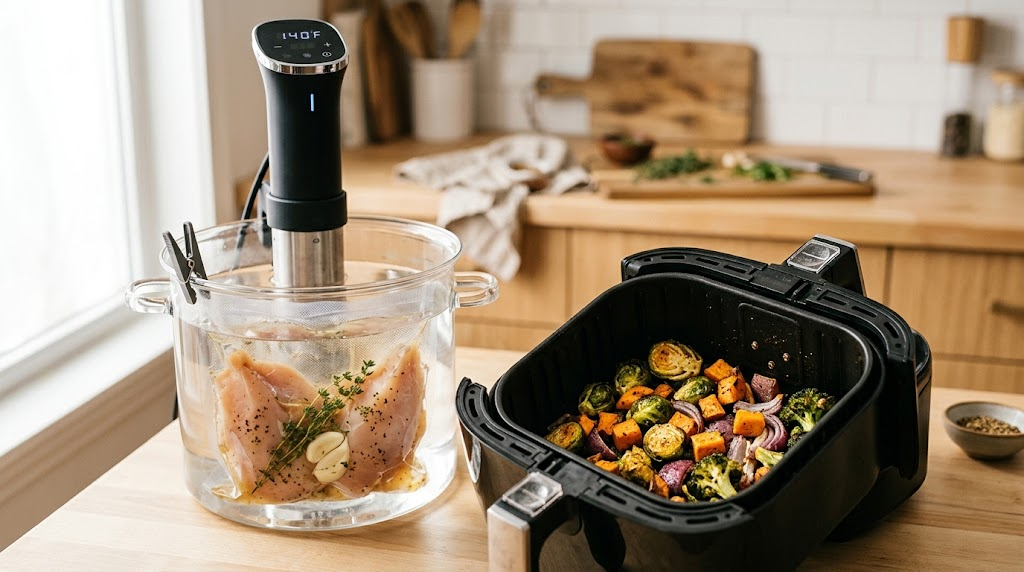
This isn’t really an either-or situation, and any post that tells you to throw out your air fryer is overselling it. The air fryer wins for texture — that shatter-crisp skin on wings or roasted vegetables comes from hot, dry, moving air, and sous vide cannot do that on its own. Sous vide wins for doneness control on anything where “exactly medium-rare, edge to edge” or “tender but not mushy” matters: steak, chicken breast, eggs, salmon, even vegetables you want perfectly crisp-tender. A lot of 2026’s better home kitchens are actually running both in sequence — sous vide to get the inside exactly right, then a 60-90 second finish in the air fryer or a hot pan for the crust. That combination is quietly becoming the new normal, more than either appliance replacing the other.
The Learning Curve Nobody Mentions
Air fryers are nearly foolproof out of the box. Sous vide has a real learning curve for about two weeks: you need to get comfortable with a vacuum sealer or the water-displacement bag method, you need to actually plan ahead since most proteins need 1-4 hours (some cuts longer), and the first few times you’ll second-guess whether the water bath is really doing anything because nothing looks like it’s cooking. Once it clicks, it’s one of the most forgiving methods in the kitchen. Before it clicks, it can feel like a lot of equipment for a bag of water.
From My Kitchen
I resisted sous vide for years because I assumed it was restaurant-kitchen theater, not something that earns counter space next to an air fryer that already does 80% of what I cook. What changed my mind was a fairly unglamorous chicken breast dinner. I’d overcooked chicken breast in the air fryer more times than I want to admit — it looks done on the outside well before the middle actually is, so I’d either undercook it or push the time and end up with dry, stringy meat. The first time I ran chicken breast at 149°F for about an hour and a half sous vide, then gave it 90 seconds skin-side down in a hot pan, it was the first time in years that chicken breast actually tasted like something I’d order instead of something I’d tolerate. It wasn’t dramatic. It was just correct, in a way I hadn’t managed with any amount of air fryer timer-adjusting. The one thing nobody tells you: the bag will float a little if you don’t get the air out properly, and an uneven float means an unevenly cooked piece of chicken sticking half out of the water. I learned that the annoying way, with a chicken breast that was perfect on the bottom half and slightly underdone on the top. Clip it down or weigh it, every time.
Worth Considering
If you’re curious but don’t want to commit to a full setup, the Anova Culinary Sous Vide Precision Cooker Nano 2.0 is the low-commitment entry point — small enough to store in a drawer, and accurate enough that you won’t outgrow it just for home cooking. If you want app control, faster heating for larger pots, and you think you’ll actually use the WiFi scheduling to start dinner from your phone, the Anova Culinary Sous Vide Precision Cooker 3.0 (WiFi) is the better long-term buy at 1100 watts. Either way, you’ll also want a container with a lid (a large stockpot works fine at first) and either a vacuum sealer or a box of quality zip-top bags for the water displacement method before you spend money on anything fancier.
Anova Precision Cooker Nano 2.0 — the low-commitment entry point, small enough to store in a drawer.
Anova Precision Cooker 3.0 (WiFi) — faster heating and app control if you will actually use the scheduling.
Frequently Asked Questions
Do I need a vacuum sealer to start sous vide cooking?
No. The water displacement method works fine for most home cooking: put your food in a quality zip-top freezer bag, seal it most of the way, then slowly lower it into the water bath so the water pressure pushes the remaining air out through the small opening before you seal the last bit. It’s not quite as airtight as a vacuum seal, but for anything under a few hours of cook time it makes no practical difference.
Is it safe to leave food in a water bath for hours while I’m out?
Yes, within limits that matter. Sous vide cooking at or above 130°F for extended periods is specifically designed around food-safety science — it’s how the method holds food in the safe zone for hours without drying it out. The real risk window is the first two hours getting up to temperature in a large, cold water bath; most circulators are fast enough that this isn’t an issue, but very large cuts in a very large pot can take longer to come up to temp than you’d expect, so don’t leave a whole roast unattended in a stockpot that’s more water than food.
Related: Sous vide machine vs slow cooker: how their cooking methods differ

Rimi Sultana is a home cook from Bangladesh who has cooked for her family every day for the past five years and writes about it at Smart Cooks. Perpetually testing whether internet-famous recipes actually work in a regular home kitchen. Say hello on Facebook or through the contact page.